East London’s story is one of repeated reinvention. Whitechapel, now one of the area’s most recognizable names, became infamous in 1888 after the Jack the Ripper murders exposed the poverty, overcrowding, and insecurity of Victorian East End life.
During the Second World War, the district was hit again: London endured the Blitz for 57 consecutive nights, and the East End suffered heavy bombing as industrial and civilian targets were attacked.
The area’s economic base then changed dramatically. Historic England notes that London’s great enclosed East End docks were a major legacy of the Thames trade, but decline set in in the 19th century and, by the late 20th century, the city had increasingly turned away from its rivers, canals, and docks.
That shift created decades of dereliction in some places, but it also opened the door to regeneration, with the 1990s bringing a renewed focus on the Thames and waterways as assets rather than leftovers.
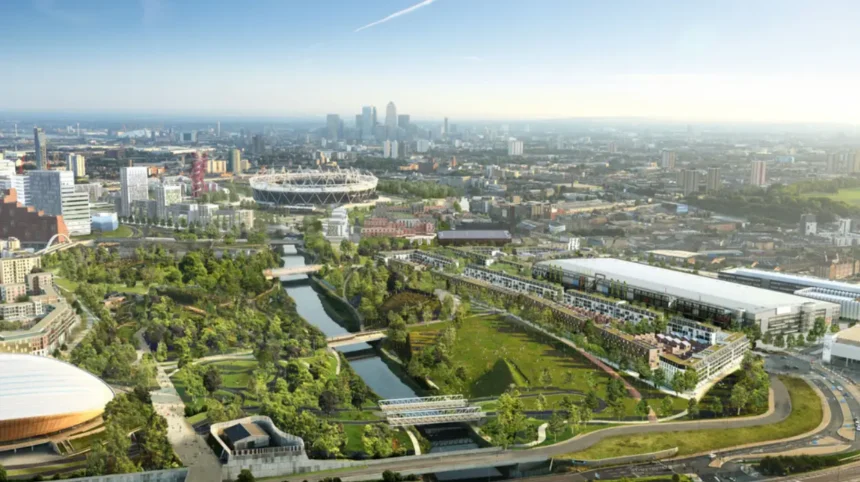
That long recovery is now visible in the capital’s newest cultural and regeneration projects. East Bank, at the heart of Queen Elizabeth Olympic Park, is presented by City Hall as the UK’s newest cultural quarter, designed to be open to everyone who lives and works in East London.
The Mayor of London has also backed Creative Enterprise Zones, including Hackney Wick and Tower Hamlets, to support artists, creative businesses, local jobs, and affordable workspace, showing how regeneration has shifted from physical rebuilding to cultural and economic inclusion.
A key local hero in that wider transformation is Lord Andrew Mawson, founder of the Bromley by Bow Centre. The centre says Mawson arrived in the East End in 1984, when the church he inherited was on the brink of closure.
From that fragile starting point, the organisation grew into a community regeneration charity with a model built around entrepreneurship, the arts, learning, social support, horticulture, and integrated health services. Its own reports describe it as an internationally recognised example of grassroots regeneration, with social businesses, local jobs, and support for residents who are often facing poverty, isolation, or poor health.
That combination of memory and momentum is what makes East London’s resilience so distinctive. The same districts once associated with deprivation, wartime destruction, and post-industrial decline are now home to major cultural institutions, community-led regeneration, and new opportunities for residents.
The story is not that East London has forgotten its past, but that it has turned survival into a civic strength. That is why its modern identity feels so powerful: creative, diverse, and shaped by people who kept rebuilding even when the odds were against them.