Key Points
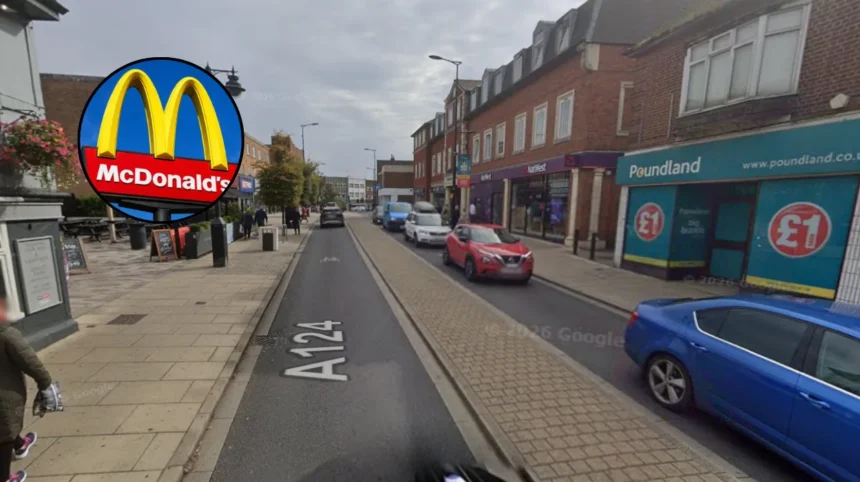
- Proposed Transformation: Plans have been formally submitted to Havering Council to convert the vacant former Poundland retail unit at 116–118 High Street, Hornchurch, into a modern McDonald’s restaurant.
- Capacity and Facilities: The proposed development features a dining area capable of accommodating approximately 125 seated customers, alongside dedicated facilities for takeaway patrons.
- Structural Alterations: The fast-food chain proposes building a new side lobby to extend the existing structure, redesigning the shop frontage with automatic sliding doors, and adding rear storage, staff parking, and secure cycle storage.
- Economic Impact and Job Creation: Planning documents highlight a major financial commitment to the area, predicting the creation of more than 120 full-time and part-time jobs for the local community.
- Timeline for Decision: Havering Council planners are expected to review the application and deliver a definitive determination by 23 July 2026.
- Community Context: The site has been empty since November 2025 following a wider corporate restructuring by Poundland, and the new application is anticipated to spark local debate regarding economic revitalization versus town centre character.
Hornchurch (East London Times) June 3, 2026 — A formal planning application has been submitted to Havering Council to transform the vacant former Poundland store at 116–118 High Street, Hornchurch, into a new McDonald’s restaurant and takeaway. According to official planning documents submitted on behalf of the international fast-food chain, the proposed redevelopment represents a substantial financial investment in the town centre. If approved, the project will bring a prominent, empty commercial premises back into active use, creating more than 120 full-time and part-time employment opportunities for local residents while establishing a modern dining facility capable of seating approximately 125 indoor diners.
- Key Points
- What Do the Specific Architectural and Structural Plans Outline for the High Street Site?
- What Direct Economic Benefits and Employment Opportunities Will the Development Bring to Hornchurch?
- Why Has the 116–118 High Street Premises Remained Vacant and What Are the Local Concerns?
- Background of the Hornchurch Retail Shift and Vacancy Trends
- Prediction: How This Development Can Affect Local Residents and Small Business Owners
- Impact on Independent Small Business Owners
What Do the Specific Architectural and Structural Plans Outline for the High Street Site?
The details of the commercial conversion reveal a comprehensive redesign of the existing layout to transition the site from a discount retail format to a high-capacity food and drink establishment. As detailed by the planning consultants acting on behalf of McDonald’s, the proposals require distinct physical alterations to both the interior and exterior of the 116–118 High Street building.
Chief among the structural modifications is the construction of a brand-new side lobby. This extension is designed to expand the building’s current footprint, optimizing customer flow between the main ordering zones and the dining room.
Additionally, the high street frontage will undergo a complete cosmetic and functional overhaul. The traditional retail entrance is to be replaced with a modern, redesigned shopfront featuring automatic sliding doors to improve accessibility for families, elderly diners, and disabled patrons.
The operational infrastructure at the rear of the property will similarly undergo extensive upgrades. According to the submitted planning blueprints, the rear layout will be reconfigured to introduce:
- Substantial cold and dry storage facilities necessary to support high-volume food service operations.
- Dedicated staff vehicle parking spaces to minimize employee impact on public town centre parking.
- Secure cycle storage units, aligning with local planning policies aimed at encouraging sustainable transport methods for workers and delivery couriers.
What Direct Economic Benefits and Employment Opportunities Will the Development Bring to Hornchurch?
In evaluating the financial weight of the project, the planning consultants representing the fast-food chain emphasize that the scheme delivers measurable economic advantages at a critical juncture for the local high street. The documentation argues that the establishment of the restaurant directly addresses a verified, unmet customer demand for the brand’s services within the immediate Hornchurch cachement area.
From a long-term fiscal perspective, the development would introduce a major commercial anchor into a town centre currently navigating post-retail vacancies.
The consultants highlighted the dual-phase economic stimulus inherent in the project, noting that the financial investment would benefit the local supply chain during the initial construction and fit-out stage, followed by sustained economic productivity through long-term operational spending and business rates contribution.
The employment metrics form a central pillar of the application’s justification. The planning documents verify that more than 120 jobs will be created, spanning both flexible part-time positions—frequently sought after by students and younger demographics—and permanent, full-time managerial and operational roles. Proponents argue this scale of job creation represents a vital boost to the Havering borough’s localized labor market.
Why Has the 116–118 High Street Premises Remained Vacant and What Are the Local Concerns?
The prime town centre location has sat entirely dark for approximately seven months. The commercial unit became vacant in November 2025, when Poundland officially shuttered its Hornchurch branch.
That closure was not isolated to the borough but occurred as part of a highly publicized, wider corporate restructuring programme implemented by the discount retailer’s parent company to consolidate its high street portfolio. Since that time, the large footprint has remained one of the most prominent empty retail units on the High Street, reflecting broader challenges facing traditional brick-and-mortar retail sectors.
While the prospect of filling a major vacant unit is viewed positively by business groups, the proposal is simultaneously generating intense debate among Hornchurch residents and local stakeholders. The application has effectively divided opinion into two clear viewpoints:
- The Case for Approval: Supporters focus heavily on the immediate practical benefits, welcoming the injection of corporate capital, the substantial job creation, and the removal of a blighted, empty storefront that could otherwise attract anti-social behavior or depress neighboring property values.
- The Case for Caution: Opponents and skeptical residents are raising familiar objections associated with high-turnover fast-food outlets. Primary anxieties center on environmental and infrastructural impacts, including the potential escalation of late-night littering, increased traffic congestion on an already busy High Street, delivery vehicle double-parking, and a broader concern regarding the changing culinary and aesthetic character of the historic town centre.
Background of the Hornchurch Retail Shift and Vacancy Trends
To fully understand the context of the McDonald’s application, it is necessary to examine the broader economic shifts that have redefined Hornchurch High Street over the last several years.
Historically functioning as a traditional market-town shopping district dominated by independent boutiques and legacy department brands, Hornchurch has increasingly transitioned into a service- and leisure-oriented economy. This evolution is largely a response to the exponential growth of e-commerce, which accelerated the contraction of national retail chains across the United Kingdom.
The departure of Poundland in late 2025 marked a symbolic turning point for the local high street ecosystem. Discount retailers had previously filled the voids left by disappearing mid-tier clothing and electronics stores.
However, when corporate restructuring pressures forced even value-tier retail brands to scale back their physical footprints, town centres like Hornchurch were left with unusually large, deep-plan commercial units that are structurally difficult to redivide for small, independent traders.
Consequently, food and drink operators have become the primary source of incoming capital capable of absorbing these massive commercial spaces. Data from urban planning studies indicate that high streets are increasingly reliant on food hospitality brands to drive footfall, which in turn sustains the surviving smaller retail shops.
The current application by McDonald’s represents the latest, most high-profile manifestation of this structural shift from retail dominance to experiential hospitality within the London Borough of Havering.
Explore More Hornchurch News
Five-Year-Old Janae Raises £520 for Hospital Library Books Hornchurch 2026
Hornchurch Residents Object 475-Home Green Belt Development 2026
Prediction: How This Development Can Affect Local Residents and Small Business Owners
Should Havering Council grant planning permission by the 23 July deadline, the activation of 116–118 High Street will trigger distinct, tangible outcomes for two specific target audiences within Hornchurch: local residents and independent small business owners.
For the resident population, the opening of a central McDonald’s will fundamentally alter local footfall dynamics and consumer convenience. Younger residents and working-class families will gain immediate access to an affordable, local dining option and a significant source of flexible, entry-level employment.
Conversely, residents living in the immediate vicinity of the High Street are highly likely to experience localized negative externalities.
Traffic congestion during peak dinner hours and weekend periods may intensify, leading to minor delays on peripheral access roads. Furthermore, despite municipal management policies, local households may face an uptick in localized litter and late-night ambient noise, potentially prompting calls for stricter council-enforced trading hour restrictions or increased street-cleaning rotations.
Impact on Independent Small Business Owners
For independent food, beverage, and café owners operating along Hornchurch High Street, the arrival of a global fast-food giant presents a complex, double-edged commercial environment.
In the short term, smaller, family-run cafes and independent fast-casual eateries may experience a tightening of profit margins.
They simply cannot compete with the economies of scale, purchasing power, and operational speed utilized by a multinational corporation, particularly regarding standard lunch menus and takeaway items.
However, from a macro perspective, an operational McDonald’s acts as a powerful regional footfall generator. By systematically drawing thousands of additional consumers into the town centre weekly, the restaurant could inadvertently increase the “passing trade” window for non-competing independent businesses, such as specialty bakeries, boutique retail shops, and evening service providers, ultimately strengthening the collective economic viability of the Hornchurch high street ecosystem.