Key Points
- Extended Timeline: Toxic fires at the Arnold’s Field landfill dump in Launders Lane, Rainham, could continue burning for another two to three years while Havering Council pursues legal routes.
- High Incident Frequency: The privately owned site has caught fire more than 160 times over the last four years, regularly releasing dense, acrid smoke over nearby residential neighbourhoods.
- Statutory Enforcement: Following the failure of voluntary agreements with the site owner, the local authority is preparing a formal Remediation Notice under Part 2A of the Environmental Protection Act 1990.
- Financial Burden: Town hall intervention using legal step-in powers could cost the financially constrained borough approximately £200,000 to carry out essential remediation works in default.
- Public Health Alarm: Local residents and campaign groups describe enduring “summers of hell”, reporting a surge in respiratory illnesses, persistent coughs, and eye irritation.
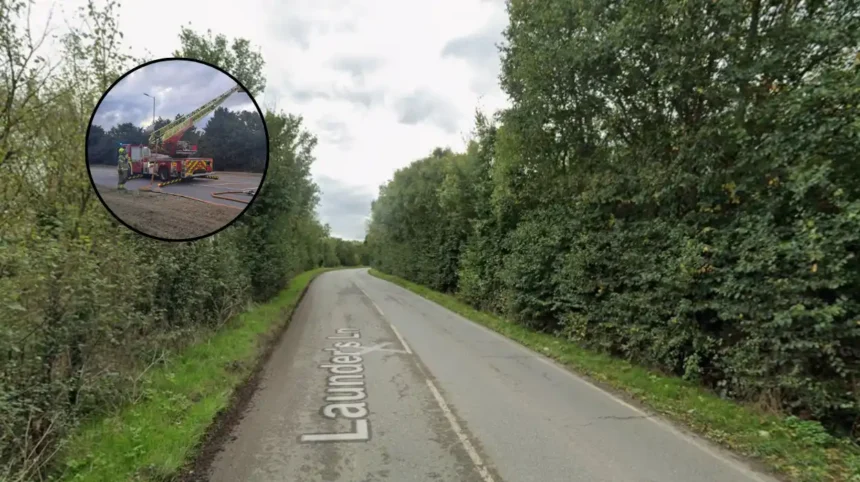
Rainham (East London Times) August 18, 2026 – Toxic surface and underground fires at the hazardous Arnold’s Field rubbish dump on Launders Lane in Rainham could continue to ignite and smoulder for up to three more years as Havering Council struggles through complex legal processes to secure a permanent solution.
As reported by Sebastian Mann of the Romford Recorder, a formal council report presented to senior figures has warned that residents face extended exposure to severe smoke nuisance while statutory enforcement procedures take their course. The privately owned 17-hectare site has logged more than 160 fire incidents over a four-year period, triggering widespread public anger and escalating health warnings.
The local authority’s new Reform UK administration pledged to eradicate the persistent blazes; however, town hall officials confirmed that legal protocols, notice periods, and potential appeals by the property owner mean direct intervention remains years away.
Why Will the Launders Lane Blazes Take Years to Extinguish?
As detailed by Francesca Lilleystone of The Havering Daily, Havering Council’s Cabinet met on August 12 to evaluate the ongoing crisis at Arnold’s Field after voluntary efforts to halt the fires broke down.
According to Lilleystone’s reporting, Council Leader Councillor Keith Prince AM stated at the meeting that there would be “no more pussyfooting” over the site. However, municipal officers cautioned cabinet members that the fastest route to resolving the blazes relied on full cooperation from the property owner—an outcome that has consistently eluded public authorities.
The council previously proposed a temporary, cost-effective solution involving a cement polymer covering designed to seal the surface and suppress combustion ahead of the 2026 summer fire season. The local authority offered to fund the installation, but the landowner rejected the scheme and failed to supply technical details or funding commitments for a viable alternative.
Consequently, the cabinet approved moving forward with legal enforcement under Part 2A of the Environmental Protection Act 1990. The council is preparing a formal Remediation Notice that mandates the landowner to execute necessary engineering works.
If the owner defaults on the order, the local authority possesses statutory powers to step in and perform the work directly. Council officers warned in their official report that navigating formal serving procedures, statutory waiting periods, legal challenges, and procurement processes means “there may be two or three more years of fires before the works are done.”
Executing these step-in works in default would place further strain on the municipality’s finances, costing the cash-strapped town hall an estimated £200,000.
How Are the Illegal Landfill Fires Impacting Rainham Residents?
The human toll on the surrounding community in East London has sparked growing desperation. As reported by The Havering Daily, local residents staged protests demanding immediate governmental intervention, declaring: “We are not asking for much — just the right to breathe like everyone else.”
Residents living within 500 metres of Arnold’s Field report being forced to keep doors and windows sealed throughout hot summer months to prevent black, acrid smoke from filling their homes. Campaign group Clear the Air in Havering has dubbed the recurring incidents as “summers of hell,” pointing out that community members frequently suffer from unexplained nosebleeds, persistent coughs, sore throats, and burning eyes.
The London Fire Brigade (LFB) has attended the venue regularly since 2018. Due to safety hazards on the site—including hidden subterranean voids, exploding gas canisters, and unstable ground reaching temperatures over 170°C—firefighters have frequently been forced to tackle blazes from the perimeter roads rather than stepping onto the land.
Councillor Luke Barry publicly supported the protesting residents, telling The Havering Daily that “previous administrations have dragged their heels with the Launders Lane crisis and this has gone on for far too long.”
Community advocates are calling for a comprehensive public health enquiry to evaluate long-term toxic chemical exposure, highlighting that air quality monitoring carried out by Imperial College London revealed elevated levels of PM2.5 particulate matter and toxic heavy metals.
Background of the Launders Lane Development
Arnold’s Field was originally utilised during the 1960s as a commercial sand and gravel extraction pit before being abandoned. In 1998, the property was acquired by North London Developments (NLD), which secured planning permission from Havering Council to operate a regulated landfill to raise land levels for future agricultural use.
Instead, the site became the target of industrial-scale illegal tipping. Dozens of heavy tipper lorries deposited unregulated waste day and night. Havering Council served an enforcement notice in 2004 requiring the dumping to cease, but NLD’s director dissolved the company shortly before an appeal deadline expired, transferring ownership to his personal name.
In 2011, Metropolitan Police officers raided the site, uncovering an illegal waste operation containing thousands of tonnes of hazardous refuse, car batteries, and home appliances, alongside a subterranean cannabis factory hidden inside shipping containers. The former owner was subsequently convicted and sentenced to 12 years in prison.
Despite the conviction, wild fly-tipping continued unabated. Waste was deposited up to five metres above permitted council thresholds, forming deep underground layers of decomposing organic materials, plastics, construction debris, and hazardous contaminants. As organic matter decays deep beneath the surface, it generates intense heat and methane gas, leading to spontaneous subterranean combustion that breaks through the topsoil during dry, hot weather.
The current owner purchased the land at auction in 2017 with stated intentions to restore the acreage. However, no formal planning applications or remediation works materialized over the subsequent nine years.
Following a High Court judicial review brought forward by local environmental campaigners, Havering Council formally designated Arnold’s Field as “contaminated land” under Part 2A of the Environmental Protection Act 1990 in late 2025. The decision confirmed that the site presents a “Significant Possibility of Significant Harm” (SPOSH) to human health due to the presence of lead, arsenic, asbestos, and benzo(a)pyrene within the soil matrix.
Prediction: How Will This Ongoing Delay Affect the Local Community and Authorities?
The projection that fires could persist for another two to three years carries severe consequences for local residents, public services, and municipal governance:
- Public Health Burden: Prolonged exposure to toxic smoke and high concentrations of fine particulate matter (PM2.5) will likely cause a sustained rise in medical appointments and emergency admissions. Individuals with pre-existing respiratory conditions such as asthma, chronic obstructive pulmonary disease (COPD), and cardiovascular vulnerabilities face heightened risks of acute complications. Psychological distress and chronic anxiety among nearby families will remain high as residents spend future summers isolated indoors.
- Strain on Emergency Services: The London Fire Brigade will continue to draw heavily on local operational resources. Repeated callouts to Launders Lane divert crucial fire engines and personnel away from other emergency incidents across East London, while subjecting fire crews to ongoing operational hazards.
- Financial Risk for Havering Council: Pursuing formal statutory enforcement against an uncooperative landowner risks drawn-out legal battles in the courts. If the local authority is forced to execute the work using step-in powers, absorbing the estimated £200,000 upfront cost will intensify financial pressure on a borough already facing severe budgetary constraints. Recovering these costs from the private landowner through land charges or litigation could take years.
- Local Property Values and Economic Stagnation: Persistent environmental hazards and negative national media coverage will depress local property values in Rainham. Potential homebuyers may avoid the area, while local businesses, schools, and outdoor recreational facilities will face ongoing disruptions during burning events.
- Escalating Political Pressure: Prolonged delays will heighten political tension between local residents, Havering Council, the Greater London Authority (GLA), and central government departments such as DEFRA and the Environment Agency. Failure to deliver a swift remedy will fuel further public protests, legal challenges, and calls for direct central government funding to resolve what is increasingly recognized as a major London public health emergency.