Key Points
- Extended Delay: Fires at the former illegal waste dump known as the “Rainham volcano” on Launders Lane could continue for another two to three years due to lengthy legal proceedings between local authorities and the landowner.
- Severe Public Health Risk: Nearby residents in Rainham, east London, have suffered from ongoing health problems, including respiratory issues, chronic coughs, itchy eyes, nosebleeds, and increased visits to general practitioners due to recurring toxic smoke.
- Frequent Blazes: The Arnolds Field site has suffered more than 160 fire incidents since 2018, with underground temperatures previously recorded at 176.4°C due to buried, decomposing waste.
- Contaminated Land Status: Havering Council formally declared the privately owned site as contaminated land under Environmental Protection Act regulations, following a High Court review.
- Disputed Responsibility: Landowner Jerry O’Donovan of DMC Services (Essex), who purchased the site in 2017 and did not dump the waste, maintains his position remains reserved pending legal proceedings, alleging the council ignored his requests to collaborate on a clearance strategy.
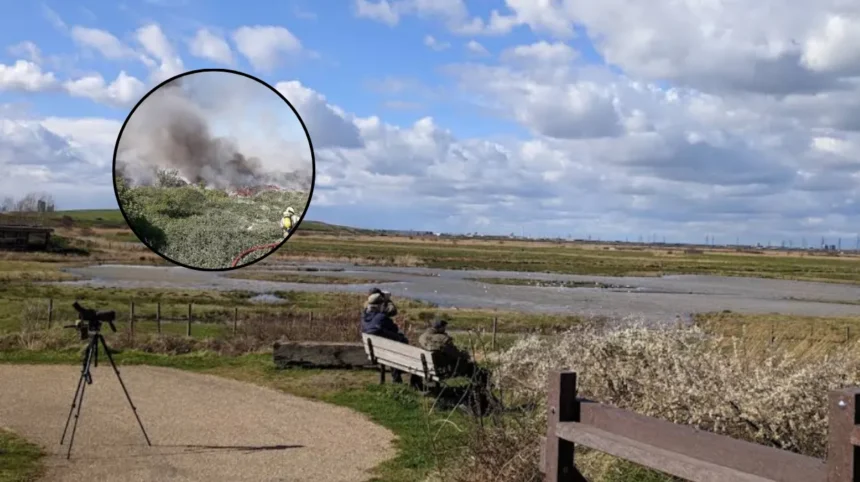
Rainham (East London Times) August 21, 2026 – Fires at a former illegal waste dump in east London, dubbed the “Rainham volcano”, could continue for another two to three years due to potentially lengthy legal proceedings, according to a council report. The privately owned site at Arnolds Field on Launders Lane has caught fire more than 160 times since 2018, causing severe disruption and health issues for the surrounding community. Nearby residents have reported a range of symptoms, including persistent coughs, itchy eyes, and an increase in visits to their local GP surgeries as toxic smoke regularly blankets the neighborhood.
- Key Points
- Why Is the Launders Lane Site Called the ‘Rainham Volcano’?
- What Are the Health and Community Impacts on Local Residents?
- What Is the Legal and Financial Dispute Between the Council and Landowner?
- Background of the Development
- Prediction: How This Development Will Affect Local Residents and Taxpayers
While Havering Council formally designated the site as contaminated land last October and stated that it could intervene directly if the owner failed to carry out remediation work, official updates indicate that enforcement action could be stalled by legal hurdles. The current landowner, who was not responsible for dumping the waste on the site, confirmed that his legal position would “remain fully reserved” until any formal case has been fully structured.
Jerry O’Donovan, director of DMC Services (Essex), purchased the land in 2017. As reported by local news outlets covering the dispute, O’Donovan stated that he had been actively trying to work alongside Havering Council to formulate a comprehensive plan to clear the property since 2018. However, O’Donovan added that the local authority had repeatedly failed to respond to his requests for advice and guidance, while simultaneously ignoring his direct attempts to initiate clearance operations at the site.
Why Is the Launders Lane Site Called the ‘Rainham Volcano’?
The nickname “Rainham volcano” was coined by local residents and regional media due to the persistent subterranean fires burning beneath Arnolds Field. The 17-hectare former agricultural plot was subject to years of large-scale illegal fly-tipping during the 2000s, where thousands of tonnes of unregulated commercial, industrial, and hazardous waste were deposited well above permitted limits.
Over time, organic and synthetic materials buried deep within the soil began to decompose, producing methane gas and extreme heat. Thermal imaging studies conducted over the property identified underground hotspots reaching temperatures as high as 176.4°C. During warm, dry summer months, these underground embers regularly ignite surface vegetation and buried waste, causing thick, acrid plumes of smoke to billow across east London. Since 2018, the London Fire Brigade has been called to extinguish or monitor blazes on the land dozens of times per year, with firefighters often forced to tackle the flames from the perimeter due to safety hazards posed by exploding canisters and unstable ground.
What Are the Health and Community Impacts on Local Residents?
For families living in Rainham and surrounding areas of the London Borough of Havering, the persistent pollution has created what many describe as unlivable conditions during peak summer periods. As documented in a health analysis cited by Havering Council, individuals residing within a two-mile radius of the Launders Lane site who suffer from underlying respiratory conditions, such as asthma, show higher rates of medical appointments and medication reliance linked directly to smoke exposure.
Residents have recounted being unable to open their windows, dry clothes outside, or allow children to play in back gardens due to toxic smog engulfing their homes. Blood tests, nosebleeds, nausea, and persistent eye irritation have been widely documented by local community action groups like Rainham Against Pollution. Furthermore, homeowners face severe financial stagnation, with estate agents noting that properties in the immediate vicinity have suffered diminished market values, leaving some residents feeling unable to sell their properties or relocate away from the environmental hazard.
What Is the Legal and Financial Dispute Between the Council and Landowner?
The stalemate over Arnolds Field stems from a complex legal and regulatory dynamic surrounding contaminated land enforcement in the United Kingdom. Under Part 2A of the Environmental Protection Act 1990, local authorities hold statutory powers to inspect, declare, and enforce the remediation of contaminated land. However, because Arnolds Field is private property, primary financial responsibility for remediation typically falls onto the current owner or the original polluters.
As reported by local journalism sources, Jerry O’Donovan maintains that he bought the site at auction with the intention of developing part of it as a commercial storage depot while remediating the remainder into public woodland. O’Donovan has argued that he inherited the environmental disaster from previous illegal operators and that the local council refused to engage constructively with his development proposals, which he claims would have funded the clearance without burdening taxpayers.
Conversely, Havering Council claims that as the legal landholder, O’Donovan bears the legal responsibility to remediate the site. While council leaders proposed an interim £300,000 plan to apply a cement polymer capping layer across fire hotspots to contain surface blazes, local authority representatives reported that O’Donovan withheld necessary access permissions, citing a requirement for formal planning consent and detailed risk assessments. With voluntary remediation stalled, the council must pursue formal Remediation Notices—a process subject to legal appeals and judicial reviews that experts estimate could take two to three years to resolve through the court system.
Background of the Development
The environmental crisis at Arnolds Field is the result of more than two decades of regulatory failures, criminal activity, and bureaucratic deadlock. In the late 1990s and early 2000s, permission was granted for the importation of inert soil to level the former agricultural field. However, North London Developments, the firm managing the operation, permitted the dumping of unregulated waste. Freight lorries deposited hazardous materials, construction rubble, and household refuse, raising the ground level by several metres above approved limits.
In 2011, Metropolitan Police officers raided the compound, uncovering an extensive illegal dumping operation alongside a subterranean cannabis factory built inside buried shipping containers. The site operator was subsequently convicted and imprisoned. A subsequent 2012 Environment Agency investigation confirmed the presence of dangerous contaminants, including asbestos, lead, arsenic, and polycyclic aromatic hydrocarbons (PAHs) such as benzo(a)pyrene.
Despite the criminal convictions, fly-tipping continued sporadically until Jerry O’Donovan acquired the site in 2017. Over the ensuing eight years, local campaigners fought for formal intervention. Following legal proceedings brought before the High Court in 2025, Havering Council reversed its former position and formally designated Arnolds Field as “contaminated land.” Despite this landmark decision, the lack of dedicated central government funding for legacy private landfills has left the council and the owner locked in opposition over who should bear the multi-million-pound cleanup costs.
Prediction: How This Development Will Affect Local Residents and Taxpayers
The legal deadlock and projected two-to-three-year delay in resolving the Launders Lane site will have direct, escalating consequences for multiple local stakeholders:
- Escalating Public Health Burden: For local residents in Rainham, the delay means enduring at least two to three more summers of smoke exposure and respiratory distress. Public health services and local NHS clinics are likely to see sustained demands for treatments related to asthma flare-ups and chronic respiratory inflammation during hot weather.
- Property Market Stagnation: Homeowners near Arnolds Field will remain caught in economic uncertainty. With the legal dispute ongoing and remediation stalled, property values within the immediate smoke plume trajectory are likely to remain depressed, severely limiting the ability of residents to sell or remortgage their properties.
- Financial Strain on Local Taxpayers: Havering Council, which operates under severe financial constraints and has previously required exceptional financial support from central government, faces substantial legal costs. If the local authority is forced to step in and execute emergency remediation works directly before recovering costs through the courts, local taxpayers could be exposed to significant public expenditure.
- Continued Pressure on Emergency Services: The London Fire Brigade will be required to maintain dedicated operational protocols for Launders Lane every summer, diverting emergency response vehicles and personnel away from other incidents across east London to handle predictable, recurring blazes on the site.