Key Points
- Ongoing Legal Deadlock: An eight-year dispute over the “Rainham volcano”—a subterranean, highly flammable waste site on Launders Lane—remains unresolved as both Havering Council and landowner Jerry O’Donovan accuse each other of delaying clean-up operations.
- Severe Health Impacts: Local residents report suffering from chronic physical symptoms, including burning eyes, sore throats, nosebleeds, nausea, and severe breathing difficulties caused by toxic smoke spewed from over 180 fires since 2018.
- Contaminated Land Designation: Havering Council formally declared the 42-acre Arnold’s Fields site as “contaminated land” under Part 2A of the Environmental Protection Act, opening pathways for statutory remediation notices.
- Rejected Temporary Fix: The landowner blocked a proposed £300,000 Cement Polymer Covering (CPC) temporary sealing plan funded by the council, labeling it a “vanity project” and calling for a permanent solution instead.
- Protracted Legal Battle Anticipated: Havering Council has announced it is appointing specialist environmental legal counsel to force a solution through the courts, warning the process could drag on for several more years.
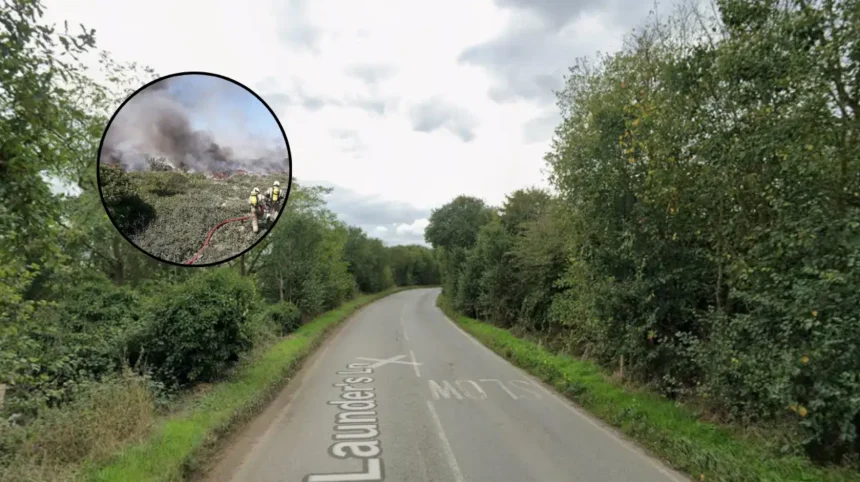
Rainham (East London Times) August 28, 2026 – An ongoing dispute over the notorious “Rainham volcano” waste site in Havering has taken a turn for the worse, with local authorities and the private landowner engaging in a continuous war of words while toxic subterranean fires burn beneath the surface. Local residents living in the immediate vicinity of Launders Lane continue to report persistent health complications, including itchy eyes, sore throats, nosebleeds, and severe respiratory distress, caused by heavy smoke drifting across the neighborhood.
As reported by Barney Davis of the Evening Standard, the conflict centers on the Arnold’s Fields dump, a 17-hectare (42-acre) plot of land where decades of unregulated fly-tipping left an estimated five metres of illegal waste buried underground. The site earned its fiery moniker due to deep-seated organic decomposition generating heat levels exceeding 170°C, causing spontaneous surface fires that have drawn the London Fire Brigade to the site nearly 200 times in recent years.
Despite more than eight years of contentious meetings and public outcry, both Havering Council and the site’s legal owner remain firmly stuck at an impasse, with each party publicly asserting that the other is responsible for delaying necessary remediation works.
What Is the Dark Criminal History Behind Arnold’s Fields?
The sprawling waste dump located on Launders Lane, Rainham, has a turbulent history marked by illicit dumping, organized crime, and complex regulatory failures. Originally operated as a gravel extraction pit in the 1960s, the land was acquired in 1998 by North London Developments (NLD), headed by John Reilly, under the guise of restoring it into agricultural land. Instead, the site became an active destination for commercial trucks dumping uncontrolled waste day and night.
According to detailed background reporting by The Guardian, Havering Council attempted enforcement action as early as 2004, issuing statutory notices demanding that NLD cease importing waste and clear the land. However, NLD was deliberately dissolved prior to enforcement deadlines, and ownership was transferred to Reilly directly.
In February 2011, Metropolitan Police officers raided the compound and uncovered extensive criminal operations, including illegal stockpiles of car batteries, industrial rubble, home appliances, weapons stores, and a sophisticated cannabis factory housed within underground shipping containers. Reilly was subsequently convicted and sentenced to 12 years in prison. A subsequent 2012 Environment Agency assessment confirmed widespread contamination, detecting hazardous levels of lead, arsenic, asbestos, and carcinogenic benzo(a)pyrene throughout the topsoil.
Why Did the New Owner Buy the Contaminated Land?
The property was put up for public auction in 2017 by Reilly’s legal representative and was acquired by Jerry O’Donovan, owner of DMC Services Essex. O’Donovan has repeatedly asserted that he bought the site almost ten years ago with the explicit intention of clearing the land, remediating the environmental hazards, and developing a portion of the site as an operational base for his waste management company while converting the remainder into accessible public woodland.
As reported by Anna O’Neill of BBC News, O’Donovan claimed he believed at the time of purchase that the site had already been largely addressed by regulatory bodies. He maintains that since 2018 he has sought to collaborate with Havering Council to formulate a comprehensive, long-term master plan to excavate, sort, and permanently remove the deeply compacted layers of illegal waste.
O’Donovan stated to the BBC:
“We are disappointed with the continuing risk and uncertainty. All we wanted to do was improve the site both for the local community, and with our company using some of it to improve our business. This would bring jobs to the area and stop the fires once and for all.”
Why Are Havering Council and the Landowner at Odds?
The central friction between the local authority and DMC Services Essex revolves around responsibility, methodology, and funding. Following the formal declaration of Arnold’s Fields as “contaminated land” under Part 2A of the Environmental Protection Act, Havering Council attempted to step in ahead of the summer fire season with an interim measure. The council proposed procuring a £300,000 Cement Polymer Covering (CPC) to cap active heat hotspots and suppress oxygen intake, preventing surface ignition.
However, as reported in official communications from Havering Council, O’Donovan withheld permission for council contractors to enter the site to apply the polymer cap. Representatives acting for O’Donovan argued that temporary capping lacked formal planning consents, required comprehensive environmental impact assessments, and failed to address the root cause of the underground fires.
O’Donovan publicly criticized the local authority’s approach, telling BBC News that the council was wasting public money. He noted:
“All the money the council has wasted over the last seven years and the £300,000 they are now committing to spending is part of a vanity project.”
He insisted that funds would be far better deployed toward an immediate, permanent site clearance.
In response, Councillor Gillian Ford, Deputy Leader of Havering Council, expressed severe frustration at the landowner’s decision to block the interim works. Statement by Cllr Ford:
“I’m incredibly disappointed in Mr O’Donovan’s conduct throughout this process. The fires at Launders Lane have been plaguing residents for far too long, and we put forward a practical, temporary solution to help contain the fires this summer and give them time to develop a permanent, long-term solution. We even offered to pay for it. And despite this, he’s continued to drag his feet at every step of the way and at the eleventh hour has now not given permission for the Council to step in…”
Background of the Particular Development
The battle over Launders Lane highlights systemic regulatory gaps regarding historical private landfills in the United Kingdom. Following years of community campaigning by groups such as Rainham Against Pollution, the site was brought under increased scrutiny by the London Fire Brigade, the Environment Agency, and the Greater London Authority.
Due to the extreme hazards presented by underground voids and toxic gases—highlighted in May 2020 when an exploding buried gas canister narrowly missed a firefighter—the London Fire Brigade instituted a safety protocol prohibiting crews from stepping onto the field, forcing them to extinguish blazes exclusively from adjacent roadsides.
Havering Council, operating under strict financial constraints and receiving exceptional financial support loans from central government, has repeatedly petitioned the Department for Environment, Food & Rural Affairs (DEFRA) for direct capital intervention. Council Leader Ray Morgon wrote directly to ministers pointing out that while central government created national funds to clear high-risk illegal waste dumps, Arnold’s Fields—which contains significantly higher waste volumes than other national sites—was left off the government funding list, leaving the local authority and private owner trapped in an expensive legal stalemate.
Prediction: How This Development Will Affect Local Residents and Taxpayers
The immediate outlook for the residents of Rainham remains troubling, with every indication pointing toward a protracted legal process that could extend over several years. As Havering Council prepares to serve formal Remediation Notices and engage high-court environmental law specialists, the legal proceedings themselves will inevitably delay physical work on the ground.
For the local community, this ongoing paralysis means:
- Continued Health Vulnerability: Residents living downwind will face another series of summers with elevated particulate matter (PM2.5), volatile organic compounds, and toxic smoke exposure, increasing long-term risks of respiratory conditions and cardiovascular complications.
- Depressed Property Values: Homeowners in the Launders Lane vicinity will continue to struggle with property devaluations and difficulty selling their homes due to the environmental designation and visible smoke plumes.
- Taxpayer Financial Strain: Local taxpayers will bear the increasing costs of prolonged litigation, specialized legal counsel, and emergency fire brigade call-outs while the root cause remains unaddressed.