Key Points:
- Proposal Opposition: Romford MP Andrew Rosindell has publicly demanded that Havering Council scrap plans for a high-rise development at the Como Street car park site.
- Community Coalition: The MP confirmed his continued backing for the local resident group, the Como Street Action Group, which has campaigned against high-density housing on the site.
- Political Context: Rosindell linked the issue to local council elections, asserting that residents voted to elect Reform UK to protect the area’s character from becoming a “concrete jungle.”
- Demands for Transparency: Rosindell has formally written to the Chief Executive of Havering Council, requesting complete transparency over future development plans for Como Street and neighbouring roads.
- Alternative Vision: The MP urged council leadership to return to the drawing board and propose a lower-density development suitable for the Lower Mawneys neighbourhood.
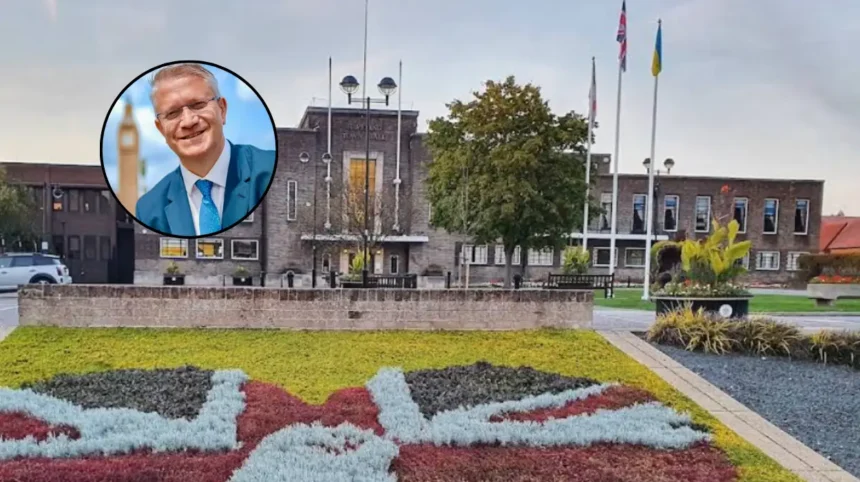
Romford (East London Times) August 22, 2026 – In a direct intervention regarding urban development in East London, Romford Member of Parliament Andrew Rosindell has called on Havering Council to immediately abandon proposals for a high-rise housing development at the Como Street car park.
The intervention highlights mounting friction between local residents and municipal planning authorities over the density and scale of new housing projects across the borough. Mr Rosindell confirmed that he is maintaining his long-standing alignment with community campaigners who argue that large-scale tower blocks threaten to alter the structural character of the surrounding suburban neighbourhood.
Why is Andrew Rosindell Opposing the Como Street High-Rise Development?
As reported by Sandra Lawman of The Havering Daily, Andrew Rosindell MP stated that:
“As Romford’s MP, I have supported the Como Street Action Group from day one in their opposition to any high-rise development on the Como Street Car Park, as proposed by the former Havering Residents Association administration.”
The MP framing of the issue places the high-rise scheme as an outdated initiative inherited from prior municipal leadership. According to local reporting by the publication, Mr Rosindell asserted that the outcome of recent local council elections reflected public dissatisfaction with high-density urban planning.
As reported by Sandra Lawman of The Havering Daily, Mr Rosindell stated:
“The HRA were comprehensively defeated at the council elections in May, as local people voted to stop our borough turning into a concrete jungle and voted Reform UK to bring about real change.”
The core of the objection rests on preserving the distinct identity of the area. Local resident groups and their parliamentary representative have consistently argued against adopting inner-city architectural models within outer London boroughs.
As reported by Sandra Lawman of The Havering Daily, Mr Rosindell added:
“I agree with local residents. We don’t want to see Romford swallowed up by Khan’s inner London nightmare and retain our character as a ‘town and country borough’.”
What Actions Has the Romford MP Demanded From Havering Council?
To halt the current trajectory of the site, Mr Rosindell has formally called for the immediate cancellation of the project and requested procedural clarity from town hall officials.
As reported by Sandra Lawman of The Havering Daily, Mr Rosindell declared:
“I continue to stand with the local residents who live in the Como Street area. This proposed development should be cancelled immediately! Havering Council must go back to the drawing board and consider a more appropriate plan for this location which is in keeping with the Lower Mawneys area of Romford.”
In addition to public statements, formal parliamentary correspondence has been initiated to address concerns surrounding administrative decision-making.
As reported by Sandra Lawman of The Havering Daily, Mr Rosindell stated:
“I have today written to the Chief Executive of Havering Council, asking for complete transparency over the council’s intentions for this site. Local people who live in Como Street and the surrounding roads deserve to know what is happening.”
Concluding his remarks, the MP re-emphasised the political alignment between local representatives and the campaign group, stating:
“Reform UK in our Town Hall must always be on the side of local people!”
Background of the Como Street Development Dispute
The dispute surrounding the Como Street car park site forms part of a broader, long-running debate over housing targets, land allocation, and urban density across the London Borough of Havering. The site, situated near central Romford and adjacent to the Lower Mawneys residential area, has been identified in recent years under municipal regeneration agendas as a candidate for brownfield re-development.
Under previous town hall administrations, including cabinet decisions led by the Havering Residents Association (HRA), council-owned car parks were evaluated for residential conversion to help satisfy regional housing allocations set out under the Mayor of London’s London Plan. Proposals for Como Street included high-density, multi-storey residential accommodation designed to maximise housing yield near key transit corridors.
However, the designation of the car park for high-rise construction met immediate opposition from surrounding householders. Area residents formed the Como Street Action Group to formally petition the local authority against the height, massing, and potential traffic congestion associated with the draft plans. Campaigners have consistently maintained that multi-storey blocks are incompatible with the existing streetscape, which predominantly features low-rise, single-family Victorian, Edwardian, and mid-century suburban housing.
Following local political shifts in municipal governance, the future of council-owned development sites across Romford has become a focal point of legislative and community scrutiny.
How Will This Development Conflict Impact Local Residents and Property Owners?
The ongoing impasse over the Como Street car park development directly affects local residents living in Lower Mawneys, Como Street, and adjacent roads in several key operational and social ways:
- Property Character and Overlooking: If high-rise plans are sustained, residents in nearby low-rise properties face potential impacts regarding daylight loss, visual enclosure, and loss of privacy caused by multi-storey structures overlooking existing gardens.
- Infrastructure and Parking Capacity: The conversion of an active public car park into high-density housing raises practical concerns for local householders regarding street-parking spillover, traffic congestion along suburban arterial roads, and increased demand on localized healthcare and public services.
- Planning Uncertainty: Property owners within the immediate vicinity face a period of continued uncertainty regarding local land values and neighborhood density until Havering Council clarifies whether it will withdraw, modify, or proceed with the site’s designation.
- Future Development Precedents: The final outcome of the Como Street site will serve as an indicator for how Havering Council intends to balance outer London housing targets against suburban conservation requests across other council-owned brownfield assets.