Key Points
- First Breeding Evidence: Health officials have confirmed that the invasive Aedes aegypti mosquito, capable of transmitting diseases such as dengue fever, Zika, and chikungunya, has been found breeding inside residential properties in east London.
- Public Health Risk: The UK Health Security Agency (UKHSA) has clarified that the immediate risk to the public remains low, as there is no evidence of human disease transmission or presence in surrounding public spaces.
- Climate Factor: While the insects were detected following recent hot weather and heatwaves, officials emphasize the species is not yet established in the UK and cannot easily survive typical, colder British winters.
- Eradication Efforts: Health authorities have implemented targeted pest control operations to destroy larvae, increased surveillance traps, and requested the public clear standing water from gardens and outdoor areas.
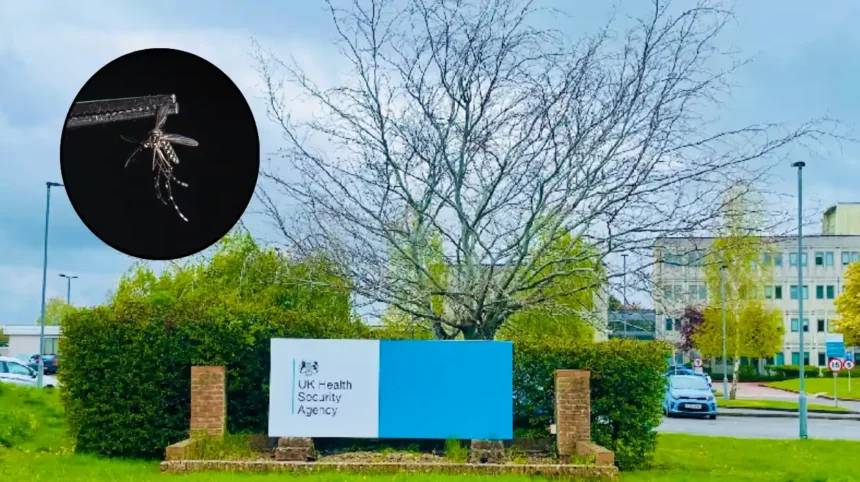
East London News (East London Times) September 4, 2026 –Health chiefs have issued an official alert after invasive mosquitoes capable of spreading tropical diseases—including dengue fever, chikungunya, and the Zika virus—were discovered breeding inside residential homes in east London. The UK Health Security Agency (UKHSA) confirmed that while the species Aedes aegypti has been detected four times historically across the country, this marks the first confirmed instance of the insect successfully reproducing on British soil.
- Key Points
- Why Have Health Officials Raised the Alarm Over Mosquitoes in London?
- What Steps Are Being Taken to Prevent the Spread of the Mosquitoes?
- How Are Environmental Groups and Experts Reacting to the Findings?
- Background of the Particular Development
- Prediction: How This Development Can Affect London Residents and Public Health Strategy
The discovery was made through the UKHSA’s Mosquito Watch surveillance scheme, which relies on public submissions and active monitoring to track exotic insect populations. Following an extended spell of warm weather and heatwaves in the capital, health inspectors identified both adult specimens and viable larvae within water collection points in private residential properties. Pest control teams were immediately dispatched to treat the affected sites and destroy the breeding colonies.
Why Have Health Officials Raised the Alarm Over Mosquitoes in London?
As reported by Pippa Neill of The Guardian, health authorities and environmental scientists have expressed growing concern regarding how changing weather patterns in the United Kingdom are enabling exotic insects to survive. As noted by the UKHSA, Aedes aegypti mosquitoes are native to tropical and subtropical climates and are not inherently suited to northern European environments. However, warmer summer temperatures create microclimates in urban gardens and residential properties that allow accidentally imported insects to reproduce.
As reported by Patrick Glover of The Herald, the head of medical entomology and zoonoses ecology at the UKHSA, Dr Jolyon Medlock, stated that
“while Aedes aegypti can transmit diseases such as dengue, chikungunya, and Zika virus in countries where these infections are circulating, the risk to the public from this finding is assessed as very low”.
Dr Medlock added that
“there is no evidence that these mosquitoes have caused human infections and, importantly, to date, there is no evidence of the mosquitoes or larvae being detected in nearby public areas”.
Official documentation released by the UKHSA further details that the insects are believed to have arrived in the country via transport networks, likely hitchhiking on international vehicles, inside personal baggage, or hidden within soil attached to imported potted plants.
What Steps Are Being Taken to Prevent the Spread of the Mosquitoes?
Following the confirmation of breeding larvae, public health workers launched localized eradication protocols to stop any potential establishment of the population.
Specialists have set specialized traps throughout the affected east London neighbourhood to monitor adult mosquito activity and evaluate whether any remaining larvae exist in adjacent drainage systems or domestic gardens.
The UKHSA advised residents to systematically inspect their gardens and outdoor yards for standing water. Standing water serves as the primary nursery for female mosquitoes laying eggs. Members of the public are being urged to empty rainwater collected in buckets, watering cans, paddling pools, plant pot saucers, and open containers. Additionally, citizens who spot unusual or aggressive daytime-biting mosquitoes are encouraged to capture photos or submit physical specimens directly to the UKHSA Mosquito Watch scheme for laboratory testing.
How Are Environmental Groups and Experts Reacting to the Findings?
As reported by Pippa Neill of The Guardian, advocacy organizations are calling for stricter UK biosecurity measures at ports and borders to prevent similar incursions in the future. David Smith, the advocacy and social change manager at the wildlife conservation charity Buglife, stated that
“recent reports of non-native invertebrates, including mosquito species, highlight the urgent need for the government to strengthen biosecurity, improve surveillance and address pathways such as the movement of potted plants and soils, through which numerous invertebrates can hitchhike undetected”.
As documented in expert reactions gathered by the Science Media Centre, entomologists note that while Aedes aegypti cannot survive cold British winters, global temperature shifts mean northern Europe is becoming increasingly hospitable to tropical pests during the summer months.
Dr Medlock emphasized that “despite evidence of breeding in this local area and the recent heatwaves, the species is not established in the UK and cannot survive long-term in the typical UK climate, which is too cold overall,” but warned that
“in a warming climate, we will continue to see incursions of invasive mosquitoes, and increased reports of them being able to survive in the UK”.
Explore More Local East London News
State Funding for Primary School Mandating Hijabs in North London 2026
Cycle Sisters Launch Cycling Sessions for Somali Women Tower Hamlets 2026
Background of the Particular Development
The detection of breeding Aedes aegypti in London comes against a backdrop of increasing invasive mosquito activity across continental Europe. Over the past decade, warmer average temperatures, extended summer heatwaves, and global freight trade have accelerated the spread of exotic insect species northwards from the Mediterranean basin.
In particular, the Asian tiger mosquito (Aedes albopictus)—a closely related invasive species—has established permanent populations in France, Germany, and regions surrounding the English Channel. That species has already caused localized outbreaks of dengue fever and chikungunya in southern Europe.
The UK Health Security Agency has run surveillance networks at major UK ports, ferry terminals, and motorway service stations for several years to detect incoming insects. Prior to this event, individual adult Aedes aegypti mosquitoes had been captured at British entry ports on three separate occasions, but inspectors had never documented live reproduction, egg laying, or larval development in domestic settings.
Prediction: How This Development Can Affect London Residents and Public Health Strategy
This development is likely to prompt a shift in how urban health authorities and local councils manage public health and environmental monitoring in the capital.
Residents in London and the South East are likely to face clearer municipal guidelines regarding garden maintenance and urban water management. Local councils may begin incorporating mosquito control protocols into standard pest control services, encouraging households to regularly drain standing water sources. Community engagement campaigns regarding biosecurity and insect identification through citizen science programs are expected to expand significantly.
Because plant transport and soil movement are recognized entry points for invasive larvae and eggs, trade bodies and government departments overseeing agriculture and biosecurity may introduce tighter quarantine rules. Importers of exotic plants, outdoor landscaping materials, and horticultural goods could face rigorous screening procedures at ports of entry to block hitchhiking insects before they reach domestic supply chains.
Although the immediate threat of native disease transmission remains near zero due to the absence of widespread viral circulating pools, NHS trusts and public health departments will need to integrate invasive vector tracking into routine surveillance. As European summers become warmer and longer, health systems will need to monitor travelers returning with feverish symptoms more closely, ensuring that if localized vector-borne transmission ever occurs, early response protocols can be deployed swiftly.