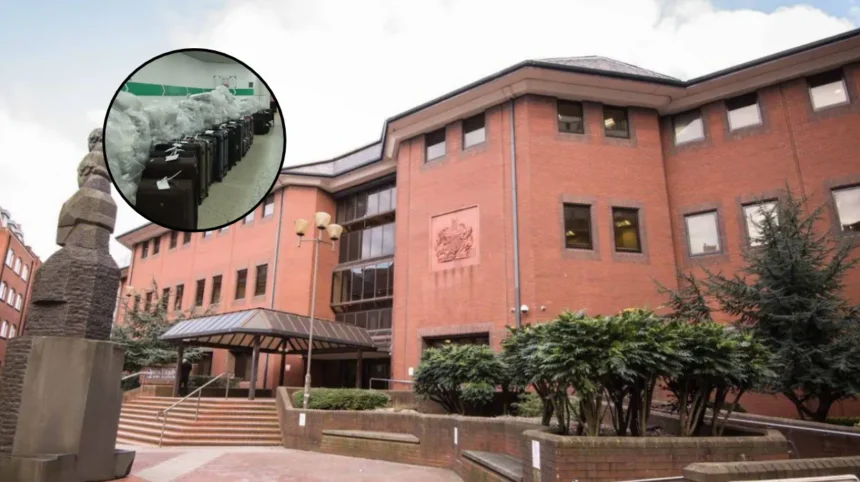
- Conviction & Sentence: Jamal Clarke, 22, of Walthamstow, east London, has been sentenced to 30 months in prison at Birmingham Crown Court for his role in importing £13.8 million worth of cannabis into the UK.
- Operation Scale: The illicit operation involved couriers attempting to bring 460 kilograms of cannabis into the country inside packed luggage.
- Smuggling Route: The couriers traveled from Thailand to Birmingham Airport via Paris before being intercepted by authorities in August 2024.
- Key Evidence: Border Force officers discovered Apple AirTag trackers inside the suitcases, all registered to a single Apple ID.
- Law Enforcement Response: National Crime Agency (NCA) investigators intercepted the operation after staffing the “nothing to declare” customs channel based on identified travel patterns.
East London (East London Times) November 10, 2026 – An east London man has been handed a 30-month custodial sentence at Birmingham Crown Court for his central involvement in a multi-million-pound international drug trafficking scheme. Jamal Clarke, aged 22, residing at The Mile End, Walthamstow, was sentenced today following an extensive law enforcement operation that disrupted an effort to import £13.8 million worth of cannabis directly into the United Kingdom.
The court heard that Clarke operated as part of a organized network of couriers who arrived at Birmingham Airport on a flight originating from Thailand, with a layover in Paris, in August 2024. Upon arrival, officers from the Border Force intercepted the group as they attempted to pass through customs controls carrying significant quantities of controlled substances.
How Was the £13.8 Million Cannabis Operation Uncovered by Border Force?
The interception took place following targeted monitoring of incoming international flights. Border Force officers noted suspicious travel patterns and subsequently fully staffed the green “nothing to declare” customs channel at Birmingham Airport to inspect arriving passengers from high-risk routes.
When officers searched the luggage carried by Clarke and his co-couriers, they discovered a total of 460 kilograms of cannabis packaged inside multiple suitcases. During the detailed forensic search of the seized baggage, investigators located Apple AirTag tracking devices placed alongside the drugs. Subsequent technical analysis revealed that all of the AirTags discovered across the separate pieces of luggage were linked to a single, shared Apple ID, confirming a synchronized and central direction behind the smuggling attempt.
Following the sentencing, Paul Boniface, senior investigating officer at the National Crime Agency (NCA), emphasized the severe consequences facing individuals recruited into organized drug networks, stating that these couriers are now facing time in prison and life-altering convictions that put future career and travel prospects in serious peril.
Background of International Cannabis Importation Trends via Aviation Routes
The conviction of Jamal Clarke highlights a documented rise in attempts to transport commercially grown cannabis from overseas jurisdictions into the United Kingdom via commercial air travel. Following legal changes and commercial expansion of cannabis production in countries such as Thailand and specific jurisdictions in North America, law enforcement agencies have reported an increase in courier-based importation schemes targeting major UK ports of entry.
Organized criminal groups frequently recruit young individuals to act as couriers, tasking them with carrying high-density consignments of contraband within standard passenger baggage. To monitor their illicit cargo across transit stops such as European hubs, syndicates have increasingly relied on consumer GPS and Bluetooth tracking technology, including Apple AirTags. However, as demonstrated in the Birmingham Airport interceptions, the reliance on unified digital tracking footprints has provided law enforcement agencies including the NCA and Border Force with critical digital evidence to link individual couriers back to broader criminal operations.
Prediction: How Will This Development Affect Prospective Couriers and Aviation Security Measures?
This judicial outcome and the public detailing of law enforcement tactics are expected to impact several key areas surrounding cross-border drug enforcement:
Deterrence for Vulnerable and Young Recruits
The imposition of immediate custodial sentences for first-time or young couriers like 22-year-old Clarke serves as a direct legal precedent. Organized crime syndicates often market courier roles to young individuals as low-risk, high-reward opportunities. The public confirmation of 30-month prison terms, combined with long-term criminal records that permanently restrict international travel and employment opportunities, significantly alters the risk assessment for prospective recruits targeted by trafficking networks.
Inter-Agency Border Screening and Technological Detection
The successful deployment of pattern recognition and targeted customs staffing at Birmingham Airport is likely to lead to increased monitoring of indirect flights originating from source countries. Air passengers traveling from regions with legal cannabis markets through intermediate European transfer hubs—such as Paris—will face heightened screening protocols. Furthermore, Border Force and the National Crime Agency are expected to expand digital forensic procedures focused on consumer tracking devices found within commercial freight and passenger luggage to identify broader operational networks behind individual couriers.