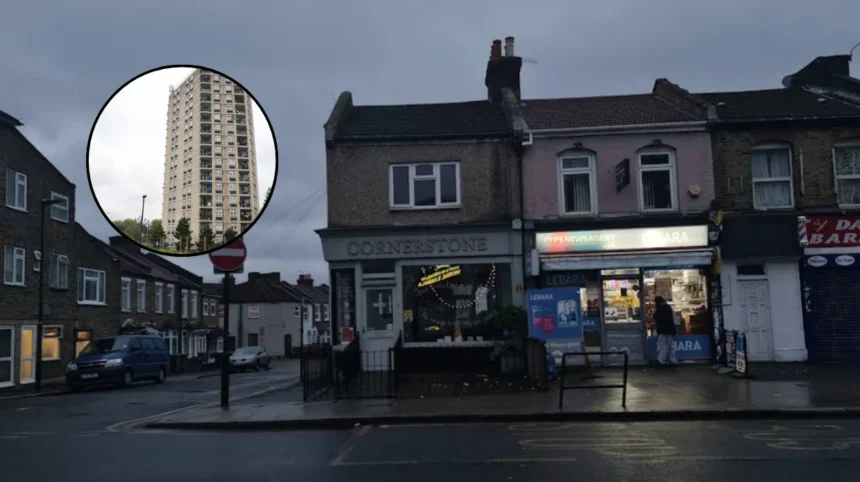
Key Points
- Five-year-old Aalim Ahmed, who was autistic, died instantly on 16 May 2024 after falling from a 15th-floor kitchen window in Plaistow, east London.
- An inquest at East London Coroner’s Court heard that Aalim jumped from the window because he could not properly assess the risk and believed he could fly or would not be harmed.
- Assistant Coroner Ian Wade KC delivered a narrative conclusion, finding no culpability on the part of Newham Council and no compelling reason why the family should not have been housed on the 15th floor.
- The inquest heard conflicting evidence about window safety. A council engineer said the windows were working properly in December 2023, while Aalim’s mother had raised concerns about the window width and missing keys.
- The coroner decided not to issue a Report to Prevent Future Deaths, finding that the flat’s location was not the primary cause of the incident.
Plaistow (East London Times) August 25, 2026 – A coroner has determined that a five-year-old autistic boy died after jumping from a 15th-floor kitchen window in east London, believing he could fly. Delivering a narrative verdict at East London Coroner’s Court, Assistant Coroner Ian Wade KC recorded that Aalim Ahmed suffered fatal injuries when he fell from a tilt-and-turn window at a residential block in Plaistow. The inquest heard contrasting evidence regarding the maintenance of the property’s windows, but the coroner ultimately cleared local authority landlords of legal responsibility, stating there was no indication that placing the family in high-rise accommodation was inherently unsuitable.
- Key Points
- What Were the Findings of the Inquest into Aalim Ahmed’s Death?
- What Evidence Was Presented Regarding Window Maintenance and Safety?
- Why Was Newham Council Exonerated of Culpability?
- Background of High-Rise Building Safety Regulations and Local Authority Housing Allocation
- Prediction: How This Verdict May Affect Local Authorities, Housing Providers, and Families in High-Rise Properties
What Were the Findings of the Inquest into Aalim Ahmed’s Death?
Delivering his formal findings, Assistant Coroner Ian Wade KC detailed the events surrounding the morning of the accident. The court heard that Aalim Ahmed woke up early on 16 May 2024, left his bedroom, and entered the kitchen of the 15th-floor flat.
According to the coroner’s findings, the child pulled a chair up to the window, climbed onto the windowsill, and managed to open the tilt-and-turn mechanism. Wade stated:
“Aalim was an active five-year-old boy who suffered from a diagnosed condition called autism, such as to render him incapable of making reliable judgments about his personal safety and abilities. In the early hours of 16 May 2024, he awoke and went from his bedroom to the kitchen; he climbed on to a chair and then on to the windowsill of an insecure double turn and tilt window. He opened the window and in a naïve belief that he could fly or alternatively could come to no harm he leapt from the open window. He died at the scene.”
Wade concluded that the falling incident occurred because the child lacked the capacity to evaluate structural risk or physical harm due to his neurodevelopmental condition.
What Evidence Was Presented Regarding Window Maintenance and Safety?
During the proceedings, East London Coroner’s Court evaluated conflicting statements concerning the operational condition of the flat’s windows leading up to the tragedy.
What Was Newham Council’s Inspection Evidence?
The inquest received evidence detailing an inspection carried out by an engineer on behalf of Newham Council in December 2023. The council’s technical representative had been dispatched to inspect and assess an overhaul of the window mechanisms and handles. The engineer reported that the tilt-and-turn windows were operating correctly and fully functional at the time of the site visit.
What Concerns Were Raised by the Boy’s Family?
In contrast, the court heard testimony from the boy’s mother, Sahra Osman, who outlined a series of complaints submitted over several months prior to the incident. Osman expressed persistent fears regarding window safety, testifying that the windows were opening excessively wide and noting that she had not been provided with a key to restrict their movement.
Osman previously stated that she was “horrified” when Newham Council initially allocated the family a top-floor flat that required repair works, maintaining her view that the local authority “could have prevented this tragic thing from happening.”
Why Was Newham Council Exonerated of Culpability?
In his final assessment, Assistant Coroner Ian Wade KC determined that Newham Council bore no direct responsibility for the fatality, finding that the windows “were not used appropriately” on the morning of the fall.
The coroner observed:
“I find there was no compelling reason why a landlord should’ve considered that placing this little boy on the 15th floor was inappropriate. It wasn’t the fact that it was the 15th floor that was significant, what was significant was that the windows had become compromised.”
Concluding the proceedings, Wade confirmed he found no adequate legal ground to issue a formal Report to Prevent Future Deaths to local authorities or window manufacturers.
Following the delivery of the narrative conclusion, Newham Council released an official response. Councillor John Gray stated:
“This was a tragic accident which resulted in the heartbreaking death of a young five-year-old child. Our thoughts continue to be with Aalim’s family and friends during this incredibly difficult time. We are grateful to the coroner Ian Wade KC for his thorough and fair hearing of the facts of this case, which have at times been very difficult to hear and revisit.”
Background of High-Rise Building Safety Regulations and Local Authority Housing Allocation
The allocation of high-rise social housing to families with young children or vulnerable dependants remains governed by local authority housing allocations policies under Part 6 of the Housing Act 1996. While housing providers are required to assess suitability, height alone does not disqualify a household from high-rise placement unless specific medical or physical mobility restrictions are formally documented.
Regarding window infrastructure, local councils and housing associations across the United Kingdom must adhere to British Standards (BS 8213-1), which govern window safety and security. Windows installed in domestic high-rise properties above ground level are generally fitted with restrictors designed to limit the initial opening width to 100 mm to prevent falls. Where “tilt and turn” mechanisms are present, key-lockable handles or restrictor catches are typically fitted to allow maintenance while restricting full opening during daily use. Inquest findings involving compromised or bypassed window restrictors routinely highlight the balance between maintenance schedules, resident reporting systems, and structural safety guidelines.
Prediction: How This Verdict May Affect Local Authorities, Housing Providers, and Families in High-Rise Properties
The narrative conclusion and exoneration of local authority culpability in this case carry notable implications for council housing departments, maintenance contractors, and residents in high-rise social housing.
Impact on Local Authorities and Landlords
- Clarification of Liability Standards: By finding that the height of the flat was not a contributing legal factor, the verdict establishes that placing families with neurodivergent children in high-rise accommodation does not in itself constitute negligence by housing providers.
- Focus on Equipment Functionality: Landlords are likely to re-evaluate window inspection procedures and documentation, ensuring that routine inspections and key issuance for window restrictors are audited to defend against potential claims of structural safety failures.
Impact on Residents and Families with Vulnerable Dependants
- Heightened Personal Safety Measures: Families caring for children with conditions such as autism—where spatial awareness or risk assessment may be impaired—may face an increased operational burden to secure internal childproofing locks independently.
- Re-evaluation of Rehousing Criteria: Advocacy groups representing vulnerable tenants may push for policy revisions regarding medical priority points, urging housing departments to factor specific developmental conditions into high-rise placement criteria, even if legal standards do not explicitly mandate it.