Key Points:
- A “Climate Death Vigil” was conducted in Ilford town centre on 4th November to protest against climate change and local fossil fuel investments.
- The demonstration was organised by the Redbridge Green Party, supported by the Red Rebel Brigade—an international performance art branch of Extinction Rebellion.
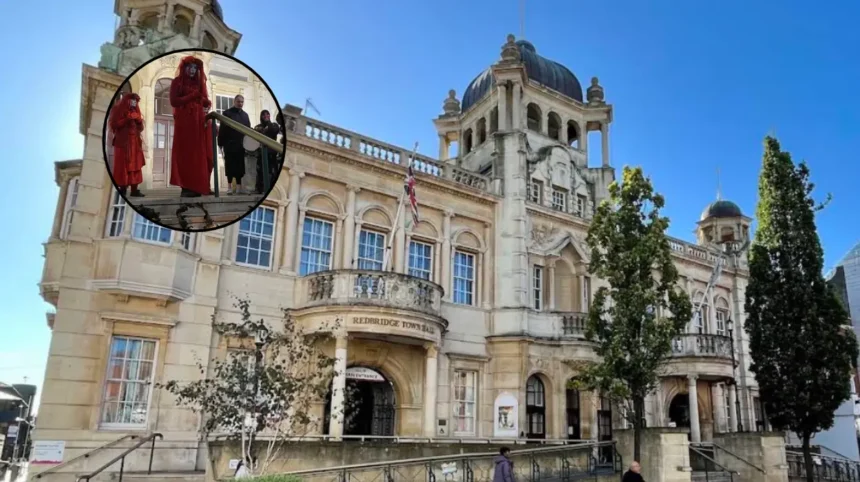
- Protesters marched in black attire alongside performers dressed in red robes with white face paint, ending the parade by laying wreaths and candles at Redbridge Town Hall.
- Redbridge Green Party spokesman Bilal Muhammad highlighted local infrastructure vulnerabilities, referencing the August heatwave water disruptions that left residents without water for nearly a week.
- Campaigners called on Redbridge London Borough Council to divest its municipal pension funds from fossil fuel industries.
Ilford (East London Times) November 9, 2026 – Members of the public in Ilford town centre were met with a silent procession on 4th November as climate campaigners gathered to host a “Climate Death Vigil” aimed at highlighting the global impact of climate change and local municipal finance decisions. Organised by the Redbridge Green Party, the demonstration focused specifically on the investment strategy of the Redbridge local authority pension fund, urging decision-makers to remove public sector pension monies from companies operating within the fossil fuel sector. The event combined traditional political campaigning with visual performance art, drawing significant attention from passers-by along the high street.
- Key Points:
- What Occurred During the Climate Death Vigil in Ilford?
- Why Did the Redbridge Green Party Organise the Protest?
- How Are Local Infrastructure Issues Linked to the Climate Emergency in Redbridge?
- What Are the Campaigners’ Demands Regarding Redbridge Pension Investments?
- Background to the Redbridge Council Fossil Fuel Divestment Movement
- Predictions: How Could Pension Divestment Decisions Affect Local Stakeholders?
What Occurred During the Climate Death Vigil in Ilford?
The demonstration featured a procession through Ilford town centre, ending on the steps of Redbridge Town Hall on 4th November. Participants organised by the Redbridge Green Party wore black clothing to signal mourning for victims of environmental disasters. They were accompanied by members of the Red Rebel Brigade, an international performance art cadre affiliated with the environmental movement Extinction Rebellion. The performers, dressed in scarlet robes with white face paint, moved through the commercial district using slow, expressive hand gestures to engage onlookers.
As the procession reached Redbridge Town Hall, members of the Red Rebel Brigade laid wreaths and lit candles on the steps of the civic headquarters. Onlookers and shoppers along the route stopped to watch the parade, with several recording the event on mobile devices.
Why Did the Redbridge Green Party Organise the Protest?
The primary objective of the vigil was to draw public attention to what organisers view as a lack of urgent action regarding global climate change, alongside specific local council financial policies. Prior to the commencement of the vigil, Redbridge Green Party spokesman Bilal Muhammad stated that the group was protesting the continued failure to treat the climate emergency with the urgency it deserves.
Bilal Muhammad explained that the organisers wanted to create a moment of reflection, honouring those who have lost their lives to climate change and reminding people of the human cost of inaction. The group maintained that symbolic actions alongside public policy demands are necessary to hold local government bodies accountable to their environmental declarations.
How Are Local Infrastructure Issues Linked to the Climate Emergency in Redbridge?
During the public address surrounding the event, campaign representatives connected global environmental concerns to recent service disruptions within the London Borough of Redbridge. Reference was made to the extreme weather conditions experienced in August, during which high temperatures coincided with severe water supply disruptions across several local neighbourhoods.
During the heatwaves of August, many households in Redbridge were left without running water for almost a week following waterwork disruptions. Addressing the incident, Bilal Muhammad noted that while the burst pipes caused the outage, it exposed how vulnerable local infrastructure and communities are during extreme weather. He added that this is not a distant crisis, but one happening directly on the local doorstep.
What Are the Campaigners’ Demands Regarding Redbridge Pension Investments?
The central policy demand of the Climate Death Vigil was the complete divestment of the Redbridge municipal pension scheme from companies involved in fossil fuel extraction and production. Local authorities across the United Kingdom administer pension funds for local government employees, which often hold diversified investment portfolios across international equities, bonds, and energy assets.
Campaigners argued that holding shares in traditional energy companies contradicts climate action goals. Bilal Muhammad stated that the community cannot declare a climate emergency while continuing to invest in the industries driving it. The Green Party and supporting activists requested a formal review of the council’s portfolio allocations to ensure alignment with environmental sustainability targets.
Background to the Redbridge Council Fossil Fuel Divestment Movement
The protest in Ilford forms part of a broader national campaign across the United Kingdom targeting Local Government Pension Scheme (LGPS) funds. Over the past decade, numerous UK local authorities have faced scrutiny from environmental groups, public sector unions, and residents over the inclusion of oil, gas, and coal assets within public pension portfolios.
In response to public pressure, several local councils across London and the wider UK have adopted formal divestment commitments or introduced decarbonisation targets for their investment funds. These strategies typically involve reallocating capital toward renewable energy projects, green infrastructure, and sustainable technology funds. However, local authority financial officers and pensions committees often balance these requests against their legal fiduciary duty, which requires them to seek maximum financial returns to secure pension payouts for local government retirees.
Redbridge London Borough Council previously declared a climate emergency, committing to reduce council operational emissions and work toward wider borough environmental targets. The debate over whether to exclude fossil fuel shares from the council-administered pension portfolio remains a recurring topic of discussion within municipal finance meetings and local political debates.
Predictions: How Could Pension Divestment Decisions Affect Local Stakeholders?
The ongoing campaign for fossil fuel divestment in Redbridge carries several potential implications for local residents, council employees, and municipal governance:
- Impact on Council Taxpayers and Municipal Finances: If the council moves toward full divestment, portfolio managers will need to reallocate capital into alternative sectors or green energy assets. The long-term financial performance of these replacement investments could influence the overall funding level of the pension scheme. A well-performing portfolio helps protect local council budgets, whereas significant underperformance could place pressure on public funds or require adjustments to municipal spending priorities.
- Impact on Scheme Members and Retired Staff: Council workers, teachers, and retired local authority staff whose pensions are managed by the scheme rely on fund stability. A transition toward sustainable assets may protect the fund against potential long-term risks associated with stranded fossil fuel assets as global energy markets shift. Conversely, fund trustees must ensure that any divestment process strictly preserves the financial returns required to meet existing pension obligations.
- Impact on Local Climate Policy and Community Engagement: Continued public activism by groups such as the Redbridge Green Party and Extinction Rebellion is likely to keep environmental governance at the forefront of local political debates. Continued pressure could lead to increased public consultation on council investment strategies, greater transparency regarding portfolio holdings, and accelerated investment in local green infrastructure projects aimed at improving climate resilience.