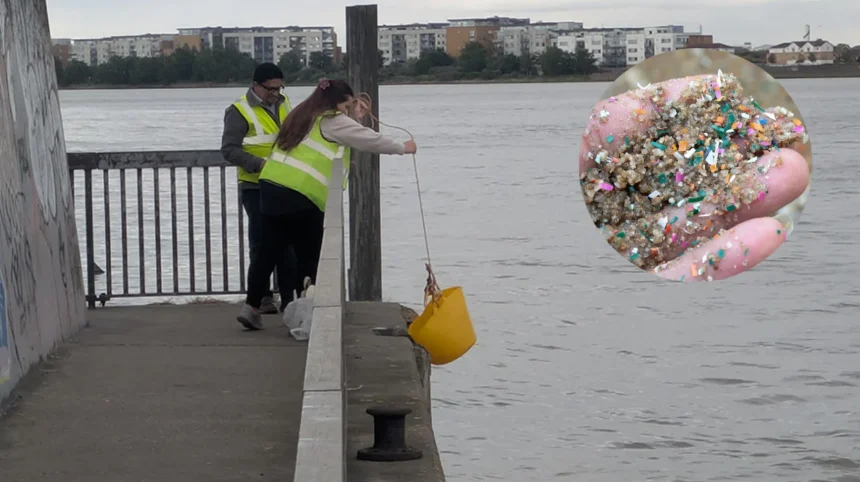
Researchers at the University of East London (UEL) are launching a new study into microplastic pollution in the River Thames in a bid to influence environmental policy and water quality.
The project, led by Dr Ria Devereux from UEL’s Sustainability Research Institute, will gather data from locations stretching from Teddington to Southend to assess how pollution levels are changing and what impact climate pressures may be having on the river system.
Building on more than three years of continuous monitoring and research, the study will combine new sampling with existing datasets to provide updated evidence on microplastic contamination across the Thames.
The River Thames flows for more than 200 miles through southern England and supports hundreds of species of fish, birds and marine life, while also serving as a vital source of transport, recreation and economic activity. Once declared “biologically dead” in the 1950s, the river has undergone decades of environmental recovery, with improvements in water quality helping wildlife return to central London and surrounding estuaries. However, researchers say growing pressures linked to urban runoff, wastewater discharge, storm overflows and plastic waste are creating new environmental challenges that require closer scientific monitoring.
The research team includes Dr Ravindra Jayaratne, Reader in Coastal Engineering at UEL’s School of Architecture, Computing and Engineering (ACE), whose international work on flood resilience and environmental modelling has helped inform coastal policy and engineering standards in the UK and overseas.
The researchers say the findings could help shape future discussions around wastewater management, river protection and plastic pollution policy at local and national level.
Dr Devereux’s research into microplastics in the River Thames has already attracted international attention while her work has also been referenced in UK Government and environmental advisory reports.
The new project will involve engagement with stakeholders including the Environment Agency, DEFRA, the Port of London Authority, water companies and environmental organisations.
Dr Devereux said:
“The River Thames is one of the most internationally recognised urban rivers in the world, yet we are still learning about the scale and complexity of microplastic pollution within it.
“This project is about providing robust scientific evidence that can support better environmental decision-making and help policymakers understand where interventions may be needed most.”
The study will also examine how storm activity and changing environmental conditions may influence microplastic levels across the river system.
Alongside scientific analysis, the project will produce policy briefings and bring together regulators, environmental organisations and policymakers through a dedicated stakeholder workshop hosted at UEL’s Royal Docks Centre for Sustainability.
Dr Jayaratne said:
“Environmental challenges such as microplastic pollution require long-term evidence, interdisciplinary collaboration and strong engagement with policymakers.
“By combining environmental monitoring with engineering and policy expertise, we hope this work will help support more informed environmental management and future regulatory discussions.”
Dr Devereux added:
“Microplastic pollution is not just an environmental issue – it is increasingly linked to wider discussions around public health, water quality and climate resilience.
“We want this work to help bridge the gap between scientific research and practical policy action.”