Key Points
- A critical road junction over the A12 in East London remains without a signalised pedestrian crossing, more than six years after a coroner warned that further fatalities could occur without safety infrastructure.
- Senior Coroner Mary Hassell issued a Prevention of Future Deaths report in February 2020 following the death of a young man struck by a speeding driver on New Year’s Day 2019 near Wick Lane, Bow.
- Tower Hamlets Council and Transport for London (TfL) pledged joint action in 2020 to install pedestrian lights and erect safety railings, but only the railings have been installed.
- Local resident Adam Werlinger, who has campaigned for a safe crossing for roughly a decade, revealed via Freedom of Information requests that council design plans date back to 2015.
- Internal communications reveal administrative delays, complex signal modelling, COVID-19 financial pressures, and shifting funding responsibilities between TfL and Tower Hamlets Council.
- Tower Hamlets Council is now seeking to secure necessary funding from private developers involved in the upcoming regeneration of the nearby Bow Goods Yard.
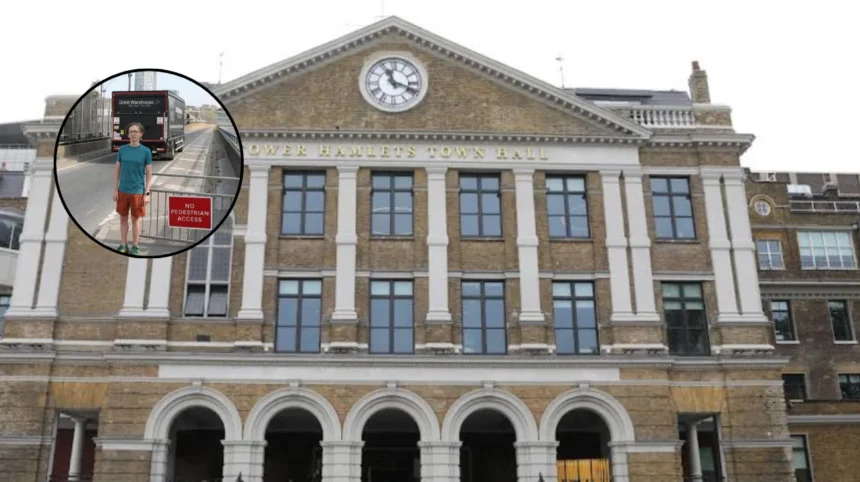
Tower Hamlets (East London Times) September 9, 2026 – As reported by Ruby Gregory of the Local Democracy Reporting Service (LDRS) and published by the East London Advertiser, both Tower Hamlets Council and Transport for London (TfL) promised to take concrete action after a young man was killed while attempting to cross the A12 near Wick Lane, Bow, in 2019. Despite official pledges made to the coroner’s court, pedestrian signals have failed to materialise.
- Key Points
- Why Is the Wick Lane A12 Junction Considered So Dangerous for Pedestrians?
- What Did the Coroner Warn Authorities Following the 2019 Fatal Collision?
- How Did Tower Hamlets Council and Transport for London Respond to Official Warnings?
- What Do Freedom of Information Requests Reveal About Bureaucratic Delays?
- Background of the Development
- Prediction: How Will This Development Affect Local Residents and Commuters?
Why Is the Wick Lane A12 Junction Considered So Dangerous for Pedestrians?
As reported by Ruby Gregory of the Local Democracy Reporting Service (LDRS), local resident Adam Werlinger—who has campaigned for safety improvements at the site for roughly ten years—described the overpass as an exceptionally hazardous environment for members of the public attempting to navigate the junction on foot.
According to Mr Werlinger, traffic converges on the overpass from four separate directions as vehicles continuously join or leave the busy A12 dual carriageway. Describing the mechanical flow of traffic, Mr Werlinger stated:
“Vehicles always have a green light. There’s no moment when there is a red light or a safe moment for pedestrians to cross. They’re either coming from the left, from the right, or straight across.”
Furthermore, Mr Werlinger highlighted that significant urban expansion in the immediate vicinity, including new residential developments across Fish Island, has dramatically elevated pedestrian footfall across the junction. As documented by the LDRS, dropped kerbs are present at the location, which falsely signal to members of the public that the site is intended for safe pedestrian passage.
As reported by the LDRS, Mr Werlinger observed:
“Pedestrians coming from Bow Road or Bow Church, or walking towards Stratford, use that crossing quite often. The dropped curb signals people should be able to cross it. Tragically there have been quite a few accidents here – cycle accidents, pedestrians being injured – and as a member of the local community we don’t want any of that on our roads. We just want people to be able to cross this junction safely.”
What Did the Coroner Warn Authorities Following the 2019 Fatal Collision?
As detailed in the LDRS report, official pressure to alter the road layout mounted following a fatal incident shortly after 3:00 am on New Year’s Day in 2019, when a speeding driver struck and killed a young man who was attempting to cross the A12 near the Wick Lane junction.
Following an inquest into the fatality, Senior Coroner Mary Hassell issued a formal Prevention of Future Deaths report in February 2020 directed at both Transport for London and Tower Hamlets Council. Coroner Hassell instructed both public bodies to implement structural alterations to make the junction safer, explicitly recommending the installation of a formalised pedestrian crossing.
In her formal notice, Coroner Mary Hassell stated:
“In my opinion, there is a risk that future deaths will occur unless action is taken.”
How Did Tower Hamlets Council and Transport for London Respond to Official Warnings?
As reported by Ruby Gregory of the LDRS, public records reveal that both statutory entities acknowledged the coroner’s warnings in early 2020 and agreed that safety measures were necessary.
In March 2020, Will Tuckley, who was serving as the Chief Executive of Tower Hamlets Council at the time, confirmed that municipal officers had developed comprehensive plans to introduce dedicated pedestrian phases into the existing traffic signals at the Wick Lane junction. Mr Tuckley further noted that physical railings would be constructed at the top of the A12 slip roads leading onto Wick Lane to physically deter pedestrians from entering the main carriageway.
Shortly thereafter, in April 2020, Transport for London formally responded to the coroner, confirming plans to prohibit pedestrian access directly onto the A12. TfL stated that it had convened coordination meetings with Tower Hamlets Council, which had been designated to design and construct the new signalised crossing. However, while physical pedestrian railings were eventually erected along the slip roads, the primary signalised pedestrian crossing across the junction was never installed.
What Do Freedom of Information Requests Reveal About Bureaucratic Delays?
As reported by the LDRS, documents obtained by campaigner Adam Werlinger through Freedom of Information (FOI) Act requests reveal that administrative discussions regarding a pedestrian crossing at the Wick Lane junction predate the 2019 fatality by several years.
The FOI disclosures confirm that Tower Hamlets Council began preliminary design work for a crossing as far back as 2015. However, internal correspondence from 2019 indicates that securing technical sign-off from TfL to alter traffic signals proved “exceptionally slow.” Council officers cited “the complexity of signal modelling” alongside the compounding operational impacts of nearby construction works as key factors stalling progress.
The FOI records further reveal conflicting accounts surrounding project funding. In one official response to Mr Werlinger, Tower Hamlets Council stated that TfL had cancelled pre-agreed design funding in 2022 “due to Covid 19.”
Conversely, TfL informed the Local Democracy Reporting Service that it had not withdrawn financial support. TfL stated that throughout 2020 and 2021, Tower Hamlets Council continued to receive its standard annual Local Implementation Plan (LIP) funding allocation—statutory capital provided by TfL to London boroughs to deliver mayoral transport and road safety priorities.
Commenting on the procedural gridlock, Mr Werlinger told the LDRS:
“There has been a stop and start over whether a crossing will be built or not, and yet here we are six years later and nothing has happened. It feels a bit as if TfL and Tower Hamlets Council are pointing at each other. They all agreed a crossing was needed. On a busy road in the middle of London, it boggles the mind. It really needs to be made fit for the many homes that have been built in this area.”
According to updates provided to Mr Werlinger, Tower Hamlets Council is currently seeking to secure capital funding for the Wick Lane crossing via section planning contributions from a private developer involved in the proposed regeneration of the neighboring Bow Goods Yard site.
Background of the Development
The A12 East Cross Route, constructed as part of major urban arterial highway expansions in late 20th-century East London, serves as a primary trunk road connecting the East End to outer borough networks and Essex. The Wick Lane overpass bridges this high-speed corridor, connecting traditional residential areas of Bow with former industrial zones along the River Lea navigation.
Over the past decade, the surrounding area—specifically Fish Island and the adjacent Queen Elizabeth Olympic Park fringe—has undergone rapid urban regeneration. Dozens of former industrial warehouses have been demolished and replaced by high-density, multi-storey residential developments, attracting thousands of new residents, families, and commuters.
This dramatic shift in local land use converted what was historically an industrial traffic overpass into a heavily used foot route for pedestrians walking toward public transport hubs at Bow Church, Bow Road, and Stratford. Despite this substantial growth in foot traffic, the road infrastructure across the Wick Lane overpass remained tailored primarily to vehicular throughput joining the A12.
Following the 2019 fatal collision, the issue became a central focal point for local road safety campaigners, urban transport advocates, and municipal leaders. Under Section 21 of the Coroners and Justice Act 2009, coroners have a statutory duty to issue Prevention of Future Deaths reports to authorities when evidence reveals a ongoing risk to life. While public bodies are legally obligated to respond to such reports within 56 days detailing actions taken or proposed, enforcement mechanisms to ensure the actual physical completion of municipal engineering works remain limited.
Prediction: How Will This Development Affect Local Residents and Commuters?
The continued lack of a signalised crossing at the Wick Lane junction poses direct physical safety and accessibility risks to the local community, particularly residents of Bow and Fish Island.
For pedestrians, cyclists, and vulnerable road users—such as children, parents with pushchairs, and individuals with mobility impairments—navigating four un-signalised streams of merging traffic will remain a daily hazard. The presence of dropped kerbs without corresponding traffic signals creates an ongoing risk of pedestrian casualties, as foot passengers may misjudge speed or vehicle movements on a road where drivers maintain continuous right-of-way.
From an urban planning perspective, relying on private developer contributions from the Bow Goods Yard project ties critical public safety infrastructure to complex, long-term commercial regeneration timelines. If planning approvals or construction schedules for Bow Goods Yard experience delays, funding for the Wick Lane crossing could remain stalled for years.
Furthermore, the persistent impasse between Tower Hamlets Council and Transport for London risks eroding public trust in local governance and transport management. Until a dedicated, signalcontrolled pedestrian phase is fully integrated into the junction’s traffic systems, community members will continue to face an unsafe pedestrian environment along one of East London’s key arterial routes.