Key Points
- Core Premise: The exhibition titled “I Am Here” is an ongoing, work-in-progress multimedia project created by artist Alexandra Stenberg, focusing on wellbeing as a continuous practice rather than a final goal.
- Artistic Mediums: The installation utilizes a wide array of artistic disciplines, including video, canvas collage, jewellery, disco balls, and tactile installations.
- The Disco-Ball Alter Ego: A central element of the exhibition is a conceptual disco-ball alter ego designed by the artist to serve as a symbolic armor, sanctuary, and celebration for inner-child expression.
- Philosophical Approach: The collection intentionally rejects a polished finish, embracing a philosophy of intuition, messiness, and experimentation rooted in the maxim that “anything worth doing well is worth doing poorly.”
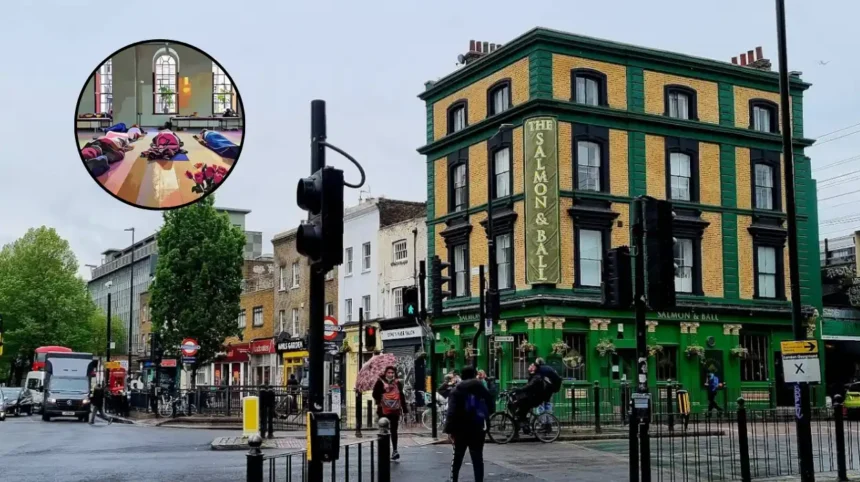
- Venue: The event is hosted at St Margaret’s House, located in Bethnal Green, London, serving as a community space for multidisciplinary wellness and artistic engagement.
Bethnal Green (East London Times) June 13, 2026 – A transformative multimedia exhibition titled “I Am Here,” created by contemporary artist Alexandra Stenberg, has officially opened to the public at St Margaret’s House in Bethnal Green. Operating as an ongoing, work-in-progress showcase, the exhibition addresses the foundational question,
- Key Points
- Why Is the ‘I Am Here’ Exhibition Transforming Bethnal Green’s Art Scene?
- How Does the Disco-Ball Alter Ego Function as Both Armor and Sanctuary?
- What Is the Significance of Intentional Messiness in Modern Fine Art?
- Background of the ‘I Am Here’ Project and St Margaret’s House
- Prediction: How This Development Can Affect the Local Arts Community and Gallery Visitors
“What makes you feel joyfully present?”
Through a diverse array of mediums—including video, canvas collage, disco balls, custom jewellery, and interactive tactile installations—Stenberg explores themes of joy, presence, emotional healing, and intuitive inner-child expression. The project conceptualises personal wellbeing not as a fixed destination or static state, but as a continuous, active practice of returning to the self through creative ritual.
As documented in the exhibition’s curatorial release, the collection reflects the artist’s foundational belief that wellbeing is inherently multidisciplinary.
Because different emotional states require distinct rituals, practices, and forms of expression, the exhibition layout is deliberately varied to satisfy diverse psychological and sensory needs.
What initially began as a personal creative attempt to ground the artist in the present moment gradually evolved into a larger conceptual framework, highlighted by the creation of a unique “disco-ball alter ego.” According to project documentation, this evolving figure functions simultaneously as a psychological armor, a sanctuary, and a visual celebration.
The persona provides a dedicated safe space where the artist’s inner child is permitted to exist freely—characterized as expressive, emotional, excessive, playful, and completely unashamed.
Why Is the ‘I Am Here’ Exhibition Transforming Bethnal Green’s Art Scene?
The arrival of “I Am Here” at St Margaret’s House marks a notable shift in how community art spaces are engaging with mental health and wellness topics. By presenting a “work-in-progress” collection, Alexandra Stenberg challenges the traditional gallery standard of presenting only polished, completed commercial items. Instead, the local creative community is presented with an installation that functions as a living laboratory for self-care.
In descriptions compiled by regional cultural reporters, the physical space of the gallery has been configured to merge traditional fine art elements with tactile craft items. Canvas collages line the walls alongside video screens looping conceptual footage, while suspended disco balls fracture light across the space, creating a participatory environment where visitors are prompted to contemplate their own emotional landscapes.
How Does the Disco-Ball Alter Ego Function as Both Armor and Sanctuary?
The conceptual anchor of the exhibition—the disco-ball alter ego—serves a dual purpose that has drawn significant interest from art theorists and visitors alike.
On one level, the reflective, hard surface of the disco ball represents a protective armor against external societal pressures, judgements, and the rigid expectations of adulthood. It acts as a barrier that shields the vulnerable inner child from external scrutiny.
Conversely, the internal space created by this persona operates as a sanctuary. Within this symbolic boundary, playfulness and emotional excess are not hidden but celebrated.
The light cast by the rotating mirror facets transforms the immediate environment into an interactive stage for joy, allowing the artist—and by extension, the viewer—to experience presence without the requirement of performance or perfection.
What Is the Significance of Intentional Messiness in Modern Fine Art?
A major talking point within the exhibition is its deliberate resistance to final polish. The individual works are displayed with visible signs of experimentation, embracing rough edges, intuitive layering, and unresolved structures. Stenberg explicitly adopts the counter-cultural philosophy that
“anything worth doing well is worth doing poorly.”
In an era dominated by heavily curated, digitally filtered imagery and hyper-polished artistic productions, this installation argues that the true value of creativity resides entirely within the process of making rather than the end product.
The messiness serves as a direct testament to “showing up anyway”—an encouragement to engage in creative experimentation, instinctual mark-making, and emotional output even when the final outcome remains uncertain or unresolved.
Explore More Bethnal Green News
Mindful Solstice Nature Workshop Launched by St Margaret’s House: Bethnal Green 2026
Cressida Cowell Launches Literacy Campaign in Bethnal Green 2026
Background of the ‘I Am Here’ Project and St Margaret’s House
To fully understand the context of this development, it is necessary to examine the history of both the creator’s methodology and the venue hosting the installation.
Alexandra Stenberg’s “I Am Here” project developed out of a growing contemporary art movement that fuses psychological therapy techniques—specifically Inner Child Work and Art Therapy—with public fine art installations. Over the past decade, practitioners have increasingly moved these practices out of private clinical settings and into public galleries to democratise conversations surrounding mental health, isolation, and stress management.
St Margaret’s House, situated in the heart of Bethnal Green, provides the historical and cultural infrastructure necessary for such an undertaking. Established as a charity, the venue has spent decades supporting local community health, arts, and social justice initiatives in the East End of London.
By hosting multidisciplinary projects that bridge the gap between community wellness workshops and professional art exhibitions, the venue has maintained a long-standing reputation for championing accessible art.
The staging of “I Am Here” represents the latest chapter in this institutional tradition, aligning with post-pandemic cultural trends where audiences actively seek out sensory, interactive, and community-driven art experiences over passive viewing.
Prediction: How This Development Can Affect the Local Arts Community and Gallery Visitors
The ongoing presentation of “I Am Here” is highly likely to influence both local gallery visitors and the broader arts community in several distinct ways.
For the general public and gallery visitors, the exhibition’s participatory and raw nature offers an accessible entry point into art-making. By visibly lowering the barrier to entry regarding technical perfection, the installation is expected to demystify the creative process for non-artists.
Visitors experiencing high levels of urban stress or burnout may find actionable inspiration in Stenberg’s use of simple, tactile craft processes—such as collage and basic jewelry making—as viable, self-directed tools for emotional grounding and mindfulness in their daily lives.
For the local arts community and emerging curators, this development serves as an operational case study in the viability of non-traditional, work-in-progress exhibitions. If “I Am Here” continues to generate sustained foot traffic and high levels of audience engagement, regional galleries may increasingly allocate budget and exhibition space to unfinished or evolving installations.
This could lead to a shift in funding paradigms, encouraging artists to apply for residencies and grants focused on long-term community engagement and iterative studio processes rather than the delivery of static, salable objects.