
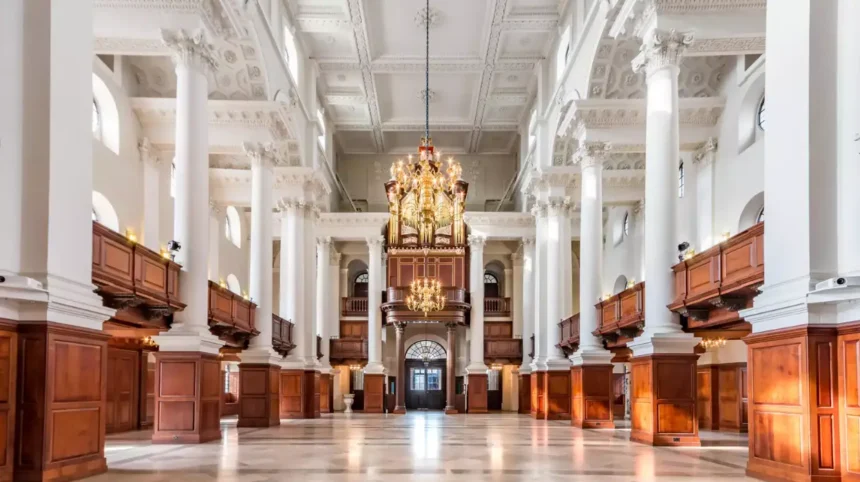
Standing proudly above the streets of Spitalfields, Christ Church is one of East London‘s most recognisable landmarks and one of the finest examples of English Baroque architecture. Designed by renowned architect Nicholas Hawksmoor, the church has dominated the East End skyline for nearly 300 years, serving as both a place of worship and a symbol of the area’s rich and complex history.
Construction of Christ Church Spitalfields began in 1714 and was completed in 1729 as part of the ambitious “Fifty New Churches Act” of 1711. The initiative was launched by Parliament and supported by Queen Anne to provide Anglican churches for London’s rapidly expanding population. At the time, Spitalfields was experiencing significant growth due to the arrival of French Huguenot silk weavers and other migrant communities settling in East London.
Nicholas Hawksmoor, a former assistant to the legendary architect Sir Christopher Wren, was commissioned to design several of the new churches. Of all his London projects, Christ Church is widely regarded as his masterpiece. The building combines classical Roman influences with dramatic Gothic elements, creating a unique architectural style that continues to attract historians, architects and visitors from around the world.
One of the church’s most striking features is its towering spire, which rises above the surrounding streets and remains visible across much of East London. The imposing design was intentional. Parliament wanted the new churches to stand out prominently against the growing number of nonconformist chapels in the area, making Christ Church a powerful statement of Anglican presence in the East End.
Throughout its history, Christ Church has witnessed many of the social changes that shaped Spitalfields. The surrounding neighbourhood evolved from a centre of silk weaving and immigration to a bustling commercial district known for markets, culture and diversity. Over the centuries, the church welcomed worshippers from different backgrounds while remaining an important community landmark.
By the mid-20th century, however, the building had fallen into serious disrepair. In 1957, Christ Church was declared structurally unsafe and closed to the public. There were even proposals to demolish the church entirely. Preservation campaigners, including supporters of Hawksmoor’s architectural legacy, fought to save the building, launching one of Britain’s most significant restoration efforts.
The restoration process lasted several decades and ultimately cost millions of pounds. Completed in 2004, the project carefully returned the church to its original 18th-century appearance. During the restoration, archaeologists excavated nearly 1,000 burials from the crypt, producing valuable research into Victorian life, health and burial practices that influenced archaeological studies worldwide.
Today, Christ Church Spitalfields functions as both an active church and a cultural venue. Alongside regular services, it hosts concerts, exhibitions, lectures and community events. Its beautifully restored interior and historic crypt attract thousands of visitors each year, making it one of East London’s most important heritage attractions.
Nearly three centuries after its completion, Christ Church Spitalfields remains a powerful symbol of East London’s history. As one of Nicholas Hawksmoor’s greatest achievements, the church continues to connect modern Londoners with the architectural brilliance, cultural diversity and resilience that have long defined the East End.