Key Points
- Escalating Resident Complaints: Flat owners and tenants living above Petticoat Lane Food Court in East London report that the market has transformed their daily living conditions into a severe nuisance involving vermin infestations, dense smoke, and continuous noise.
- Separation of Markets: The food court—established by Tower Hamlets Council in 2009 along Wentworth Street, Bell Lane, and Goulston Street—is distinct from the historic 400-year-old Petticoat Lane Market. It has expanded from a small setup to nearly 30 stalls.
- Severe Hygiene and Safety Violations: Campaigners from the Food Court Action Group (FCAG) have documented raw meat transport in unhygienic cages, rat droppings in storage and food prep zones, blocked drains from poured cooking grease, and smoke entering residential hallways and homes.
- Vermin Infestation and Vehicle Damage: Residents claim “super rats” fed by food court waste have infested communal areas and underground car parks, chewing through car wiring and causing hundreds of pounds in vehicle repairs.
- Health and Safety Impact: A local resident suffering from multiple sclerosis reported being forced to leave her home for several weeks every summer due to heavy cooking smoke affecting her breathing.
- Community Demands: Over 600 local stakeholders have signed petitions calling for the closure or relocation of the food court, citing a lack of enforcement and poor initial consultation by Tower Hamlets Council.
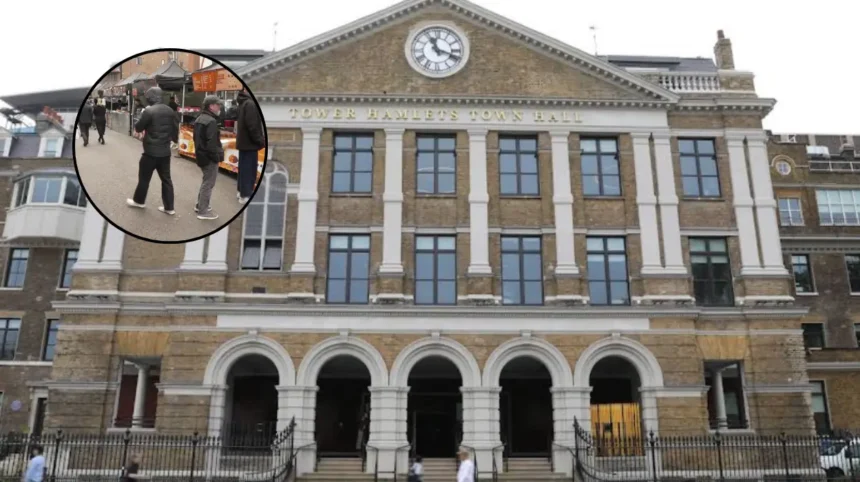
Tower Hamlets (East London Times) July 25, 2026 – In an escalating dispute between local inhabitants and municipal authorities in East London, residents residing directly above the Petticoat Lane Food Court have voiced severe grievances regarding conditions they state have rendered their lives “hell”. The market—which was founded in 2009 by Tower Hamlets Council to drive local footfall—operates along Wentworth Street, Bell Lane, and Goulston Street. Although distinct from the centuries-old historic Petticoat Lane Market, the food court has expanded from a handful of original traders to nearly 30 food stalls operating directly beneath residential apartments.
- Key Points
- What Are the Specific Environmental and Property Impacts Raised by Residents?
- How Are the Health Conditions of Local Occupants Being Affected?
- What Is the Response From Tower Hamlets Council and Local Authorities?
- Background of the Petticoat Lane Food Court Development
- Prediction: How This Development May Affect Local Stakeholders
As reported by Ayokunle Oluwalana, Senior Multimedia Journalist for MyLondon, local occupants residing in surrounding blocks such as Arcadia Court and Merchant House have provided extensive documentation detailing unhygienic practices and persistent environmental nuisances.
Visual evidence shown to MyLondon included photographs of raw, fresh chicken being transported in open cages, rat droppings present in storage zones where food is prepared, evidence of human and animal urination marks along main water pipes leading to flats above, and video footage depicting thick cooking smoke wafting directly into residential communal spaces and private properties.
Residents interviewed on the condition of anonymity expressed that while they do not oppose local commercial enterprises, the physical impacts generated by the daily operation of the food court far outweigh any perceived community benefits.
Members of the newly formed Food Court Action Group (FCAG) assert that their ongoing complaints to Tower Hamlets Council have been systematically neglected for years, with one anonymous resident describing the current multi-faceted disruption as being “like Frankenstein’s monster”.
What Are the Specific Environmental and Property Impacts Raised by Residents?
The grievances documented by local occupiers span public health hazards, fire safety risks, and physical damage to private property.
As reported by Ruby Gregory of the East London Advertiser and London Now, members of the Food Court Action Group have recorded significant rodent infestations within the shared underground car parking facilities and bin storage areas. Professional pest control documentation reviewed by journalists confirms an official link between the food court waste streams and severe rodent activity.
In emails dated from mid-2025, pest control specialists warned local authority representatives that the infestation was “getting out of control,” noting that market stallholders were routinely leaving uncontained food waste in shared management spaces.
The physical damage caused by the rodent population has impacted residents financially. As detailed by Ruby Gregory of the East London Advertiser, one FCAG member who utilizes the shared residential underground car park described an incident where rats nested inside her vehicle’s engine compartment, gnawing through essential spark plug wiring and incurring repair bills approaching £500.
Months later, the same resident reported finding dead rats inside the engine bay after warning lights illuminated a second time, prompting her to permanently cease using the parking space.
Furthermore, FCAG campaign spokesperson Emmanuel Ray stated that discarded open food packaging from the court acts as a “banquet” for vermin, leading to sightings of unusually large rodents throughout the immediate vicinity.
Additional physical nuisances detailed by residents to MyLondon include:
- Drainage Blockages: Video evidence captured stall traders pouring leftover cooking oil and grease directly down surface water drains, leading to recurring blockages.
- Noise Pollution: Traders arriving as early as 4:00 AM to set up equipment prior to permitted operating hours, generating noise that disrupts residential sleep cycles.
- Gas Canister Storage: Concerns surrounding large stockpiles of liquefied petroleum gas (LPG) canisters stored in enclosed car parks and storage units beneath domestic dwellings, which residents argue present a direct fire and safety hazard.
How Are the Health Conditions of Local Occupants Being Affected?
The operational smoke and fumes generated by high-density hot food cooking stalls have created significant environmental issues for residents living on upper floors.
As reported by Ayokunle Oluwalana of MyLondon, one long-term resident who suffers from multiple sclerosis and has lived above the market site since 1998 described the severe physical toll caused by daily airborne emissions. The resident stated:
“The smoke goes into the hallways of our flats as we aren’t able to close the windows. Every summer, I have to go away for three to four weeks, as the smoke is too intense and it affects my breathing”.
Residents also raised questions regarding how several food stalls maintained high food hygiene ratings from inspecting officers despite operating in an environment lacking dedicated public sanitation facilities, external hand-washing setups, or centralized grease management infrastructure.
While individual traders interviewed by MyLondon maintained that they fully “abide by the rules” set out by market licensing agreements, residents argue that the overall scale of nearly 30 food stalls operating simultaneously in narrow residential streets exceeds the capacity of the local infrastructure.
What Is the Response From Tower Hamlets Council and Local Authorities?
In statements issued regarding the ongoing disputes at Petticoat Lane Food Court, spokesperson representatives for Tower Hamlets Council defended the market’s presence while acknowledging enforcement responsibilities.
As reported in statements obtained by MyLondon and SWNS, a spokesperson for Tower Hamlets Council stated that the broader Petticoat Lane market infrastructure represents an
“award-winning destination and an important part of Tower Hamlets and London’s wider cultural and economic life”.
Addressing the complaints raised by the Food Court Action Group, the local authority stated:
- Inspection Regimes: Environmental Health Officers regularly execute both routine and intelligence-led inspections of food traders and adjoining commercial properties.
- Enforcement Measures: Pest control measures have been scaled up across council-managed properties, with enforcement notices issued where non-compliance regarding waste or gas storage is verified.
- Multi-Landowner Complexity: The council noted that because the site encompasses market stalls, private residential blocks, and third-party commercial premises, responsibility for overall maintenance and pest management is divided across multiple landowners and private site operators.
Although residents acknowledge that minor council interventions regarding specific fire safety and waste storage complaints have occurred intermittently, they maintain that the lack of continuous daily enforcement leaves long-term issues unresolved.
Consequently, an online petition launched by the FCAG calling for the formal closure or relocation of the food court has gathered over 600 verified signatures.
Explore More Tower Hamlets Council News
Ombudsman Finds Council Failures Led To Evictions: Tower Hamlets, 2026
Tower of London Moat Water Restoration Approved, Tower Hamlets 2026
Background of the Petticoat Lane Food Court Development
The street food trading area situated along Wentworth Street, Bell Lane, and Goulston Street is a relatively modern addition to the East London commercial landscape.
While the historical Petticoat Lane Market dates back to the mid-17th century and established an international reputation for textile and clothing sales, Tower Hamlets Council formally established the Petticoat Lane Food Court in 2009.
The initiative was originally designed as a urban regeneration scheme to diversify street trading, capture weekday footfall from adjacent City of London office developments, and boost local commercial activity.
Over the subsequent decade and a half, the food court underwent rapid expansion, growing from a limited cluster of daytime food stalls into a concentrated operational zone comprising nearly 30 independent vendors.
However, because the underlying street layout within the Wentworth Street Conservation Area consists of narrow corridors directly flanked by high-density residential buildings, tensions grew over space utilization.
Unlike purpose-built indoor food halls, the open-air food court relies on shared residential car parks, basements, and public surface drainage systems for daily operations, logistics, and refuse handling. Over time, the absence of dedicated commercial waste infrastructure led directly to the establishment of the Food Court Action Group by local occupants seeking regulatory intervention.
Prediction: How This Development May Affect Local Stakeholders
The escalating confrontation between the Food Court Action Group, market traders, and Tower Hamlets Council is likely to trigger significant structural and operational changes that will affect three primary audiences:
If Tower Hamlets Council maintains its current regulatory stance without imposing major structural restrictions, local residents face continued reductions in their standard of living and potential financial impacts.
Persistent pest activity and documented damage to parked vehicles will drive up individual maintenance costs and insurance premiums for residents in Arcadia Court and Merchant House.
Furthermore, ongoing complaints regarding smoke, excessive noise, and unhygienic conditions may impair local property valuations, making flats increasingly difficult to sell or let to prospective tenants.
Conversely, should the FCAG petition force full legal closure or relocation of the stalls, residents will gain improved air quality, reduced noise, and a reduction in vermin activity.
Market traders face heightened regulatory scrutiny and financial uncertainty. Increased intelligence-led inspections by Environmental Health Officers will likely result in mandatory operational costs for vendors, including compulsory investments in certified grease traps, elevated waste disposal contracts, and strict transport containers.
Should Tower Hamlets Council cap vendor numbers, alter operating hours, or relocate the food court away from high-density footfall areas on Wentworth Street, traders could experience notable reductions in daily revenue derived from lunch-hour City workers. Non-compliant traders face the prospective risk of license revocations or formal enforcement closures.
For Tower Hamlets Council, the situation presents a administrative challenge balancing urban economic vitality against statutory public health obligations.
Continued media coverage and potential legal challenges from organized residential groups could compel the council to execute costly infrastructural retrofits, such as installing designated waste compaction units, external grease-filtering infrastructure, and dedicated utility access points.
Failure to decisively resolve the statutory nuisance complaints could expose the local authority to formal litigation under environmental protection and public health legislation, establishing a precedent for street food market management across Greater London.