Key Points
- Overwhelming Vote: Tower Hamlets councillors have overwhelmingly passed a motion calling for the local authority’s pension fund to divest from companies operating in illegal Israeli settlements.
- Target Body: The motion targets the London Collective Investment Vehicle (London CIV), which manages Local Government Pension Scheme (LGPS) assets across London, asking it to pull funds from firms complicit in violations of international law.
- Cross-Party Alignment: Members from the Aspire, Labour, Green, and Liberal Democrat parties supported the motion, whilst conservative representation voted against it.
- Cross-Sectional Support: Trade union members from Unison, the Campaign for Nuclear Disarmament (CND), Stop the War Coalition, and Palestine Solidarity Campaign joined protests outside the town hall prior to the vote.
- Expands 2025 Audit: The new resolution builds on an earlier January 2025 motion that committed to auditing pension assets and divesting from arms manufacturers.
Tower Hamlets (East London Times) July 28, 2026 –Councillors at Tower Hamlets Town Hall have overwhelmingly voted in favour of a motion directing fund managers to pull public staff pension investments out of businesses operating within Israeli settlements in occupied Palestine. As reported by Local Democracy Reporter Nick Clark of Tower Hamlets Slice, the motion calls directly upon the London Collective Investment Vehicle (London CIV)—the central asset manager responsible for handling Local Government Pension Scheme (LGPS) assets across the capital—to divest from companies accused of being
“complicit in violations of international law, including Israel’s illegal occupation of the occupied Palestinian territories”.
The proposal, which was launched and introduced during the full council meeting on Wednesday 22 July 2026 by Green Party Councillor Jonathan Purcell, demands that pension managers explicitly withdraw financial holdings from commercial entities involved in illegal settlement trade across the West Bank and East Jerusalem.
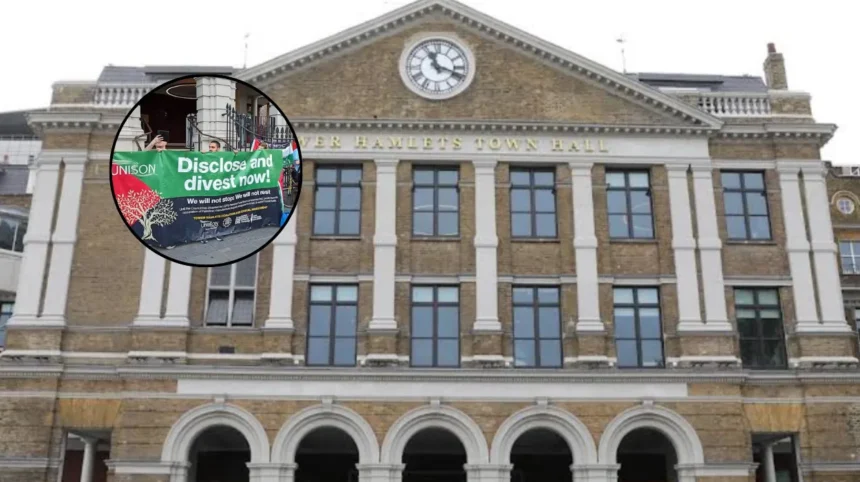
Prior to the debate, members of Unison—the largest trade union representing Tower Hamlets Council workers—alongside campaigners from the Palestine Solidarity Campaign, Stop the War Coalition, and CND, assembled outside the municipal offices in a demonstration of support.
Why Did Councillors Call for Divestment From Companies Operating in Occupied Territories?
Proposing the motion on behalf of the Green Group, Cllr Jonathan Purcell stated that municipal staff “do not want their pensions invested in these companies”.
Reflecting on historical context and personal experiences in the Middle East, as reported by Nick Clark of Tower Hamlets Slice, Cllr Purcell referred to “59 years of illegal occupation” and “78 years of continuous Nakba”—referencing the Arabic term for “catastrophe” associated with the displacement of approximately 750,000 Palestinians around the creation of the State of Israel in 1948.
During his address, Cllr Purcell described personal visits to the West Bank city of Hebron, where he witnessed Palestinians barred from a central thoroughfare due to settler presence, as well as a Palestinian farmer whose water tank had been destroyed. As reported by Nick Clark of Tower Hamlets Slice, Cllr Purcell stated that:
“This is the world that companies operate in, to turn a bigger profit come what may”.
In media coverage by the London Post, Cllr Purcell was further quoted emphasizing the broader coalition strategy:
“Tower Hamlets is a beacon of pro-Palestinian solidarity, and it is crucial that councils across London come together to put pressure on London CIV to divest from companies complicit in genocide”.
Which Political Parties Supported the Divestment Motion?
The motion received broad cross-party support from Aspire, Labour, the Green Party, and the Liberal Democrats.
As reported by Nick Clark of Tower Hamlets Slice, Aspire Deputy Mayor Maium Talukdar characterized the resolution as a “reasonable request,” telling the chamber:
“We cannot change events overseas from this chamber, but we can decide what happens with public money here in Tower Hamlets”.
Labour Councillor Victoria Lupton, who noted she had spent 12 years working with Palestinians across the Middle East and North Africa and had returned from Beirut that day after witnessing destruction in South Lebanon, backed the call while raising concerns over local implementation. As reported by Nick Clark of Tower Hamlets Slice, Cllr Lupton stated:
“18 months on that audit has still not been reported back to the pensions committee,”
urging the authority to “finish what it started” regarding a commitments made in January 2025 to audit pension holdings.
The vote passed with an overwhelming majority. Conservative Councillor Peter Golds, who did not speak during the chamber debate, registered the sole vote against the motion.
Explore More Tower Hamlets Council News
All Points East launches free In The Neighbourhood — Victoria Park 2026
Tower Hamlets Wins Whitechapel Market Trip Appeal Case Whitechapel 2026
Background of the Development
This divestment call represents a major expansion of policy decisions initiated by Tower Hamlets Council 18 months prior. In January 2025, the local authority passed an initial motion committing to an audit of all council pension fund usages, with a specific objective to divest from companies involved in the arms trade.
However, the July 2026 motion introduced by the Green Group broadens the mandate significantly. Beyond arms manufacturers, the updated directive explicitly covers commercial businesses involved in settlement infrastructure, supply chains, and economic activity in the occupied Palestinian territories.
Israeli settlements established in the West Bank and East Jerusalem following the 1967 War are widely regarded as illegal under international law, including under UN Security Council resolutions, though Israel disputes this status.
Tower Hamlets Council itself does not directly manage stock selection for all of its public employee pension funds. Instead, asset pooling is managed via the London Collective Investment Vehicle (London CIV), a centralized pool created to oversee Local Government Pension Scheme (LGPS) funds across London local authorities. Consequently, local council motions act as institutional directives instructing representatives on the London CIV board to alter investment parameters.
Prediction: How This Development Could Affect Stakeholders
The adoption of this motion carries administrative, legal, and political implications for various affected groups:
- For Tower Hamlets Council Workers and Scheme Members: Council staff enrolled in the LGPS will see their retirement assets subjected to stricter Environmental, Social, and Governance (ESG) screening protocols. While union members from Unison advocated for ethical alignment, pension fund trustees remain bound by statutory fiduciary duties, which dictate that ethical divestment must not compromise long-term financial returns for plan beneficiaries.
- For London CIV and Regional Local Authorities: Because London CIV manages pooled assets for multiple London boroughs, a formal instruction from Tower Hamlets creates pressure on the pool’s governance board. If other London councils adopt similar resolutions, London CIV may be forced to establish specialized exclusionary sub-funds or renegotiate contracts with underlying global asset managers.
- For Commercial Businesses and Corporate Contractors: Multi-national companies operating in infrastructure, telecom, banking, or supply-chain logistics within West Bank settlements face an escalating risk of divestment from UK public sector capital pools. Furthermore, as the motion encompasses procurement alongside investments, affected firms could potentially face exclusions from municipal procurement tenders across participating London boroughs.