Key Points
- Tower Hamlets Council is actively developing plans to establish designated parking zones for dockless bicycles across the borough.
- The local authority’s decision follows a formal petition presented by community campaigners highlighting a growing “dockless bikes crisis.”
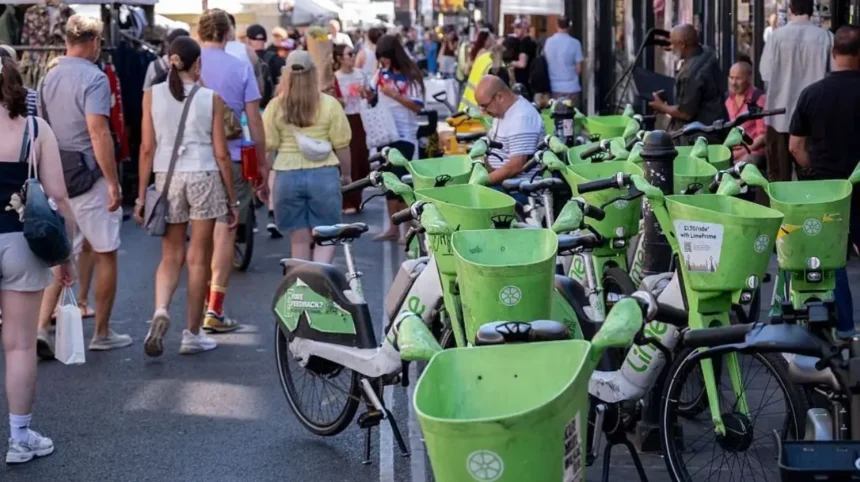
- Petitioners emphasized that abandoned e-bikes present severe safety hazards on narrow footpaths, particularly around Spitalfields, Shoreditch, and Brick Lane.
- Vulnerable pedestrians—including wheelchair users, parents with pushchairs, elderly residents, and individuals with mobility impairments—are frequently forced into oncoming traffic due to blocked pavements.
- Campaigners urged the council to implement strict enforcement measures, including anti-social behaviour monitoring, bike seizures, and dockless bike exclusion zones.
- Chief Executive Stephen Halsey confirmed that council officers are reviewing parking zone models previously implemented by neighboring inner London boroughs such as Hackney and Islington.
Tower Hamlets (East London Times) October 14, 2026 – Tower Hamlets Council has initiated formal preparations to introduce designated parking zones for dockless hire bicycles, responding directly to public outcry over severe pavement obstructions across the borough. Chief Executive Stephen Halsey confirmed that council officers are evaluating regulatory frameworks similar to those adopted by neighboring inner London authorities to address the growing street management challenge. The municipal intervention follows a petition submitted to elected members during a full council meeting, where local campaigners warned that improperly parked e-bikes are creating hazardous conditions for vulnerable pedestrians, particularly across the congested corridors of Spitalfields, Shoreditch, and Brick Lane.
- Key Points
- What Prompted Tower Hamlets Council to Address Dockless Bike Parking?
- How Does Poorly Parked Micro-Mobility Impact Vulnerable Residents?
- What Specific Solutions and Enforcement Options Were Proposed by Campaigners?
- How Is Tower Hamlets Council Responding to the Petition?
- What Is the Background of the Dockless Bike Parking Development in London?
- What Is the Prediction for How This Development Will Affect Key Stakeholders?
What Prompted Tower Hamlets Council to Address Dockless Bike Parking?
The municipal action was triggered by a formal community petition presented to council members during a public session on 7 October. Campaigners Abul Khair, Guljar Khan, and Yasmin Haque addressed the chamber to highlight what they described as an ongoing and unmanaged “dockless bikes crisis” affecting public spaces across the borough.
Speaking on behalf of the petitioners, Abul Khair told councillors that the purpose of the representation was not to oppose cycle transit, but to confront the physical hazards created by indiscriminate parking on public footpaths.
“What may seem like a minor inconvenience can quickly become a serious obstruction for people trying to move around safely,”
Khair stated during his address to the council.
The petition specifically drew attention to the spatial pressures on historic and high-footfall thoroughfares, pointing out that the “narrow and congested pavements around Brick Lane” in Spitalfields and Shoreditch are particularly vulnerable to pedestrian blockages when commercial hire bikes are left across walkways.
How Does Poorly Parked Micro-Mobility Impact Vulnerable Residents?
During the council presentation, campaigners detailed the operational impact that scattered micro-mobility vehicles have on daily pedestrian movement throughout East London. The delegation emphasized that abandoned bikes create severe accessibility barriers for individuals with specific mobility requirements, transforming routine journeys into public safety risks.
Elaborating on the safety risks posed to local residents, Abul Khair explained to the council chamber that
“for wheelchair users, parents with pushchairs, older residents and people with mobility needs, a badly parked bike can mean leaving the pavement and stepping on to the road.”
Addressing the history of community advocacy on the matter, Abul Khair told councillors that he and fellow campaigners had been raising the issue with senior council managers for the past 18 months. However, despite repeated meetings and representations over the year-and-a-half period, campaigners reported that they had “seen no improvements” on borough streets.
What Specific Solutions and Enforcement Options Were Proposed by Campaigners?
To address the persistent clutter on footpaths, the petitioning group outlined a multi-tiered enforcement strategy for council consideration. The proposal urged local authority leadership to move beyond voluntary operator agreements and implement direct physical and administrative controls over commercial dockless bike operators.
As part of the suggested measures, Abul Khair recommended utilizing municipal anti-social behaviour enforcement officers to actively patrol identified hotspots across Tower Hamlets. Under this proposal, authorized officers would monitor high-density transport nodes and commercial corridors, with statutory powers to seize and impound dockless bikes found to be causing physical obstructions on public footways.
In addition to targeted enforcement patrols and vehicle seizures, the campaigners further recommended the establishment of dockless bike exclusion zones. These red-routed areas would legally or technologically prevent users from terminating hire sessions in highly congested, narrow, or heritage pedestrian areas across Spitalfields, Shoreditch, and surrounding neighborhoods.
How Is Tower Hamlets Council Responding to the Petition?
In response to the community representations, Chief Executive Stephen Halsey confirmed that municipal officers had already initiated technical work to establish formal parking controls for dockless schemes across the local authority’s jurisdiction.
Acknowledging the demand for urgent municipal intervention, Stephen Halsey stated that work on designated parking zones was actively under way following the petition’s call for “swift and decisive action to address the problematic parking.”
Outlining the strategic direction being evaluated by the local authority, Stephen Halsey explained:
“The options that are available to the council are to do what Hackney, Islington and other inner London boroughs have done, which is have parking zones.”
Providing an update on the progress of the policy draft, Stephen Halsey added that “that piece of work is currently under way.” While community campaigners proposed an array of direct punitive actions—including active patrols, vehicle seizures, and complete territorial exclusion zones—Halsey clarified that the council’s immediate operational focus remains centered on designing and implementing dedicated dockless parking bays.
What Is the Background of the Dockless Bike Parking Development in London?
The rise of dockless micro-mobility schemes across Greater London began in earnest during the late 2010s with the entry of private commercial operators offering app-based electric and standard bicycle rentals. Unlike traditional municipal cycle hire frameworks—such as Transport for London’s Santander Cycles, which rely on fixed, hard-anchored docking stations—dockless schemes permit users to initiate and terminate hires anywhere within a designated operational boundary using smartphone software.
While dockless bicycles have significantly increased flexible, zero-emission travel options across urban centers, their rapid expansion introduced complex highway management challenges. Under current UK highway law, local London boroughs maintain statutory responsibility as highway authorities for managing footpaths and roads within their municipal boundaries, whereas Transport for London manages arterial routes. This divided oversight led to an inconsistent regulatory landscape across the capital.
In response to widespread sidewalk clutter, several inner London boroughs—most notably Hackney, Islington, Lambeth, and the City of London—began drafting bespoke legal agreements and traffic regulation orders (TROs) with commercial operators. These frameworks mandated “geofenced” parking bays, requiring hire companies to configure their mobile applications so that users are charged continuous rental fees until the vehicle is parked inside an authorized paint-marked or physical bay.
Tower Hamlets, which encompasses commercial districts, high-density residential zones, and historic narrow streets, has experienced increasing pressure as surrounding boroughs instituted mandatory bays, often displacing unregulated parking into bordering neighborhoods. The recent petition to Tower Hamlets Council represents the culmination of an 18-month community campaign seeking legal parity with neighboring local authorities.
What Is the Prediction for How This Development Will Affect Key Stakeholders?
The prospective introduction of mandatory dockless bike parking zones in Tower Hamlets is anticipated to alter urban navigation and operational frameworks across several distinct groups:
Impact on Pedestrians and Vulnerable Road Users
For wheelchair users, visually impaired individuals, parents with pushchairs, and elderly residents, the implementation of designated parking bays and geofenced end-of-ride requirements will likely result in clearer, more accessible footpaths. Eliminating arbitrary drop-offs on narrow footways, particularly around heritage corridors like Brick Lane, will reduce the necessity for mobility-impaired pedestrians to step off kerbs into live traffic lanes, thereby improving overall pedestrian safety.
Impact on Commuters and Cyclists
Dockless bike users may experience a slight reduction in point-to-point convenience. Instead of leaving bicycles immediately outside personal destinations, riders will be required to locate, navigate to, and terminate hires within designated council bays. Failure to park within authorized geofenced zones may incur ongoing financial penalties or administrative fees from bike operators. However, standardized bays will also provide cyclists with more predictable vehicle availability when searching for operable bicycles.
Impact on Dockless Bike Operators and Council Administration
Commercial operators will face heightened operational and compliance costs associated with mandatory integration into Tower Hamlets’ spatial parking grid. Operators will need to update their proprietary software to enforce geofenced boundaries, adjust fleet rebalancing procedures, and potentially contribute to the infrastructure costs of line-marking or installing physical bays. For Tower Hamlets Council, the policy shift will require dedicated administrative and legal oversight to enact Traffic Regulation Orders, alongside continuous monitoring to ensure operators comply with borough-wide parking parameters.