Key Points
- Appellate Reversal: The Court of Appeal has overturned a Deputy District Judge’s ruling that found the London Borough of Tower Hamlets liable for a pedestrian’s severe injury.
- The Incident: A woman, 36 weeks pregnant, suffered a serious ankle fracture after tripping over unmarked metal scaffolding poles protruding from an unattended market trader’s trolley after dark near Whitechapel Station.
- Legal Distinction: The Court of Appeal re-established that public authorities do not owe a common law duty of care to protect individuals from third-party harms unless they directly cause the harm or explicitly assume responsibility.
- Nuisance Claim Dismissed: The court rejected claims that the council “suffered or permitted” a public nuisance, ruling that a local authority cannot realistically guarantee or marshal every aspect of a market trader’s conduct.
- Precedent Upheld: The decision heavily relies on the Supreme Court landmark ruling Tindall v Chief Constable of Thames Valley Police, clarifying the boundaries of public authority liability in negligence.
Whitechapel (East London Times) June 23, 2026. The London Borough of Tower Hamlets has successfully appealed a lower court’s decision that held the local authority legally liable for injuries sustained by a pregnant pedestrian who tripped over a market trader’s equipment. June 23, 2026.
- Key Points
- What Were the Original Legal Arguments Against Tower Hamlets Council?
- The Public Nuisance Argument
- The Negligence Argument
- Why Did the Deputy District Judge Originally Rule Against the Council?
- How Did the Court of Appeal Handle the Local Authority’s Grounds of Appeal?
- Ground 1: The Misapplication of the Duty of Care
- Ground 4: The Failure of Causation
- Why Did the Court Dismiss the Public Nuisance Claim Against Tower Hamlets?
- Background of the Whitechapel Market Regulatory Framework
- Prediction: How This Ruling Affects Pedestrians and Local Councils
- The Impact on Local Authorities and Council Budgets
The Court of Appeal set aside the original judgment of Deputy District Judge (DDJ) green, ruling that the council owed no private law duty of care to the claimant and could not be held responsible under the law of public nuisance for the transient obstructions left by unidentified third parties on a public footpath.
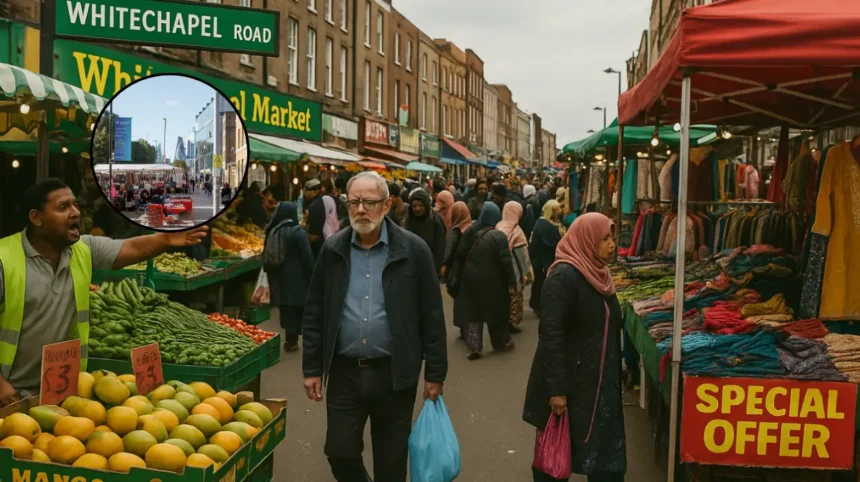
The legal battle stems from an incident in Whitechapel Market, located in East London. The claimant, who was 36 weeks pregnant at the time, was walking toward a hospital maternity ward tour at approximately 5:00 pm after dark. While navigating the pavement near a bus stop close to Whitechapel Station, she tripped over metal scaffolding poles.
These poles were protruding from an unattended trolley parked between two market stalls and extended directly across the pedestrian footpath without any warning signs or markings.
The pedestrian suffered a serious ankle fracture requiring medical intervention. Her unborn child was uninjured, and she subsequently gave birth to a healthy baby.
Because the incident occurred near packing-up time in a busy market environment, the specific stallholder responsible for leaving the trolley unattended was never identified. Consequent legal proceedings were built entirely upon the assumption that the equipment belonged to an unidentifiable and independent market trader.
What Were the Original Legal Arguments Against Tower Hamlets Council?
In the initial lawsuit brought before the County Court, the claimant asserted that the London Borough of Tower Hamlets bore direct civil responsibility for the hazardous state of the walkway.
While Transport for London (TfL) serves as the formal highway authority for that specific stretch of road, Tower Hamlets functions as the statutory licensing and management authority for street trading within Whitechapel Market under the London Local Authorities Act 1990.
The claimant’s legal team advanced a dual-track argument rooted in public nuisance and the tort of negligence:
The Public Nuisance Argument
The claimant alleged that Tower Hamlets caused, permitted, suffered the existence of, adopted, or otherwise failed to abate a public nuisance.
It was argued that by failing to supervise the market adequately, the council allowed it to be operated in a manner that created dangerous obstructions on an adjacent footpath, directly causing her injury, loss, and damage.
The Negligence Argument
Alternatively, the claimant argued that the council was liable in negligence for failing to exercise reasonable care in managing and running the market.
The claim asserted that because the council possessed regulatory oversight, it owed a duty of care to ordinary users of the adjacent highway to ensure that licensed street trading did not spill over into foreseeable hazards for pedestrians.
Why Did the Deputy District Judge Originally Rule Against the Council?
When the matter was first evaluated, the Deputy District Judge ruled in favour of the injured pedestrian, finding Tower Hamlets fully liable for the accident.
The trial judge looked closely at the council’s internal regulatory frameworks, including its 2018 Street Trading Licence Conditions and its 2017 Standard Operating Procedures and Processes for Market Officers (SOPP).
The DDJ concluded that through these extensive regulatory documents, the local council had effectively assumed operational responsibility for the physical existence and rules under which the market operated. In his judgment, the lower court judge stated that the day-to-day operation of the market “was squarely the responsibility” of Tower Hamlets.
The DDJ’s ruling rested on several key findings of fact and law:
- Proximity and Duty: The judge found a sufficiently proximate relationship between a pedestrian alighting from a bus within metres of the market and a council exercising considerable regulatory control over stallholders.
- Timing of the Hazard: The lower court concluded that the scaffolding poles had been left at the scene from at least 2:45 pm until the accident occurred at 5:00 pm.
- Operational Failure: The judge determined that the council failed to comply with its own SOPP 2017 guidelines by failing to conduct vigilant, hourly monitoring and inspections, thereby permitting a public nuisance to persist.
The lower court judge concluded that by “suffering or permitting” market components to obstruct a walkway, the defendant council failed in its duty of care. However, recognizing the wider legal implications of his ruling, the DDJ granted Tower Hamlets permission to appeal to the Court of Appeal across four distinct grounds.
How Did the Court of Appeal Handle the Local Authority’s Grounds of Appeal?
The appeal was heard by Lord Justice Stuart-Smith, Lady Justice Yip, and Lord Justice Bean. The appellate bench systematically dismantled the lower court’s reasoning, ultimately allowing the council’s appeal on Ground 1 (existence of a duty of care), Ground 2 (factual findings regarding timing), and Ground 4 (causation of the breach).
Ground 1: The Misapplication of the Duty of Care
As reported by legal correspondents reviewing the judgment of Lord Justice Stuart-Smith, the Court of Appeal emphasized that the lower court had failed to apply established common law principles governing public authority liability.
Lord Justice Stuart-Smith highlighted the Supreme Court’s definitive declarations in Tindall v Chief Constable of Thames Valley Police [2024] UKSC 33, which reinforced that public authorities are held to the same negligence standards as private individuals.
Lord Justice Stuart-Smith stated that:
“As a general rule, a person has no common law duty to protect another person from harm or to take care to do so: liability can generally arise only if a person acts in a way which makes another worse off as a result.”
The appellate court observed that while protective, regulatory, and rescue public bodies have statutory powers to mitigate public harm, a failure to exercise those powers does not automatically yield a civil claim for compensation.
To establish liability, a claimant must demonstrate that the authority actively created or worsened the harm, rather than merely failing to prevent a danger initiated by an independent third party.
The court examined whether Tower Hamlets fell under the exception of having “assumed a responsibility” to the pedestrian. Lord Justice Stuart-Smith ruled there was “nothing approaching” the specialized relationships found in landmark cases such as Phelps v Hillingdon London Borough Council or Barrett v Enfield London Borough Council.
The council’s standard licensing terms did not mean it assumed an individual duty to protect pedestrians from the stray equipment of traders.
Furthermore, the court dismissed the idea that the council possessed a “special level of control” over the rogue market trader.
The local authority’s only mechanism of control lay in its statutory powers of licence revocation or enforcement under the 1990 Act, which is vastly different from the direct physical control required to trigger a common law exception.
The Court of Appeal also overturned the lower court’s finding that the trolley had been left on the pavement since 2:45 pm.
Lord Justice Stuart-Smith concluded that there was absolutely no evidence presented during trial that could justify a definitive finding that the obstruction had been sitting in that exact position for over two hours prior to the accident.
Ground 4: The Failure of Causation
Even if the court had accepted a hypothetical duty of care requiring market officers to inspect the market perimeter once within that afternoon window, the claimant could not legally prove causation.
Because the precise timing of when the trader abandoned the trolley remained entirely unknown, it was impossible to prove that a standard council inspection would have caught or disrupted the hazard before the 5:00 pm fall. Consequently, Ground 4 was allowed, while Ground 3 was dismissed as irrelevant given the absence of any foundational duty of care.
Why Did the Court Dismiss the Public Nuisance Claim Against Tower Hamlets?
Beyond the scope of negligence, the Court of Appeal firmly rejected the assertion that Tower Hamlets was liable for creating or maintaining a public nuisance.
The claimant had argued that by failing to strictly enforce its standard operating procedures, the council effectively “permitted” the market to deteriorate into a public hazard.
Lord Justice Stuart-Smith rejected this expectation as entirely disproportionate to the realities of local governance. The appellate judge noted that:
“Whatever the terms of the SOPP, this is wholly unrealistic for a borough council with limited resources whose market officers could not possibly marshal every aspect of every market trader’s conduct.”
The judgment further clarified that the legal argument presented by the claimant essentially demanded that local authorities provide an absolute guarantee against any breach of licensing conditions by private entities. The Court of Appeal found no legal justification for imposing such an “unrealistic, unreasonable, and unenforceable obligation” upon a borough council operating under its regulatory statutory powers.
The existence of internal documents, local plans, or levelling-up applications recognizing that licensing infractions might occasionally happen does not imply that the council condones or legally “permits” those hazards.
Explore More Tower Hamlets News
Tower Hamlets £500m Housing Safety Programme 2026; East London
Katie Hopkins Ejected From Packed Pub After Row: Bethnal Green 2026
Background of the Whitechapel Market Regulatory Framework
The operational management of street trading across London is fundamentally governed by the London Local Authorities Act 1990. Under this legislation, boroughs are granted the power to designate specific streets as “licensed fields” for trading, issuing individual licences to stallholders to regulate local commerce and preserve public order.
In the case of Tower Hamlets and Whitechapel Market, the council had established a structured matrix of oversight tools, notably the 2018 Street Trading Licence Conditions and the 2017 Standard Operating Procedures and Processes for Market Officers (SOPP).
These frameworks dictate that individual stallholders are strictly responsible for the safe assembly, maintenance, and teardown of their pitches. Crucially, the terms mandate that each trader must independently maintain valid public liability insurance to cover third-party injury claims.
Historically, claimants seeking damages for slips, trips, and falls on public property have attempted to hold local authorities liable by pointing to these internal inspection policies. Lower courts have occasionally interpreted a council’s detailed internal enforcement procedures as an assumption of a broader duty of care to the public.
However, upper-tier UK courts have spent the last several years re-establishing strict boundaries. The Supreme Court’s ruling in Tindall [2024] acted as a major corrective, making it clear that a public body’s statutory power to regulate or inspect does not automatically translate into a private law duty to compensate victims when independent parties break the rules. The Whitechapel Market appeal serves as an application of this developing administrative law doctrine.
Prediction: How This Ruling Affects Pedestrians and Local Councils
This judgment sets a powerful legal precedent that will significantly impact personal injury litigation, municipal risk management, and the rights of ordinary pedestrians across the United Kingdom.
For everyday citizens and personal injury lawyers, this ruling severely narrows the path to seeking compensation following accidents in public marketplaces or shared municipal spaces.
When a pedestrian is injured by a hazard created by a third party—such as a market trader, an independent street performer, or a mobile food vendor—the claimant can no longer look to the local council as a deep-pocketed defendant of last resort simply because the council licensed the activity.
Future claimants will face the difficult task of identifying, tracking down, and suing the specific third-party operator or their public liability insurance provider directly. In cases where the wrongdoer packs up and disappears unidentified, injured parties will likely be left with no legal route to recover damages.
The Impact on Local Authorities and Council Budgets
For local authorities across the UK, the ruling offers massive legal relief and protection for overstretched public funds.
Had the original Deputy District Judge’s ruling stood, it would have opened local councils to vast financial liabilities, forcing them to act as literal insurers for the behavior of every independent contractor or licensee operating on public pathways.
Following this clear line from the Court of Appeal, councils can maintain standard licensing frameworks and internal operating guidelines without the fear that these administrative documents will be used against them in court as proof of an “assumed responsibility.”
Municipalities will likely continue their shift toward strict enforcement of mandatory public liability insurance for all individual traders, insulated by the law from direct liability when those same traders create transient hazards on adjacent walkways.