Key Points
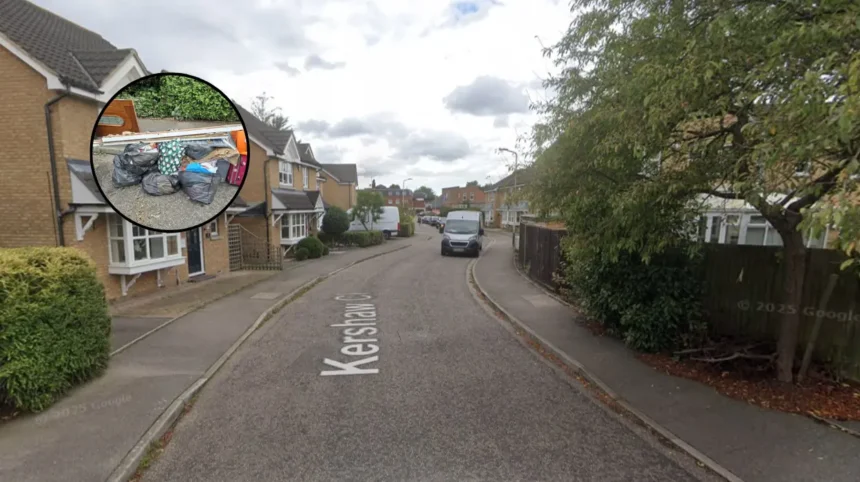
- Hazardous Waste Discovered: A substantial fly-tip containing suspected prescription medication, dirty nappies, soiled clothes, and household waste was found on a public footpath in Kershaw Close, Hornchurch.
- Proximity to Local Schools: Residents expressed severe concern regarding the discarded medical supplies due to the close proximity of the site to local educational institutions and the public health risks involved.
- System Closure Conflict: Official correspondence from residents indicates that an initial report regarding the waste issues was filed on 10 June, but the council local reporting case was subsequently closed prior to final resolution.
- Community Self-Clearance: Local individuals felt compelled to manually clear items—including cutting a discarded wooden front door in half—due to an alleged lack of direct response from elected officials.
- Council Defense: Havering Council stated that they cleared the hazardous and medical waste immediately after becoming aware of it on Tuesday, 16 June, and are actively pursuing enforcement enquiries to trace the perpetrators.
Hornchurch (East London Times) June 23, 2026 – A localized public health panic has emerged in a residential cul-de-sac after a massive haul of illegal fly-tipped rubbish, containing prescription medication and used nappies, was discovered strewn across a public footpath near local schools. Frustrated residents living in Kershaw Close claim that they were abandoned by local authorities and left to physically dismantle and dispose of the hazardous materials themselves after receiving automated system notifications that their filed complaint case had been officially closed. Conversely, Havering Council has strongly defended its operational timeline, asserting that its teams intervened and cleared the site immediately upon receiving notification of medical biohazards on 16 June.
- Key Points
- Why Did the Kershaw Close Fly-Tip Spark Public Safety Concerns?
- How Did the Communication Breakdown Between Residents and Havering Council Occur?
- What Actions Were Local Residents Forced to Take?
- What Is Havering Council’s Official Account of the Cleanup?
- Is Fly-Tipping an Ongoing Neighborhood Issue in Hornchurch?
- Background of Fly-Tipping and Waste Enforcement in Havering
- Predictions: How This Incident Will Affect Local Residents and Borough Policy
The incident has exposed a deep rift between the local community and municipal services regarding response times, communications, and administrative tracking.
While the local authority maintains that the matter was dealt with urgently due to the toxic nature of the waste, neighbours report a six-day wall of silence from their elected ward councillors and municipal staff, during which time they felt forced to intervene to secure their own neighbourhood from contamination risks.
Why Did the Kershaw Close Fly-Tip Spark Public Safety Concerns?
As reported by Francesca Lilleystone of The Havering Daily, the specific composition of the dumped material converted a routine local council grievance into an urgent public safety matter.
The fly-tip, positioned directly onto a public footway heavily trafficked by children and local pedestrians, comprised far more than standard garden clippings or minor commercial overflow.
According to community accounts documented by journalists, the dynamic heap consisted of:
- Piles of black bin liners leaking household waste.
- Dozens of heavily soiled nappies.
- Stained, discarded clothing.
- Old suitcases packed tight with unidentified domestic items.
- A solid, discarded wooden front door blocking the pavement.
- Bundles of what appeared to be un-dispensed or discarded prescription-only medication.
The presence of pharmaceutical items escalated local anxieties. Because Kershaw Close sits within walking distance of several local schools, parents and homeowners noted that any loose, controlled chemical substances left out in public view presented an immediate, potentially fatal risk to curious school children walking home, as well as to domestic pets and local wildlife.
How Did the Communication Breakdown Between Residents and Havering Council Occur?
The core of the dispute rests on a timeline mismatch and automated system notifications that left residents believing they had been ignored.
Local individuals provided verifiable journalistic evidence and correspondence showing that the initial waste issues in the immediate area had been officially logged within the council’s reporting system as early as 10 June.
Following this submission, the file tracking the complaint was updated to a “closed” status. To the residents, this signaled that the local authority had dismissed the occurrence without taking physical action on the ground, leaving the footpath blocked.
Disappointed by this digital administrative response, and watching further rubbish continue to accumulate on the pathway daily, the neighborhood felt compelled to take matters into their own hands.
Residents described an atmosphere where they felt entirely abandoned by their local infrastructure, triggering an ad-hoc community cleanup operation simply to keep their children safe.
What Actions Were Local Residents Forced to Take?
According to reporting from The Havering Daily, the lack of visible municipal intervention drove homeowners to extreme measures to restore order to their street.
In one documented instance, a resident was forced to bring out personal power tools to cut the abandoned wooden front door completely in half so that it could be safely lifted, transported, and disposed of at a local refuse site.
Other neighbours volunteered their time, donning gloves to clear portions of the scattered household items and bag up loose debris before it could blow into nearby gardens.
Chris Oliver, a resident of Kershaw Close, detailed the extensive, unsuccessful efforts made by the community to establish human contact with their local representatives. In an official statement provided to The Havering Daily, Oliver explained the chronological progression of their frustration:
“As soon as we saw the latest dumping, several of us emailed the three ward councillors, and Havering Council. Over the following three days I sent further emails asking for assistance. Six days later, residents have still not received even the courtesy of a reply.”
The lack of an acknowledgement email or standard courtesy response compounded the growing anger within the cul-de-sac, with residents questioning why an issue explicitly involving suspected controlled medications near school zones did not automatically trigger an emergency response sequence from the civil servants they contacted.
What Is Havering Council’s Official Account of the Cleanup?
In a bid to clarify the situation and address the severe allegations of systemic neglect, a spokesperson for Havering Council issued a public statement presenting the local authority’s side of the timeline. According to the council’s internal logs, their department was made aware of this specific occurrence on Tuesday, 16 June.
The Havering Council spokesperson stated:
“We were made aware of this fly tipping on Tuesday [16 June] and this was dealt with by our teams immediately. It was cleared straight away due to the presence of the hazardous and medical waste.”
The local authority explicitly disputed the idea that they had allowed a known pharmaceutical hazard to linger indefinitely.
The spokesperson further stated that the council’s specialized environmental enforcement teams have launched active enquiries to trace the origin of the bags and identify the specific individuals responsible for dumping them.
Furthermore, the council sought to minimize claims that Kershaw Close has become a perpetual hotspot for systemic waste crimes. The spokesperson stated:
“This looks to be an isolated incident. While in the past year we have received only two reports for waste issues in this area, we have issued waste enforcement notices during this time and will always look to take strong action against anyone found fly-tipping in our borough.”
The council concluded its response by appealing to the public for collaborative vigilance, stating:
“We encourage all our residents to report fly-tipping, as the sooner we know about it, we can deal with it and also take the necessary enforcement action too.”
Is Fly-Tipping an Ongoing Neighborhood Issue in Hornchurch?
While Havering Council’s press desk categorizes the Kershaw Close incident as an isolated event based on formal logged complaints, the lived experience of the residents tells a vastly different story. Local people claim that the neighborhood is experiencing an escalating fly-tipping problem that standard council metrics fail to capture accurately.
Before the medical waste appeared on 16 June, neighbours reported that they had already personally cleared away an entirely separate, large-scale illegal dump at the exact same location. That prior fly-tip consisted of heavy discarded sash windows and various ferrous metals.
Within days of the residents clearing those industrial materials by themselves, the secondary, more dangerous wave of nappies and medication was dropped in its place.
This cycle of recurring dumping has caused local homeowners to argue that treating each report as an unconnected, single event ignores a broader, predatory pattern by rogue waste clearance traders targeting their quiet cul-de-sac.
Background of Fly-Tipping and Waste Enforcement in Havering
To understand the friction between Hornchurch residents and the local authority, it is necessary to examine the broader context of municipal waste management and environmental enforcement within the London Borough of Havering. Fly-tipping—defined legally as the illegal dumping of liquid or solid waste on land or in highways—is an indictable offence under Section 33 of the Environmental Protection Act 1990.
The London Borough of Havering has historically struggled with waste enforcement due to its unique geography, which features a mix of dense suburban town centres like Hornchurch and Romford, alongside sprawling, unlit rural borders and arterial roads that allow easy escape routes for illegal tippers.
According to historical enforcement data published by Havering Council’s Environmental Protection and Planning directorates, the borough handles thousands of fly-tipping reports annually. For example, in a single typical quarter, Havering’s environmental enforcement teams received 1,196 independent reports of fly-tipping, initiating 861 formal investigations.
These efforts resulted in the issuance of 221 Fixed Penalty Notices (FPNs) and several high-profile prosecutions at Barkingside Magistrates Court, with total individual fines sometimes exceeding £2,000 for non-compliant offenders.
However, local authorities across Greater London have faced intense budgetary pressures, forcing a heavy reliance on automated digital platforms where residents report issues via online portals or mobile applications. When a report is submitted, automated workflows triage the item.
If multiple reports are filed for the same location, or if a collection team drives past and records a partial clearance, the software frequently marks the entire case file as “closed” to maximize system efficiency.
This digital architecture regularly creates an information vacuum for local residents, who see a “Case Closed” notification on their screens while physical piles of hazardous rubbish continue to rot on their doorsteps.
Explore More Hornchurch News
£6,400 Illegal Cigarettes and Vapes Seized Hornchurch Raid 2026
Essex Summer Fest 2026: Music, Fun & Family Events in Hornchurch 2026
Predictions: How This Incident Will Affect Local Residents and Borough Policy
This development is likely to accelerate changes in how both the local residents of Hornchurch and the wider borough administration interact over environmental crimes.
For the immediate audience of Kershaw Close and Hornchurch residents, this incident will likely trigger a shift toward community-led surveillance. Having lost faith in standard council reporting loops, homeowners are expected to increasingly install private CCTV, smart doorbells, and neighborhood watch structures to actively record the license plates of suspicious vehicles entering their cul-de-sacs.
The fear of future toxic or pharmaceutical contamination near local schools will maintain a heightened state of civilian alertness, potentially leading to direct confrontations with illegal dumpers if municipal enforcement is perceived as delayed.
For the broader audience of Havering taxpayers, this clash will likely force Havering Council to review its automated CRM (Customer Relationship Management) protocols.
To avoid future public relations failures, the council will likely have to implement a secondary verification step before a hazardous waste case can be marked “closed” in their system.
Additionally, because the council has publicly committed its enforcement teams to a full investigation of the medication found in Kershaw Close, any successful tracing of prescription labels could culminate in a public prosecution.
A high-profile court penalty would serve as a crucial deterrent, sending a clear warning to commercial fly-tippers that dumping hazardous waste in residential areas will result in significant financial and legal consequences.