A system that has refused to fund gambling, weapons and pure speculation for over fourteen centuries turns out to share most of its rule book with the ethical investment industry that Wall Street rediscovered about fifteen years ago. The overlap is not a coincidence, and it is not trivial. It might also be one of the more underused answers to a very expensive question: who pays for the green transition.
I’m a Muslim student, and for a while now I’ve been circling one question: how do you point money at the problems that actually matter? That took me toward climate finance. It also, less expectedly, took me back to Islamic finance, a system I’d grown up around without ever examining closely. As I began exploring the intersection of climate finance and ethical investing, I found myself returning to voices such as Mufti Faraz Adam and the growth of Wahed. They made me question whether a financial system I had grown up around was addressing some of the same problems that sustainable finance is only now trying to solve. From this I started, to really wonder whether a set of rules written centuries before the phrase ‘responsible investment’ existed had quietly been solving a modern problem the entire time.
Let me be clear about what this is and is not. I am not arguing Islamic finance should replace conventional finance, or that it is some untapped miracle. It has real limitations, and I will get to them. The narrower, more interesting part of this is this: some of its core principles line up almost suspiciously well with what green infrastructure actually needs, and the climate finance gap is large enough that we should be looking everywhere, including places the City tends to treat as niche.
What Is Islamic Finance?
For many people, Islamic finance begins and ends with one idea: it prohibits interest. That is true, and it is the foundation, but it undersells the true logic. The prohibition on riba (usury), which is usually translated as interest, isn’t a quirk. It flows from a deeper idea that money should not make money on its own. Money is a measuring stick, not a commodity. If you want a return, you must put capital to work in something real, share in the risk of whatever that is, and take your reward from its success or your loss from its failure. Lending at a fixed rate regardless of what happens to the borrower, and calling the gap profit, is precisely what the system rules out.
From that one principle, most of the rest follows. If you can’t earn from interest, you earn from ownership. Instead of lending a business £10 million at 6%, an Islamic financier might buy a £10 million asset and lease it to the business or take an equity stake and share the profits. The financier’s return is tied to a tangible thing doing tangible work. That’s the mechanism behind sukuk, often called Islamic bonds, though the comparison flatters conventional bonds more than it should. A conventional bond is a loan: you lend, then you’re owed interest, then repaid. A sukuk gives you a share of ownership in an actual asset, a solar farm, a toll road, a fleet of ships, and your return comes from the income that the asset produces. You essentially own a slice of something that exists, not a promise of interest on a debt.
Two more rules matter here. The system bans gharar, excessive uncertainty or speculation, which rules out the kind of leveraged bets and opaque derivatives that turned a US housing wobble into a global collapse in 2008. And it screens out entire sectors on ethical grounds: alcohol, gambling, weapons, tobacco, pornography, and conventional interest-based banking itself. A Sharia board, a panel of scholars, signs off whether a given deal or company passes. If that sounds familiar, it should. It is a negative screen, the exact tool the ethical investment industry now sells as an innovation.
Where It Meets ESG and Where It Does Not
ESG (The environmental, social and governance movement) entered mainstream finance in around 2015 and spent a decade being alternately hyped and mocked. Strip away the branding and the core idea is old: do not put your money into things that do harm, and weight it towards things that do not. Islamic finance got there first, by roughly fourteen hundred years, and arguably with more consistency, because its rules aren’t a marketing choice that can be quietly dropped when a fossil-fuel stocks start outperforming.
The overlaps are genuine. Both exclude harmful industries. Both claim to care about the real world consequences of where capital goes. Both attract investors who want their money to reflect their values. Wahed’s own executives have pointed out that their Sharia-compliant products increasingly appeal to non Muslim ethical savers, which tells you the Venn diagram is closer to a circle than either side usually admits.
But the differences are where it gets honest. ESG will happily hold interest-bearing debt; Islamic finance won’t touch it. ESG tolerates high leverage as long as the borrower ticks the environmental boxes; Islamic finance caps debt levels as a condition of compliance, which is why heavily indebted companies fail the screen even when they are green. ESG is, at bottom, a preference you can flex. Islamic finance is a set of hard constraints you cannot. The rigidity is a weakness when you want flexibility. It is a strength when the whole problem, as in 2008, was that everyone had too much flexibility and too little skin in the game.
The Number That Makes This Worth Discussing
Now here is why any of this matters beyond a theological footnote. The International Energy Agency reckons the world needs to be spending around $4 trillion a year on clean energy by 2030 to stay on a net zero path. Not total. Per year. For context that is the entire annual economic output of Germany, redirected into wind, solar, grids, storage and water, every twelve months, for decades.
No single pool of capital covers that. Government budgets cannot. Conventional green bonds, as useful as they are, do not come close. Which strenghens the case for casting the net wider, and Islamic finance sits on a large and growing pool: the global sukuk market alone runs around $190 to $200 billion in annual issuance, with roughly $1 trillion outstanding, and total Islamic finance assets are heading towards $4 trillion. Even a modest reallocation of that toward climate projects would move real money.
And the structural shift is far better than you would expect, which is the part I find genuinely compelling rather than just neat.
Why the Shape of Islamic finance Suits Green Infrastructure
Think about what a solar farm or an offshore wind project actually is as a financial object. It is a large, tangible, long-lived asset that costs a fortune upfront and then produces a steady, predictable income for twenty or thirty years. It is the definition of real, productive, patient capital. That is exactly the shape Islamic finance is built to fund.
A sukuk needs an underlying asset. A wind farm is an underlying asset. The risk-sharing principle means investors are genuinely exposed to whether the project works, which aligns incentives towards building things that last rather than flipping paper. The long horizons suit a system that thinks in terms of ownership and income rather than quick trades. And the ban on excessive speculation pushes capital towards the physical and away from the financially engineered, which is precisely where climate adaptation money needs to go: into sea walls, drainage, resilient grids, things that hold up when the weather turns. Resilience isn’t a bonus feature for the investments. It’s the whole point, and a financing system that rewards durable real assets over short-term speculation is pointed in the right direction almost by accident.
This Has Existed for Years: Green Sukuk
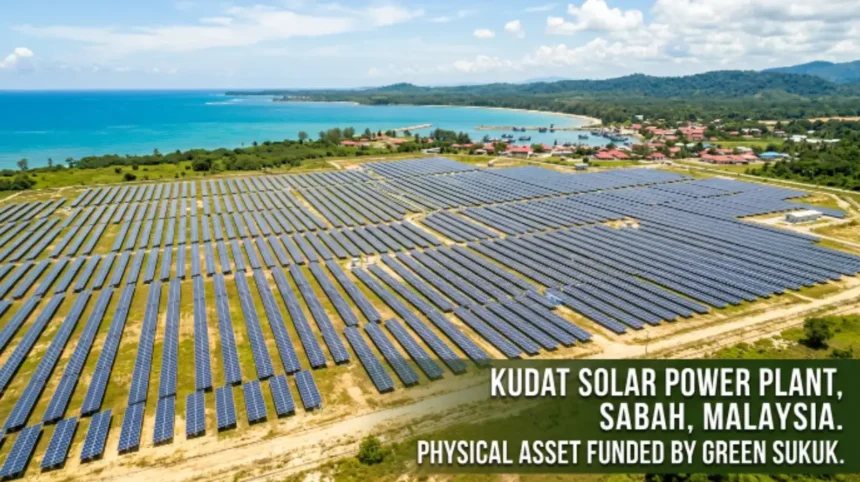
None of this is hypothetical. In 2017 Malaysia issued the world’s first green sukuk, funding large-scale solar plants in Kudat, Sabah. In 2018 Indonesia went one step further and sold the world’s first sovereign green sukuk, a $1.25 billion issue where every dollar of proceeds was ring-fenced for climate projects, with investors spread across the Islamic world, Asia, Europe and the US. Indonesia has kept issuing since, funding emissions cuts and climate adaptation, and independent reviewers verify where the money goes.
Malaysia now runs one of the deepest sukuk markets in the world. Its national power company has sold multi-tranche sustainability sukuk; hydroelectric and solar operators have raised project finance the same way. The government has floated a biodiversity sukuk of up to 1 billion ringgits to replant degraded forest and generate carbon credits from it. The global ESG sukuk market has passed $50 billion outstanding by 2025. It is still small next to the conventional green bond market, but it’s growing faster, and the direction of travel is clear.
The obvious objection here is greenwashing, and it’s fair. A green label is only as good as its verification, and Islamic finance is no more immune to loose standards than anyone else. But the asset-backing requirements give it a slight structural edge: it’s actually harder to fake a green sukuk when the rules already demand a real, identifiable asset sitting underneath the paper. Harder for sure, but not impossible. The scholars signing off are not climate scientists, and that gap between Sharia compliance and genuine environmental impact is exactly the seam where things can go wrong.
The East London Connection
This is not a distant story. London is the Western capital of Islamic finance, and has been deliberately building that position since 2014, when Britain became the first non-Muslim country to issue a sovereign sukuk, a £200 million deal that drew around £2.3 billion in orders. The London Stock Exchange now lists dozens of sukuk and has raised over £50 billion through them, more than any other non-Muslim jurisdiction. The legal expertise, the clearing infrastructure, the listing franchise all sit here.
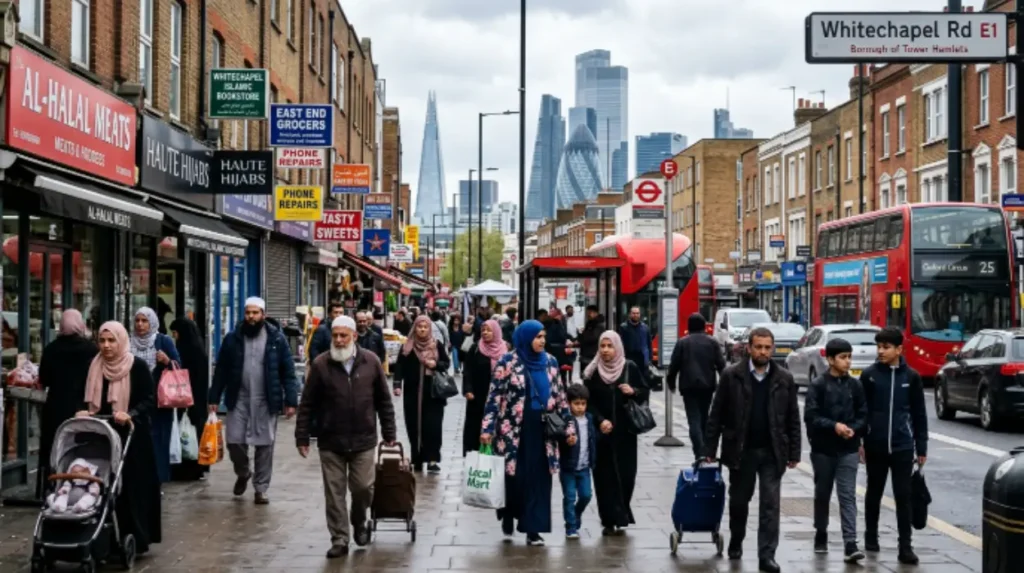
And the community that gives this relevance sits, in a large part, in East London. Tower Hamlets and Newham are among the most heavily Muslim boroughs in the country. For a lot of families here, the question of whether their savings, pensions and mortgages can be both faith-compliant and useful is not abstract; it literally shapes what they will touch. Platforms like Wahed built their UK base partly on that demand. From late 2026 the government will start offering Sharia- compliant student finance, the Alternate Student Finance scheme, after years of Muslim students being effectively locked out of interest-based loans. That’s a direct, concrete chance for young people in these boroughs, and it signals that Islamic finance is moving from the margins towards the mainstream of British financial life.
Now to connect the dots. East London is one of the parts of the city most exposed to the physical costs of climate change, sitting low against the Thames, short of green space, breathing some of the worst air in Britain. It is also home to a community with a deep, values-driven relationship to ethical finance and growing access to the instruments that could fund adaptation. A green sukuk issued in London, listed on the LSE, funding flood defences or retrofits or clean energy in the very boroughs whose residents want their money used ethically, isn’t a fantasy. The pieces are already on the table. Someone just needs to put the puzzle together.
Where I Land
I want to resist that temptation to oversell this, because that’s how good ideas are often discredited. Islamic finance won’t close the climate finance gap. It is too small, still too concentrated in a handful of markets, and it carries its own frictions: standardisation is patchy, scholars sometimes disagree on what qualifies, and a compliance structure is often more complex and more expensive to build than a conventional one. Anyone telling you it’s a silver bullet is selling something.
The honest version is narrower and, I believe, more useful. Here is a centuries-old system whose basic instincts, fund real things, share the risk, avoid pure speculation, screen out harm, think long-term, happen to be exactly the instincts that climate infrastructure rewards. That alignment is real, it’s already producing green sukuk in the billions, and the Western hub for it is a short walk from some of the communities that would most benefit. My prediction is that over the next five years, green and sustainability sukuk grow faster than the conventional green bond market, London issues at least one landmark green sovereign or municipal sukuk aimed partly at domestic infrastructure, and the ethical-saver crossover keeps pulling non-Muslim money into instruments most of them have never heard of.
The question in the headline was whether Islamic finance can help fund the green transition. The accurate answer is that it already is, quietly, in Jakarta and Kuala Lumpur, and that the more interesting question is why somewhere with London’s expertise and East London’s demand hasn’t done more of it yet. That one isn’t about theology or structure. It is about whether anyone with the power to arrange it decides it is worth their time. On current evidence, that’s the missing ingredient, and it’s the most fixable one.