
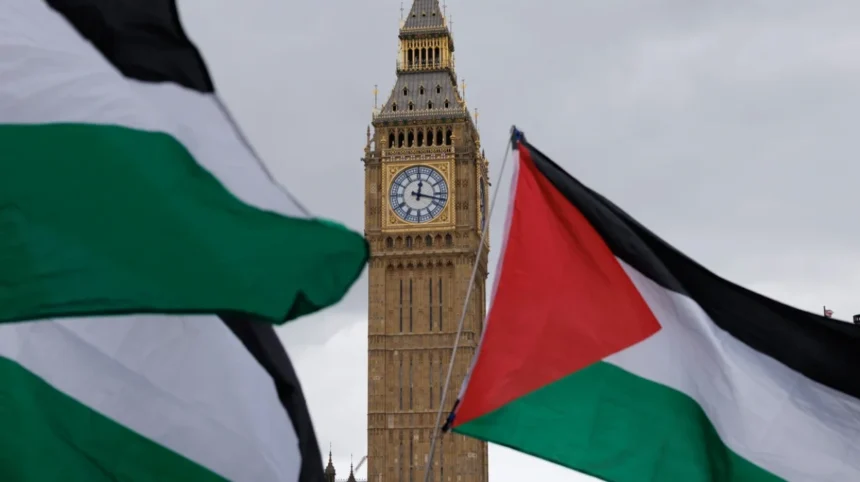
Britain’s recognition of Palestine was historic. But history is rarely made by declarations alone.
On 21 September 2025, the United Kingdom formally recognised the State of Palestine, joining Canada, Australia and a growing number of countries that support Palestinian statehood. The British government described the decision as an effort to protect the possibility of a two-state solution and create a path towards lasting peace.
Nearly a year later, the more difficult question is no longer whether Britain recognised Palestine.
It is what Britain intends to do with that recognition.
Recognition matters. It gives the Palestinian question a different diplomatic status and reinforces the principle that Palestinians have a right to self-determination. But recognition does not, by itself, change the realities on the ground. The British government has acknowledged as much.
That distinction is important.
From symbolism to policy
Diplomacy often begins with symbols.
Flags are raised. Statements are issued. Governments announce new positions.
Then comes the harder part: turning those positions into policy.
If Britain wants its recognition of Palestine to mean more than a diplomatic gesture, it needs to connect that decision to practical measures that can strengthen Palestinian institutions, support economic development and create the conditions for political stability.
The economic relationship between Britain and Palestine remains modest. UK government figures put total trade at around £38 million in 2025, including £27 million in services and £11 million in goods.
The figure is small. But perhaps that is precisely why the economic dimension deserves more attention.
Recognition will not suddenly create a functioning Palestinian economy. Nor can Britain build one on its own.
But it can help create a political environment in which Britain has a stronger reason — and greater responsibility — to support the institutions and economic foundations of a future Palestinian state.
That means more than humanitarian assistance.
It means supporting governance, education, infrastructure, entrepreneurship and the development of a credible environment for investment.
A state needs diplomatic recognition.
But it also needs institutions that work, an economy that can grow and people who can see a future for themselves.
Britain’s historical responsibility
There is another reason Britain’s decision carries unusual weight.
Britain’s relationship with Palestine is not simply a matter of contemporary diplomacy. British policy played a major role in the history of the region, from the Balfour Declaration through the Mandate period and its aftermath.
That history makes Britain’s present position particularly significant.
But historical responsibility should not become an argument for permanent political guilt. It should become an argument for responsible diplomacy.
Britain has an opportunity to use its diplomatic influence to support a political framework in which Palestinians can exercise their rights and Israelis can live with genuine security.
That requires balance.
A credible British policy cannot ignore Israeli security concerns. Nor can it ignore Palestinian rights and aspirations.
The objective should be a political environment in which two peoples can have a future without one requiring the disappearance, displacement or permanent subordination of the other.
Recognition is not a substitute for negotiations
There is a danger in international recognition: the ceremony can become the story.
But recognition does not establish final borders. It does not resolve the status of Jerusalem. It does not create functioning institutions or settle security arrangements. And it cannot, by itself, end the conflict.
Those questions still require diplomacy.
The British government has linked recognition to the viability of a two-state solution and has continued to call for reform within the Palestinian Authority. It has also said that recognition forms part of wider international efforts addressing governance, security, humanitarian access and the foundations of a future Palestinian state.
That is where the real test begins.
Recognition should be a spur to action, not a substitute for it.
The economic dimension cannot be ignored
Peace is usually discussed in political and security terms.
But people experience peace — or the absence of it — in economic terms too.
Young people need education. Businesses need investment. Workers need jobs. Families need functioning infrastructure. Governments need institutions capable of delivering basic services.
Without those foundations, political agreements can remain fragile.
For Britain, supporting Palestinian economic development should therefore not be viewed simply as aid.
It can also be understood as an investment in stability.
A more viable Palestinian economy could reduce dependence on emergency assistance, create opportunities for young people and strengthen the foundations of political stability.
But economic development cannot be separated from political reality.
Investment requires security.
Trade requires movement.
Businesses require predictable institutions.
And all three depend on a broader political settlement.
This is why the economic question should not be treated as an afterthought. If Britain genuinely wants to help make a future Palestinian state viable, economic policy has to be part of the diplomatic strategy from the beginning.
Britain’s wider influence
Britain’s decision also matters beyond its bilateral relationship with Palestine.
As a permanent member of the United Nations Security Council, the UK has a level of diplomatic influence that gives its decisions wider significance.
Recognition by Britain, alongside Canada and Australia, followed by France’s recognition, helped demonstrate that the diplomatic landscape was changing.
That does not guarantee political progress.
But diplomatic momentum can affect expectations. When major Western governments change longstanding positions, other governments begin reconsidering their own.
The question then moves from whether recognition is possible to what recognition is supposed to achieve.
That is an important shift.
What should Britain do next?
If recognition is to have lasting meaning, Britain should focus on five areas.
First, strengthening Palestinian institutions capable of delivering effective governance and public services.
Second, supporting economic development, particularly private-sector activity, education, technology and employment.
Third, working with international partners to create the conditions for reconstruction and long-term investment.
Fourth, maintaining diplomatic pressure for a negotiated political settlement that recognises the rights and security of both Palestinians and Israelis.
And fifth, judging British policy by results rather than announcements.
The last point may be the most important.
The international community has produced decades of statements about peace.
What has often been missing is not language.
It is implementation.
The real meaning of recognition
Britain’s recognition of Palestine should therefore not be judged only by the ceremony, the headlines or the diplomatic symbolism.
It should be judged by what follows.
Did it help strengthen Palestinian institutions?
Did it encourage investment and economic opportunity?
Did it improve the conditions for serious negotiations?
Did it contribute to a credible political pathway towards two states?
And did it help create a future in which both Palestinians and Israelis can live with security and dignity?
Those are much harder questions than whether Britain should recognise Palestine.
But they are the questions that matter now.
Britain has recognised Palestine.
The next challenge is to make that recognition meaningful.
Diplomacy can change a country’s status on paper. The harder task is turning that decision into institutions, opportunity and a credible path towards peace.