
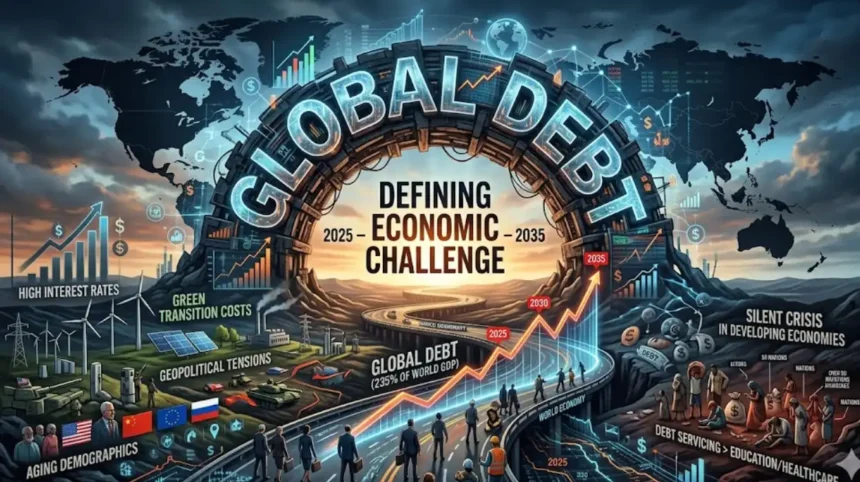
As governments, businesses, and households continue to navigate an uncertain economic landscape, a growing number of economists are warning about a risk that receives far less public attention than inflation or recession fears: the rapid expansion of global debt.
Over the past decade, borrowing has become a central pillar of economic growth. Low interest rates encouraged governments to finance public spending, companies to expand operations, and consumers to increase spending through credit. While this strategy helped sustain growth during periods of economic weakness, it also created a financial environment heavily dependent on debt.
Today, the world is entering a new phase. Interest rates are significantly higher than they were during most of the previous decade, economic growth has moderated, and governments face increasing fiscal pressures. Under these conditions, debt is no longer simply a tool for growth; it is becoming a potential source of vulnerability.
According to international financial estimates, total global debt has exceeded $300 trillion, a figure that represents several times the value of annual global economic output. While debt itself is not necessarily harmful, the speed at which it has accumulated raises important questions about long-term sustainability.
One of the most significant concerns is the rising cost of servicing that debt. During the era of near-zero interest rates, borrowing costs remained relatively manageable. Governments could refinance existing obligations at low rates, and businesses could access capital with limited financial strain. That environment has changed dramatically.
As central banks raised interest rates to combat inflation, the cost of borrowing increased across the global economy. Governments now allocate larger portions of their budgets to interest payments. Companies face higher financing expenses, while households encounter increased costs for mortgages, loans, and consumer credit.
The consequences extend beyond balance sheets. Higher debt servicing costs can limit investment, reduce public spending flexibility, and weaken economic resilience during future downturns. In some cases, governments may be forced to delay infrastructure projects, reduce social spending, or increase taxes to maintain fiscal stability.
Emerging economies face particularly complex challenges. Many developing countries borrowed heavily during periods of abundant global liquidity. Today, these nations must manage higher debt obligations while simultaneously coping with slower growth, currency volatility, and external economic shocks.
Debt sustainability becomes especially difficult when economic growth slows. Historically, countries have often relied on growth to reduce the relative burden of debt over time. However, if growth remains modest while borrowing costs remain elevated, debt levels can become increasingly difficult to manage.
Another concern involves the interaction between debt and geopolitical uncertainty. Global markets are already dealing with trade tensions, regional conflicts, and shifting supply chains. These developments can reduce investor confidence and increase financing costs, creating additional pressure on highly indebted economies.
Financial markets have so far remained relatively resilient. Investors continue to view many major economies as capable of meeting their obligations. Nevertheless, resilience should not be confused with immunity. Economic history demonstrates that financial vulnerabilities often build gradually before becoming visible.
The challenge is not limited to governments. Corporate debt has expanded significantly across many sectors. While large multinational companies often possess substantial financial resources, smaller firms may struggle to refinance obligations in a high-interest-rate environment. This can reduce hiring, limit expansion, and weaken business investment.
At the household level, debt also influences economic behavior. Rising borrowing costs reduce disposable income and may discourage spending. Since consumer demand remains one of the most important drivers of economic activity in many countries, this effect can have broader implications for growth.
Yet it would be misleading to view debt solely as a threat. Borrowing remains an essential component of modern economies. The issue is not the existence of debt itself, but whether it is being used productively and managed responsibly. Investments in infrastructure, innovation, education, and productive industries can generate long-term returns that outweigh borrowing costs.
The central question for policymakers is therefore not how to eliminate debt, but how to ensure that debt contributes to sustainable growth rather than future instability. Achieving this balance requires credible fiscal planning, disciplined public spending, and policies that encourage productivity and investment.
Looking ahead, global debt is likely to remain one of the most important economic issues of the coming decade. Inflation may rise and fall. Interest rates may eventually decline. Economic cycles will continue. However, the structural challenge posed by historically high debt levels is unlikely to disappear quickly.
For investors, businesses, and governments alike, the next decade may ultimately be defined not by how much debt exists, but by how effectively economies manage it. The countries that succeed in balancing growth, fiscal discipline, and long-term investment are likely to emerge stronger in an increasingly complex global economic environment.
In a world already confronting geopolitical uncertainty, technological disruption, and shifting trade dynamics, debt may prove to be the quiet risk that shapes the future of the global economy more than any other factor.