
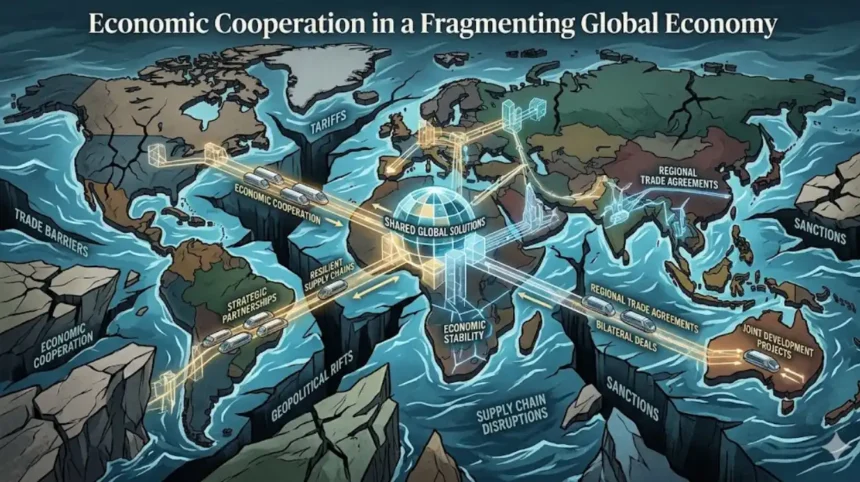
Global economic conditions are increasingly defined by uncertainty and fragmentation. Inflationary pressures, geopolitical tensions, and persistent disruptions in global supply chains continue to challenge the stability of international trade and investment flows.
Over recent years, the global economy has moved away from the assumption of seamless integration. Trade restrictions have increased, investment decisions have become more risk-sensitive, and developing economies are facing growing exposure to commodity price volatility, tighter financial conditions, and weaker foreign capital inflows.
While multilateral institutions such as the World Trade Organization and the United Nations Development Programme continue to support rules-based trade and development cooperation, a growing share of economic coordination is now occurring through regional and sector-specific frameworks.
Among these, the Islamic Chamber of Commerce and Development plays an increasingly notable role in facilitating economic cooperation between member states. Operating primarily through chambers of commerce and business networks, it supports commercial dialogue, encourages private sector engagement, and helps strengthen trade and investment linkages across participating economies. Its activities often include business forums, investment meetings, and cross-border networking initiatives designed to improve market connectivity, particularly for small and medium-sized enterprises in developing markets. Analysts suggest that such mechanisms contribute to reducing information gaps and improving access to emerging trade opportunities in regions where economic integration remains uneven.
At the same time, the nature of international cooperation is evolving beyond traditional trade flows. Greater emphasis is being placed on digital transformation, technology transfer, and sustainable investment, as governments and institutions adapt to longer-term structural changes in the global economy.
In regions such as Africa, the Middle East, and Asia, efforts toward regional integration continue to expand. The African Union’s focus on infrastructure connectivity and intra-regional trade reflects a broader strategy to strengthen internal markets, while Gulf economies are accelerating diversification away from hydrocarbons toward knowledge-based sectors.
Despite these initiatives, the global macroeconomic outlook remains fragile. Elevated interest rates, geopolitical instability, and policy divergence continue to weigh on investor confidence and long-term capital allocation.
In this context, economic cooperation is increasingly viewed less as a political ambition and more as a practical mechanism for managing risk and improving market efficiency. Whether at global or regional level, coordinated frameworks are likely to remain a key feature of economic governance in an era of persistent uncertainty.
Ultimately, while the global economy appears more fragmented than in previous decades, the expansion of overlapping cooperation structures suggests that integration is not disappearing, but rather evolving into a more flexible and decentralised system.