
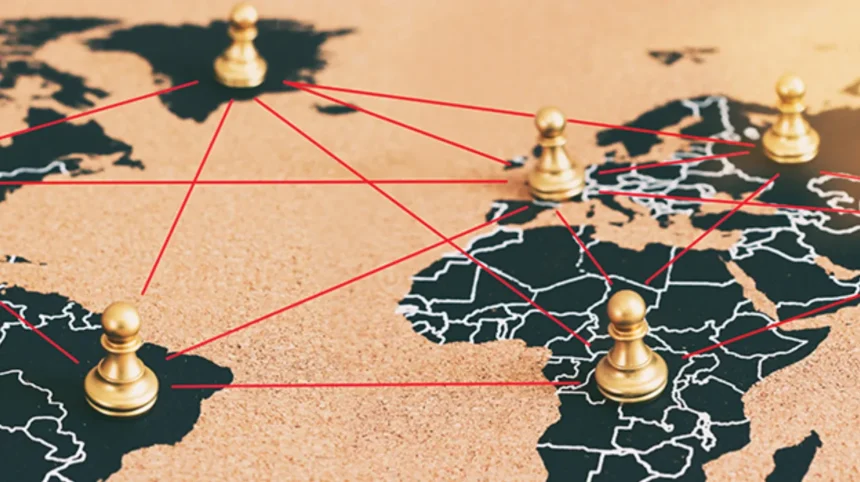
The global landscape is entering a period of heightened tension, where political conflicts and economic pressures are no longer separate challenges, but deeply interconnected forces shaping the future of international relations.
Recent developments highlight this shift clearly. Ongoing tensions between major powers such as United States and China continue to influence global trade, technology, and investment flows. What was once economic competition has increasingly evolved into strategic rivalry, affecting not only bilateral relations but the broader global economy.
At the same time, the war in Ukraine has had far-reaching consequences well beyond its borders. Energy markets have been disrupted, food supply chains strained, and inflationary pressures intensified across multiple regions. This conflict has demonstrated how regional instability can rapidly transform into a global economic challenge.
In parallel, tensions in the Middle East continue to shape global energy dynamics. The region remains central to oil and gas flows, making it a key factor in global price stability. Any escalation or uncertainty can quickly translate into volatility in international markets, reinforcing the strategic importance of energy in geopolitical calculations.
This convergence of crises is not coincidental—it reflects a structural transformation in the global system. Countries are increasingly rethinking their economic dependencies, while corporations are restructuring supply chains to reduce exposure to geopolitical risk. The result is a gradual shift away from a highly integrated global economy toward a more fragmented and strategically aligned system.
One of the most significant consequences of this transformation is the growing link between security and economics. Governments are no longer focused solely on efficiency or cost reduction. Instead, they are prioritizing resilience, diversification, and national security. This includes investing in domestic production, securing critical resources, and forming strategic alliances.
Trade policies are also evolving in response to these dynamics. Export controls, tariffs, and regulatory barriers are becoming more prominent, reflecting a shift toward protection and strategic competition. While these measures are often justified on national security grounds, they also contribute to increasing complexity and cost within the global economic system.
For global markets, this environment creates new layers of uncertainty. Investors must now account for political risk alongside economic indicators, while businesses face challenges in long-term planning. Supply disruptions, shifting regulations, and changing alliances all add to the unpredictability of global operations.
The impact of these changes is not limited to governments and corporations—it is increasingly felt at the societal level. Rising energy prices, inflation, and cost-of-living pressures are affecting households worldwide. What begins as geopolitical tension often ends as economic strain for ordinary people, linking global events directly to everyday life.
Emerging economies face particular vulnerability in this context. With limited control over global supply chains or pricing mechanisms, they are more exposed to external shocks. This can lead to currency instability, fiscal pressure, and social challenges, especially in times of prolonged uncertainty.
Despite these challenges, the current moment also represents a turning point. The global system is not collapsing, but evolving. Instead of a single, deeply interconnected framework, the world appears to be moving toward multiple centers of power, each with its own economic networks and strategic priorities.
This shift could redefine globalization itself. Rather than open and universal integration, the future may be characterized by selective partnerships and regional blocs, where political alignment plays a central role in economic cooperation.
Ultimately, the world is not simply experiencing a series of isolated crises. It is undergoing a broader transformation, where power, economics, and politics are being redefined simultaneously. The decisions made today—by governments, institutions, and global leaders—will shape the structure of the international system for years to come.
Understanding this transition is essential. In a world increasingly defined by uncertainty and competition, the ability to interpret these interconnected dynamics will be critical for policymakers, businesses, and societies alike.