Montenegro draws interest from East London communities in Newham, Hackney, Tower Hamlets, and Havering. Diverse residents from these boroughs trace roots to the Balkans, fueling demand for Montenegro travel insights. The country covers 13,812 square kilometers with 620,000 residents.
- What is Montenegro?
- Where is Montenegro located?
- What is the history of Montenegro?
- What are the main geographical features of Montenegro?
- What is the capital of Montenegro?
- What are the top attractions in Montenegro?
- What is the best time to visit Montenegro?
- How do you get to Montenegro?
- What is the economy of Montenegro based on?
- What should you know about Montenegrin culture?
- What are the main cities in Montenegro?
- What wildlife exists in Montenegro?
What is Montenegro?
Montenegro is a Balkan nation in Southeastern Europe bordering the Adriatic Sea, covering 13,812 square kilometers with 620,000 residents. It declared independence from Serbia and Montenegro in 2006 after a referendum where 55.5 percent voted yes. The capital is Podgorica, and the country features mountains, coastlines, and national parks.
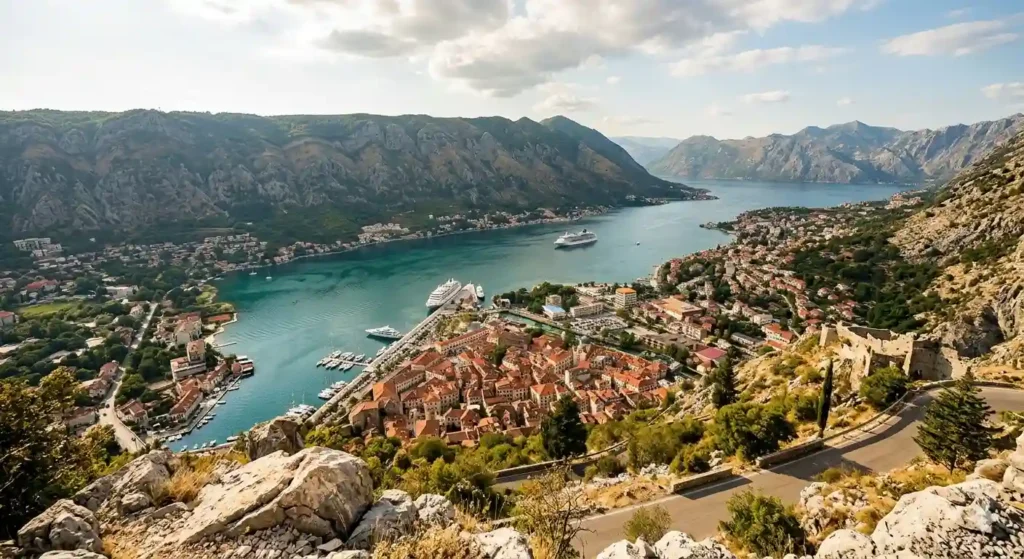
Montenegro occupies the western Balkan Peninsula. Its terrain includes the Dinaric Alps, which rise to 2,534 meters at Zla Kolata, the highest peak. The Adriatic coastline defines the southwest, with the Bay of Kotor as a central fjord-like inlet.
East London residents from Tower Hamlets often explore these features, given shared Mediterranean influences in local cuisine. Population centers in coastal areas like Budva and Kotor attract Hackney travelers. Podgorica, the administrative capital, houses 150,000 people. Cetinje serves as the historical and cultural capital with royal palaces from the Petrović dynasty. Official languages are Montenegrin, Serbian, Bosnian, Albanian, and Croatian.
Montenegro joined the United Nations in 2006. It uses the euro as currency despite lacking European Union membership. Tourism drives 25 percent of GDP, drawing 2.5 million visitors annually, including groups from East London’s Havering borough. National parks cover 10 percent of land, preserving biodiversity with 250 bird species and brown bears.
Where is Montenegro located?
Montenegro sits on the Adriatic Sea in Southeastern Europe, bordered by Croatia to the west, Bosnia and Herzegovina to the northwest, Serbia to the east, Kosovo to the southeast, and Albania to the south. Its 295-kilometer coastline forms part of the 76,214-square-kilometer Bay of Kotor UNESCO site. Coordinates center at 42.7087° N, 19.3744° E.
The country spans from the Gulf of Kotor at sea level to Durmitor National Park at 2,500 meters elevation. It covers 250 kilometers north-south and 100 kilometers east-west at widest points. The Zeta Valley hosts Podgorica, while the Lovćen massif overlooks the bay.
Proximity to Italy across the Adriatic allows ferry links from Bar to Bari, 220 kilometers distant. Inland, the Tara River Canyon measures 1,300 meters deep, Europe’s deepest. Major airports operate in Podgorica and Tivat, handling 2 million passengers yearly, with direct flights accessible from East London via Luton Airport.
Coastal Montenegro aligns with the Balkan Riviera, extending from Croatia’s Dubrovnik to Albania’s Saranda. This positions it 1,000 kilometers south of Vienna and 500 kilometers north of Athens. Road networks connect via the E65 highway to Dubrovnik, 100 kilometers away. Newham residents favor these routes for affordable group trips.
What is the history of Montenegro?
Montenegro emerged as an independent principality in 1878 under the Petrović-Njegoš dynasty after centuries of Ottoman resistance. It unified with Serbia in 1918, became a republic in socialist Yugoslavia in 1945, and regained sovereignty in 2006 via referendum. Key events include the 1941-1945 partisan resistance and 1990s wars.
Prehistoric Illyrian tribes inhabited the region by 1000 BCE. Romans conquered it in 168 BCE, naming it Doclea after local tribes. Slavic migrations arrived in the 7th century CE, establishing Zeta as a medieval state.
The Crnojević dynasty ruled from 1435, printing the first South Slavic book in 1494. Battles against Ottomans preserved autonomy; the 1878 Congress of Berlin recognized independence. King Nikola I reigned until 1918 annexation into Yugoslavia.
World War II saw 13 percent population loss in battles. Post-1945, it formed the Socialist Republic of Montenegro within Yugoslavia. Slobodan Milošević’s 1989 takeover sparked unrest. The 1992-1995 Bosnian War displaced 100,000 refugees.
The 2003 State Union with Serbia dissolved in 2006 after 55.5 percent voted for independence on May 21. NATO membership talks began in 2015; accession occurred in 2017. EU candidacy started in 2010, with negotiations from 2012. East London Times readers in Hackney connect through diaspora stories from this era.
What are the main geographical features of Montenegro?
Montenegro features a 295-kilometer Adriatic coastline, Bay of Kotor fjord, Tara Canyon at 1,300 meters deep, Durmitor massif with 48 peaks over 2,000 meters, Lake Skadar at 400 square kilometers, and Biogradska Gora rainforest. Mountains cover 80 percent of 13,812 square kilometers.
The Dinaric Alps dominate, with Durmitor National Park spanning 390 square kilometers and 25 trails. Black Lake, at 3.6 square kilometers, freezes in winter. Tara National Park protects the 146-kilometer Tara River, a UNESCO biosphere reserve.
Lake Skadar, shared with Albania, hosts 270 bird species and lily pads covering 25 square kilometers. The Bay of Kotor stretches 30 kilometers inland, ringed by 1,000-meter cliffs. Luštica Peninsula offers 30 kilometers of beaches.
Prokletije mountains in the northeast reach 2,694 meters at Komovi peak. Biogradska Gora preserves Europe’s last virgin forests over 5,000 hectares. Karst sinkholes and 200 caves, including Lipa in Durmitor, define hydrology.
Coastal plains yield olives and citrus; highlands support pastures. Annual precipitation averages 2,500 millimeters in mountains, feeding 150 rivers. Tower Hamlets birdwatchers target Lake Skadar for pelican migrations.
What is the capital of Montenegro?
Podgorica is the capital and largest city of Montenegro, with 150,000 residents in the greater area. It replaced wartime-devastated Titograd name in 1992 and serves as administrative, economic, and cultural hub. Located in Zeta Valley at 45 meters elevation, it spans 1,441 square kilometers.
Podgorica lies 60 kilometers northeast of the coast on the Moraca River. Founded as Roman Doclea in 1st century CE, it grew post-1945 reconstruction. The city hosts parliament, government buildings, and University of Montenegro with 25,000 students.
Key sites include Millennium Bridge, 173 meters long over Moraca, and Ostrog Monastery 15 kilometers south, carved into cliffs in 17th century. Central Park covers 11 hectares with fountains. Annual GDP per capita reaches 8,000 euros.
Ribnica fortress remnants date to 1480. Modern districts feature Soviet-style blocks alongside malls like Delta City. Airports handle 1.2 million passengers yearly. East London professionals from Newham visit for business conferences here.
What are the top attractions in Montenegro?
Top attractions include Bay of Kotor UNESCO site, Durmitor National Park with Black Lake, Ostrog Monastery, Sveti Stefan island resort, Budva Old Town, Tara Canyon, Lake Skadar, and Lovćen National Park with Njegoš Mausoleum. These draw 2.5 million tourists yearly.
Bay of Kotor spans 87 square kilometers with fortified towns Kotor and Perast. Kotor’s walls climb 1,350 steps to Saint John’s Fortress. Perast features Our Lady of the Rocks, artificial island built 1632 with 17th-century church.
Durmitor offers rafting on Tara River, Europe’s deepest canyon at 1,300 meters. Black Lake loops 3.7 kilometers. Sveti Stefan, a 15th-century village-turned-hotel, hosts celebrities on 12th-century coral reefs.
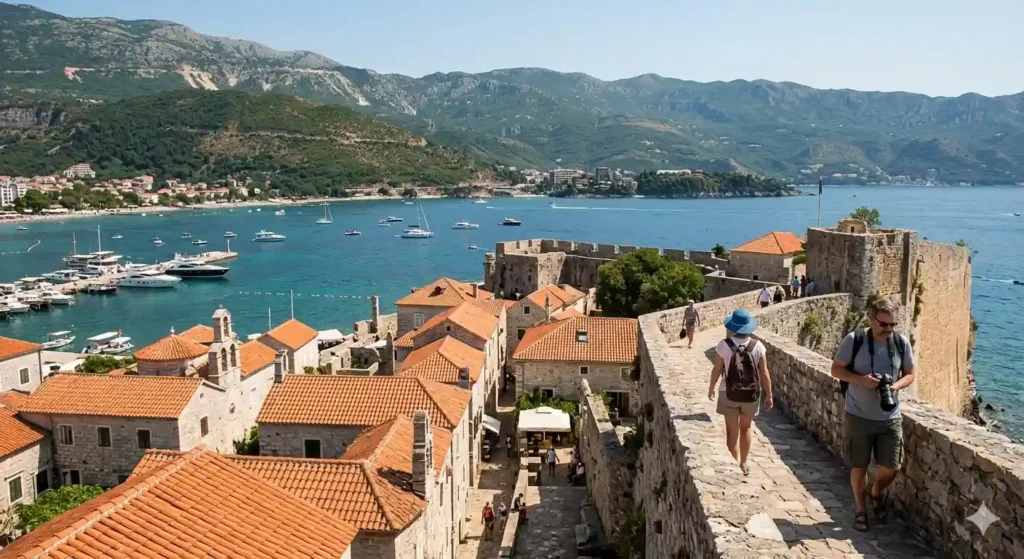
Budva Citadel dates to 1425, guarding 35 beaches. Ostrog clings to 900-meter cliffs, drawing 1 million pilgrims for Saint Basil relics. Lake Skadar boat tours spot pelicans; Lovćen summit at 1,749 meters overlooks four states.
Porto Montenegro marina berths 800 yachts. Herceg Novi forts span five centuries. Havering families book Budva for summer beach holidays.
What is the best time to visit Montenegro?
Visit Montenegro from May to September for Adriatic swimming, with July-August peaking at 30°C air and 24°C sea temperatures. Shoulder months April-May and September-October offer fewer crowds and 20-25°C weather. Winters suit skiing in Durmitor with 4-meter snowpack.
Summer brings 12 sunlight hours daily; rainfall drops to 50 millimeters monthly. Coastal water reaches 26°C in August. Hotels fill 90 percent; prices rise 50 percent.
Spring wildflowers bloom in Cetinje fields; Lake Skadar waterfowl peak March-April. Autumn harvests figs and grapes; Tara foliage turns gold October.
Winter lows hit 5°C coastal, -10°C mountains. Bjelasica hosts 20 ski lifts. Avoid November floods averaging 400 millimeters rain.
Year-round average: 14°C, 1,600 millimeters precipitation. UV index hits 9 in July. East London Times recommends May for budget East London group tours.
How do you get to Montenegro?
Fly into Podgorica or Tivat airports via 50 European hubs; Ryanair and Wizz Air serve from London Luton and Stansted, 2.5-hour flights popular with East London residents. Buses from Dubrovnik take 3 hours; ferries from Bari Italy cross 8 hours weekly. Drive E65 from Croatia.
Podgorica handles 1.5 million passengers; Tivat focuses coastal routes. Dubrovnik Airport, 90 kilometers away, connects via bus. Bar port welcomes 400 cruise ships yearly.
Trains from Belgrade cover 400 kilometers in 10 hours. Car rentals start at 30 euros daily; vignettes cost 25 euros for highways.
Borders require passports; EU citizens drive freely. Taxis from Tivat to Kotor cost 20 euros. Direct flights from East London’s airports cut travel time for Tower Hamlets adventurers.
What is the economy of Montenegro based on?
Montenegro’s economy relies on tourism at 25 percent of GDP, generating 2 billion euros yearly from 2.5 million visitors. Other sectors include aluminum exports at 15 percent, agriculture with 15 percent workforce, and hydropower from 5 plants producing 2,800 megawatts.
GDP totals 7.3 billion euros in 2026, with 5 percent growth. Unemployment stands at 15 percent; average wage 850 euros monthly. Kolašin aluminum plant exports to 30 countries.
Olives produce 20,000 tons yearly; wine regions yield 2 million liters. Porto Montenegro adds yacht services worth 100 million euros.
EU funds support 1 billion euros in infrastructure since 2012. Foreign investment reaches 500 million euros annually in real estate. Newham businesses eye tourism partnerships.
What should you know about Montenegrin culture?
Montenegrin culture blends Orthodox Christianity (72 percent population), epic poetry from Njegoš’s 1847 Mountain Wreath, kafana tavern music, and cuisine with 200 prosciutto types aged 18 months. Festivals include Kotor Carnival in February and Perast boat regattas July.
72 churches operate, including Cetinje monasteries from 1485. Folk costumes feature gold embroidery; gusle instruments accompany tales of battles.
Cuisine centers njeguški pršut, smoked over beech 3 months, and kačamak cornmeal. Rakija spirit averages 50 percent alcohol; 10 liters per capita yearly.
Sports emphasize water polo; national team won 2008 Olympic silver. Football club Sutjeska fields 10,000 fans. Hackney’s Balkan communities share these traditions at local events.
What are the main cities in Montenegro?
Main cities are Podgorica (capital, 150,000 residents), Budva (tourism hub, 25,000), Herceg Novi (bay entrance, 22,000), Bar (port, 15,000), Bijelo Polje (industrial, 15,000), and Pljevlja (coal mining, 19,000). Coastal cities host 60 percent population.
Budva walls enclose 15th-century churches; 2 million visitors yearly. Herceg Novi spans 7 kilometers promenade with 5 forts.
Bar railway museum displays 1893 locomotives. Nikšić brewery produces 300,000 hectoliters beer annually.
Coastal cluster from Ulcinj to Herceg Novi totals 200,000 residents. East London Times highlights Budva for family trips from Havering.
What wildlife exists in Montenegro?
Montenegro hosts brown bears (150 individuals), wolves (200 packs), lynx (50), golden eagles (300 pairs), and 260 bird species in Lake Skadar. Durmitor shelters chamois (1,000) and 300 plant endemics. Protected areas cover 10 percent land.
Tara Canyon protects otters and griffon vultures. Biogradska Gora rainforest shelters deer (400) and 160 butterfly species.
Marine life includes monk seals (rare) and 40 Adriatic fish types. Poaching reduced bears 20 percent since 2000.
National parks log 500,000 wildlife sightings yearly. East London nature enthusiasts from Newham plan guided tours.
Is Montenegro worth visiting or is it overrated?
Montenegro is widely considered worth visiting due to its mix of beaches, mountains, and historic towns like Kotor and Budva. It’s often seen as a quieter, cheaper alternative to Croatia.