
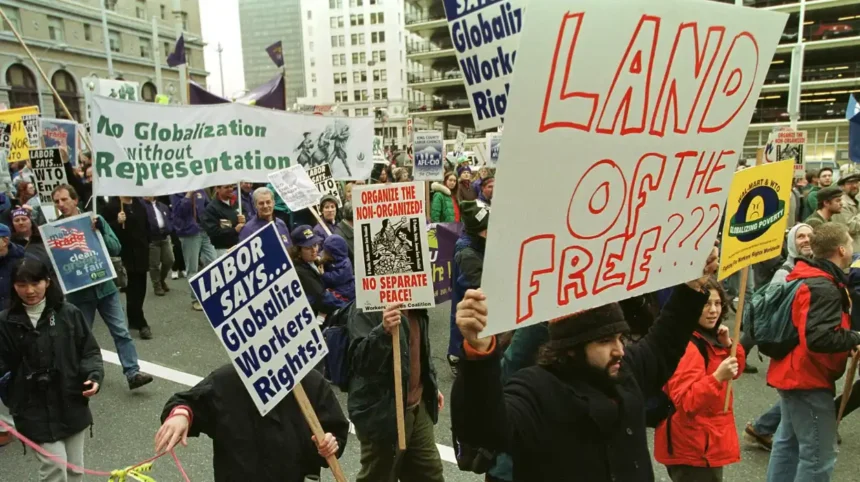
For decades, the global economy was built on efficiency. Supply chains stretched across continents, production followed the lowest cost, and markets became deeply interconnected. That model is now under pressure—not because it failed, but because the risks around it have changed.
Governments and corporations are no longer optimizing for cost alone. They are prioritizing resilience, security, and control.
This shift is already visible across global supply chains. Companies are moving production closer to home or toward politically aligned countries, a strategy often described as “nearshoring” or “friend-shoring.” What was once a purely economic decision has become increasingly political.
The change reflects a broader recalibration. Global integration is giving way to selective interdependence.
Trade policies are reinforcing this trend. Export controls, tariffs, and regulatory barriers are no longer exceptions—they are becoming structural features of the global system. These measures are designed to protect national interests, but they also contribute to a more fragmented economic landscape.
Energy markets offer a clear example. Instead of a unified global flow, energy trade is increasingly shaped by geopolitical alignment. Long-term agreements and strategic partnerships are replacing open-market dynamics, particularly in times of uncertainty.
The result is not the end of globalization, but its evolution into a more complex system. Rather than one integrated global market, the world is moving toward multiple overlapping economic blocs—connected, but less dependent on one another.
This transformation carries economic consequences. Fragmentation can increase costs, reduce efficiency, and introduce new layers of risk. At the same time, it creates opportunities for regions and companies able to adapt to shifting trade patterns.
For policymakers, the challenge is balancing security with growth. For businesses, it is navigating a system where political alignment matters as much as economic logic.
Globalization isn’t disappearing. It is becoming more strategic, more selective—and ultimately, more fragmented.