Key Points
- Nigel Farage has said he is “in no doubt” Reform UK will win Havering in the London local elections.
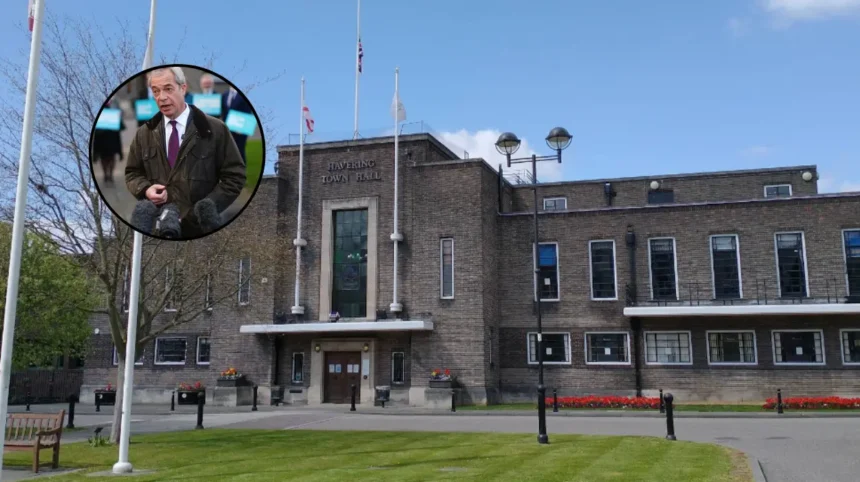
- He said his first press call on the morning of May 8 would be outside Havering Town Hall at about 7.30am.
- Farage said Reform is also “very much in contention” in Barking and Dagenham, Bexley and Bromley.
- He said Reform is “vying to be the biggest party” in Croydon, where the council could end up with no overall control.
- Farage also named Hillingdon, Barnet and Ealing as boroughs where he is optimistic Reform can win seats.
- He said London could become a “multi-coloured quilt” as the votes are split between several parties.
- The Standard’s exclusive interview also linked Reform’s campaign to wider expectations of gains by the Greens in London.
- BBC reporting has also identified Havering as a key target for Reform in the local elections.
Havering (East London Times) May 6, 2026 – Nigel Farage has said Reform UK is on course to win Havering and may also challenge in several other outer London boroughs as the capital heads into a politically fragmented local election night.
As reported by Nicholas Cecil of The London Standard, Mr Farage told the paper in an exclusive interview that there was “no doubt” in his mind that Reform would win Havering, adding that he felt “very confident” the party would take the council.
He said the party’s first public move on the morning after the vote would be a press call outside Havering Town Hall at about 7.30am on 8 May, underlining the confidence he expressed in the interview.
Which boroughs did Farage name?
Farage also named Barking and Dagenham, Bexley and Bromley as boroughs where Reform is “very much in contention”, according to The Standard. He said Croydon was a place where Reform was “vying to be the biggest party” on the council, which may end up with no overall control. He additionally said Reform was optimistic about winning seats in Hillingdon, Barnet and Ealing.
Why is Havering a focus?
BBC reporting has described Havering Council as a key target for Reform in the upcoming elections, reflecting the borough’s importance in the party’s wider London strategy.
Separate reporting from London Centric also said outer boroughs such as Havering, Bromley, Bexley and Hillingdon are central to Reform’s effort to build a political base in the capital. That broader context helps explain why Farage singled out Havering in such direct terms.
What did Farage say about London politics?
Farage said London, which he described as traditionally “red in the middle and blue on the outside”, could become a “multi-coloured quilt” after the vote.
He said the result would be hard to call because votes were being split in several directions, and suggested there could be places where 24% of the vote might be enough to win seats. The Standard also reported that he linked this landscape to expected gains by the Greens across the city.
How are other reports framing the race?
The BBC said Farage visited Romford Market with local supporters during the campaign, showing how much attention Reform has given to Havering.
The Standard’s earlier comment piece also said Reform would be highly competitive in outer London boroughs including Bexley, Bromley, Havering, Redbridge, Barking and Dagenham and Croydon. Taken together, the reporting points to a campaign focused on outer London rather than the city’s traditional political core.
Background of the development
Reform UK’s push into London comes against the backdrop of a fragmented local political picture, where votes are spread across more parties than in previous cycles.
Outer London boroughs have become the main battleground because they are seen as more open to challenge than inner London areas.
Havering has emerged as one of the clearest test cases for whether Reform can translate national momentum into local control.
What could happen next?
If Reform performs strongly in Havering, it could strengthen the party’s claim that it can win council power in London rather than only compete for protest votes. A result in boroughs such as Barking and Dagenham, Bexley, Bromley or Croydon would also shape perceptions of whether the party can broaden its appeal across outer London. For local voters, the immediate impact would be on who runs council services, budgets and local priorities after the count.