Key Points
- Reform UK MP Andrew Rosindell has issued a statement from the Havering Daily insisting that the Older Person’s Freedom Pass “is safe” and warning that claims it may be lost if Havering distances itself from London are misleading.
- Rosindell says Havering Council, not the Mayor of London or Transport for London (TfL), currently funds the Freedom Pass via payments to TfL based on pensioners’ usage of the network.
- He cites a figure of £7,286,083 paid by Havering Council to TfL in one year to fund Freedom Pass journeys for older and disabled residents.
- Rosindell points to his private‑member’s bill, the TfL Extension of Concessions Bill (Parliament Bill 4008), which would enshrine the Freedom Pass and other TfL concessions into statute for all areas served by TfL, including boroughs such as Brentwood and Epping Forest.
- He argues that the Freedom Pass predates the current Greater London Authority and the office of the Mayor and that it is not a “gift” from Sadiq Khan or TfL.
- Rosindell asserts that Havering could revert to being a fully unitary authority while still remaining part of Greater London, citing the abolition of the Greater London Council in 1986 as a precedent where core services, including transport, policing and fire, continued without disruption.
- He claims that the current Mayor and GLA have taken “hundreds of millions” in funding from Havering without delivering equivalent local benefits and says reforming the local‑government funding formula is key to protecting the pass.
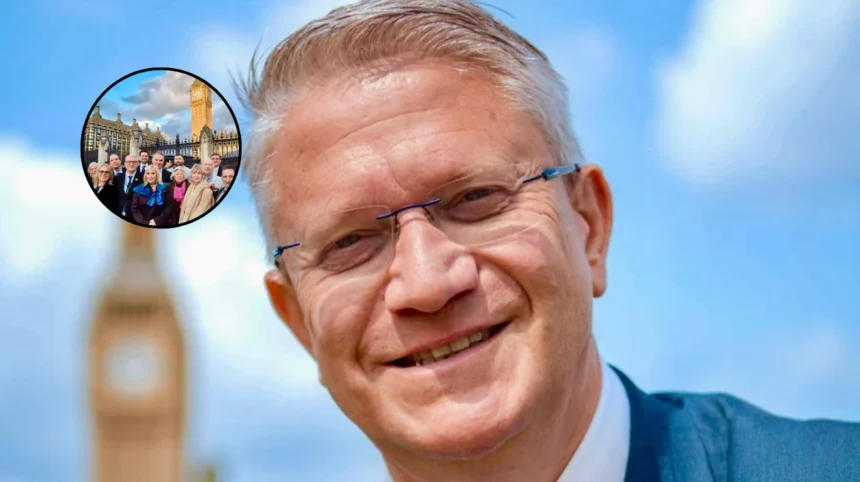
Havering (East London Times) April 20, 2026 In a piece published in the Havering Daily, Rosindell, the Reform UK Member of Parliament for Romford, framed the Freedom Pass as a non‑negotiable lifeline for pensioners and vowed that he “will never allow the Freedom Pass to be taken away for as long as I remain the MP for Romford”.
- Key Points
- How did the Freedom Pass row start?
- What is Rosindell claiming about Havering’s funding of the Freedom Pass?
- Is the Freedom Pass still under threat?
- What is the TfL Extension of Concessions Bill?
- Why is Havering’s status within London politically sensitive?
- How are other local politicians responding?
- Background to the Freedom Pass debate
- Prediction: How this development could affect Havering’s older residents
How did the Freedom Pass row start?
In early 2026, London Councils – the cross‑party body representing London’s 32 boroughs and the City of London – agreed to a new funding settlement for the Freedom Pass, raising the annual concession‑card contribution from £465,000 to £581,000 for the 2026‑27 financial year.
The BBC later reported that this move forms part of a wider discussion about the long‑term costs of the scheme, with some councils looking at possible restrictions or even scrapping aspects of the pass.
As reported by The Havering Daily, Havering councillors and local politicians reacted strongly when news emerged that proposals were being floated to cut back or even remove Tube and rail access for Freedom Pass holders, warning that older residents in the borough would be “isolated” and “cut off” from essential services. Havering Cabinet Member Barry Mugglestone, speaking to the same outlet, insisted that Havering “is totally against any reduction in the Freedom Pass” and promised to carry that message to London Councils.
What is Rosindell claiming about Havering’s funding of the Freedom Pass?
Rosindell argues that claims the pass is “dependent” on Havering remaining under the Mayor of London and the Greater London Authority are “entirely false”.
In his statement and in the Havering Daily article, he stresses that the Freedom Pass scheme existed before the current GLA structure and that Havering Council directly funds it based on how often local residents use the network.
He cites a specific figure: Havering Council paid a total of £7,286,083 to TfL in one year
“to fund the cost of the Freedom Pass for Havering’s pensioners and disabled people”.
This figure underpins his argument that the pass is locally funded rather than being a gift from the Mayor or TfL, even though travel is provided on TfL‑operated services such as buses, the Tube, DLR, London Overground, the Elizabeth line and many National Rail services within the capital.
Is the Freedom Pass still under threat?
According to reports from the BBC and The Havering Daily, London Councils has agreed to pay more for Freedom Pass cards in 2026‑27, up from £465,000 to £581,000, but this has been accompanied by internal discussions about the overall cost of the scheme.
The BBC notes that implementing changes to the pass could potentially save London councils “upwards of £100 million annually”, which helps explain why some proposals to restrict peak‑time travel or remove rail access have surfaced.
In January 2026, Rosindell responded to these reports by saying that the idea of scrapping the Freedom Pass
“will come as a shock to many, especially to pensioners in Havering, for whom the Freedom Pass is vital to their everyday lives”.
He described the proposal as “dreadful” and warned that it would “spread fear and anger” among older residents who depend on the pass.
What is the TfL Extension of Concessions Bill?
Rosindell’s TfL Extension of Concessions Bill (Bill 4008) is a private‑member’s bill currently before the House of Commons. As outlined in his statement and in coverage on his own website, the bill aims to place the Freedom Pass and other TfL concessions
“on a statutory basis for all boroughs where TfL operates”.
He argues that boroughs such as Brentwood and Epping Forest, which are served by the Elizabeth line and Central line but are outside the standard Greater London boundary, should also be able to participate in the same concessions framework if they choose to buy into the scheme.
In a video statement published by his office, Rosindell said all regions served by TfL should have “the same access to travel concessions” if they contribute financially.
Why is Havering’s status within London politically sensitive?
Rosindell has long argued that Havering’s status as a London borough is not a prerequisite for keeping the Freedom Pass or core services.
He points to the abolition of the Greater London Council (GLC) in 1986, when Havering continued to receive TfL services, policing from the Metropolitan Police and fire services from the London Fire Brigade without major disruption.
In his Havering Daily piece he notes that, when the GLC was abolished,
“we saved money and controlled how our local finances were spent; we kept the Freedom Pass, red buses, trains, and tubes; we retained the Metropolitan Police and had local police stations with a visible police presence”.
He also stresses that London weighting for public‑sector pay was not affected, suggesting that core benefits of being in the London region could be preserved even if the borough were to return to a more unitary governance model.
How are other local politicians responding?
Havering’s Reform London Assembly Member Keith Prince has backed Rosindell’s stance, telling The Havering Daily he is “appalled” by plans to reduce Freedom Pass benefits or stop free rail use for older Londoners. Prince described the proposals as evidence of Labour’s “complete contempt for the elderly” and accused the party of “hitting pensioners the hardest” after the last general election.
Across Havering political groups, there is broad opposition to restricting the pass to buses only. Councillors from different parties, including the Havering Residents Association, have told The Havering Daily they will “vehemently oppose” any change that weakens the Freedom Pass, arguing that Havering’s weaker transport links in areas such as Rainham and Harold Hill make the pass even more vital.
Background to the Freedom Pass debate
The Older Person’s Freedom Pass, administered by TfL, allows residents aged 66 and over to travel free on TfL bus, tram, Tube, DLR, London Overground and Elizabeth line services, as well as most National Rail services within London, subject to certain time‑restriction rules. Disabled Person’s Freedom Pass holders can generally travel free at all times.
The scheme is funded by a contribution from London’s 32 boroughs and the City of London Corporation, which pay TfL for the cost of the concessions.
Havering Council’s large annual payment of £7,286,083 reflects how heavily its older residents rely on the network, particularly in outer‑borough areas where bus and rail links are less dense than in central London.
Historically, the pass was created as part of a nationally supported concessionary‑travel framework for older people, but its operation within London has become closely associated with TfL and the Mayor’s office even though the boroughs themselves bear much of the financial burden.
Prediction: How this development could affect Havering’s older residents
If London‑wide proposals to restrict or restructure the Freedom Pass proceed, Havering’s older residents are likely to face harder choices about mobility, healthcare access and social participation. Some pensioners may be forced to cut non‑essential trips or rely on private transport, which could increase isolation in areas with limited daytime bus services such as Rainham and Harold Hill.