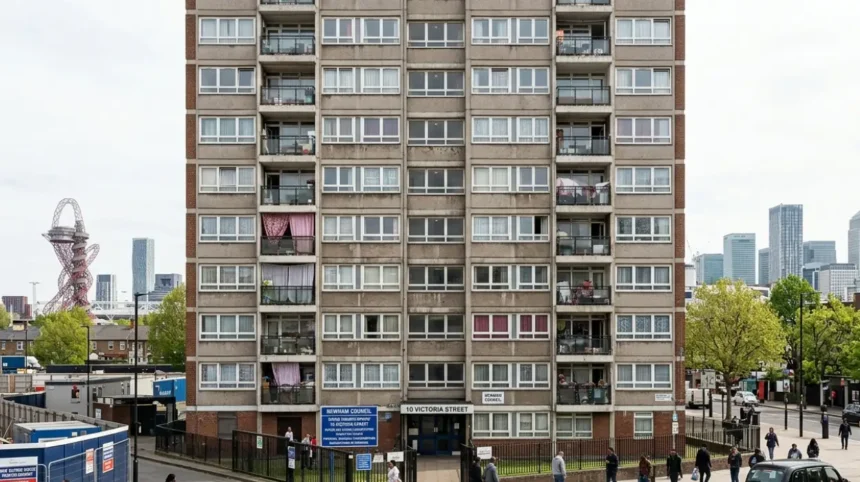
Newham Council has paused plans to demolish 10 Victoria Street in Stratford and is considering using the 218-home tower as longer-term homelessness accommodation instead. The site sits at the centre of Newham’s housing crisis, where temporary accommodation demand, high rents, and limited social housing have forced the council to rethink its redevelopment plan.
- Why did Newham originally plan demolition?
- Why is the council reconsidering now?
- What is temporary accommodation?
- How does the housing crisis shape this case?
- What would refurbishment involve?
- What would demolition and rebuild deliver?
- What does this mean for homeless households?
- What is the wider London context?
- Why does Stratford matter here?
- What happens next?
The building at 10 Victoria Street was approved for demolition and rebuild in December 2023. The council said the replacement scheme would deliver 122 new homes, including 90 two- and three-bedroom flats, compared with the current mix of 218 studio and one-bedroom homes.
The latest budget papers say the work has been “paused” while the council reviews whether the block can be used “solely for meeting the council’s temporary accommodation requirements on a more longer-term basis.” Those papers also say demolition could return if refurbishment and retrofit costs prove too high.
Why did Newham originally plan demolition?
Newham originally backed demolition because the existing block was judged unsuitable for family-sized housing and energy-efficient replacement. The proposed rebuild aimed to create larger, “genuinely affordable” homes with lower energy bills, while also replacing a tower that campaigners described as cramped and unsafe.
The council’s December 2023 announcement framed the plan as part of its response to a severe housing crisis in the borough. It said the replacement homes would be more suitable for homeless households and would improve energy performance, which directly affects running costs for residents.
The arguments for demolition fit a common planning logic in London: older blocks with poor layouts, weak insulation, or limited family housing are often considered for redevelopment rather than minor repair. In this case, the council said it wanted more two- and three-bedroom homes, which are scarce across inner London and are especially important for families.
Why is the council reconsidering now?
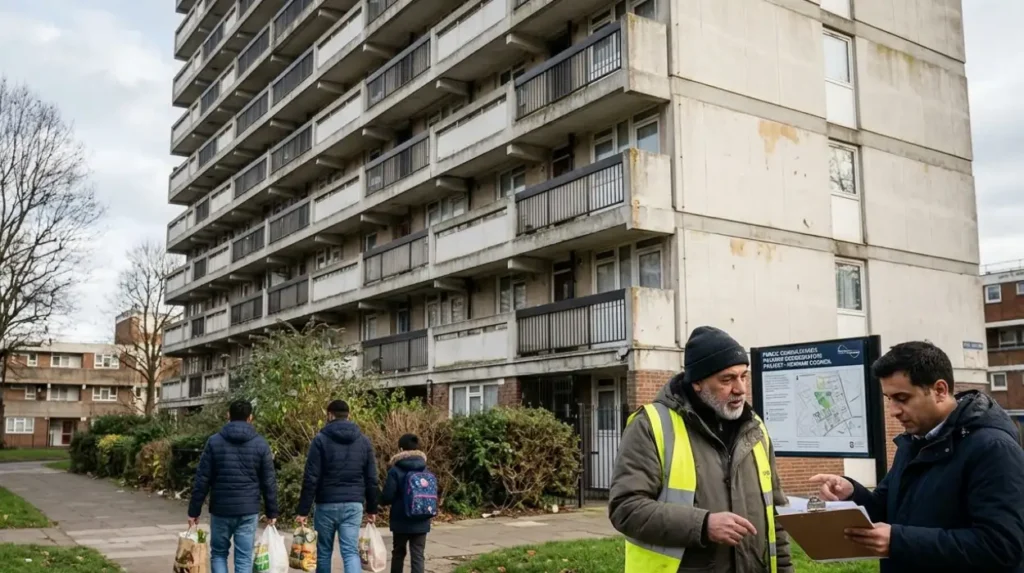
The council is reconsidering because Newham’s temporary accommodation pressure has become so severe that keeping existing homes in use has become more attractive than replacing them immediately. Budget papers show the council is weighing whether refurbishment would be cheaper and faster than a full rebuild, especially while it needs more units for homeless households.
Newham’s own homelessness guidance says the council can prevent homelessness in two ways: by helping people stay where they are or by helping them move somewhere else. It also says the council may provide temporary accommodation when a homelessness duty applies.
That policy context matters because temporary accommodation has become a major operational burden for London councils. Crisis reported that rough sleeping in London reached 3,028 people from April 2024 to March 2025, a 27% rise on the previous year, while total recorded rough sleeping reached 13,231.
In Newham, the scale of demand is even more acute. Reporting in 2025 said the borough had more than 6,000 households in temporary accommodation, with more than 3,000 in nightly booked properties such as hotels.
What is temporary accommodation?
Temporary accommodation is short-term housing used when a council owes a homelessness duty and no permanent home is available. It includes options such as nightly-booked hotels, leased flats, hostels, and council-managed units, and it is meant to provide safety while a longer-term housing solution is arranged.
Newham’s homelessness page explains that people already placed in temporary accommodation should contact the Temporary Accommodation Service rather than submit a fresh homelessness application. It also says that people can receive support through a Personal Housing Plan, rent negotiation, deposit help, and advice on rights of occupation.
Temporary accommodation is expensive because councils often pay private sector rates, especially in London where rents are high. That cost pressure has pushed boroughs to look for cheaper local housing stock they can use more efficiently, including former social housing, repurposed blocks, and newly purchased homes.
The Stratford tower is relevant because it already contains 218 homes. Reusing a standing building for temporary accommodation delivers faster capacity than a demolition-and-rebuild cycle, which takes years and removes usable units during the construction period.
How does the housing crisis shape this case?
The housing crisis shapes the Stratford decision because Newham faces a mismatch between the number of households needing housing and the number of affordable homes available. High private rents, a long waiting list, and sustained temporary accommodation demand create pressure to keep any usable homes in service.
Newham Council said in 2025 that it had around 6,000 people in temporary accommodation and a 40,000-person housing waiting list. The council also said many working families cannot afford market rents and are unlikely to receive a social rented home in the medium term.
The council’s own 2024 speech on the temporary accommodation crisis said there was not enough accommodation in Newham or nearby to meet demand. That statement shows why a block at 10 Victoria Street now carries value beyond its original redevelopment case.
London-wide data also reinforces the wider pattern. Crisis reported a 90% rise over ten years in the number of people living on London’s streets, rising from 1,595 in 2014-15 to 3,028 in 2024-25. That pressure increases the demand that eventually reaches borough-level housing services.
What would refurbishment involve?
Refurbishment would mean repairing and upgrading the existing tower so it can stay in use longer without full demolition. Typical work includes structural surveys, safety checks, energy improvements, internal reconfiguration, and upgrades to make homes more suitable for the households the council needs to house.
Budget papers reported that Newham is waiting for the outcome of survey work before deciding whether the tower can be refurbished. If the structure proves sound enough, the council can extend its use and defer demolition costs.
A refurbishment route often aims to keep homes occupied while upgrading the building’s performance. In this case, that could mean turning a block of studio and one-bedroom flats into more flexible accommodation for single people, couples, or smaller households.
The practical advantage is speed. A refurbishment path can return units to service far sooner than a full redevelopment scheme, which needs decanting, demolition, planning, construction, and final occupation.
What would demolition and rebuild deliver?
Demolition and rebuild would replace the current tower with a new housing scheme designed around larger homes and better energy efficiency. Newham said the plan would provide 122 homes, including 90 two- and three-bedroom homes, which addresses the shortage of family-sized accommodation.
This is a key policy trade-off. The existing building offers more units in total, but many are small. The replacement scheme offers fewer units overall but a more suitable mix for households needing larger homes.
The council has also linked the redevelopment case to lower utility bills and better energy performance. That matters because housing quality is not only about unit numbers; it also affects long-term living costs and maintenance.
A rebuild also creates an opportunity to redesign access, layout, and tenure mix. However, it removes existing homes from use during construction, which is one reason councils under housing stress often reconsider whether immediate demolition is the best option.
What does this mean for homeless households?
For homeless households, the immediate issue is supply. If the tower is retained, it adds usable accommodation faster; if it is demolished, Newham loses 218 homes before new ones replace them, which intensifies pressure on temporary accommodation elsewhere in the borough.
Newham’s homelessness service says it can help with mediation, rent negotiation, income support, and temporary accommodation where a duty applies. That framework shows the council is already operating in crisis-management mode rather than normal housing allocation mode.
The borough’s large temporary accommodation caseload means every available home matters. Reporting from 2025 said Newham was the London borough with the most households in temporary accommodation, reaching 6,980 by March that year.
Using 10 Victoria Street for homelessness accommodation would therefore serve as a local pressure valve. It would not solve Newham’s housing shortage, but it would give the council a controlled stock of homes it already owns or controls.
What is the wider London context?
The wider London context is a severe shortage of affordable housing, rising homelessness pressures, and growing dependence on temporary accommodation across boroughs. Newham sits at the sharp end of that crisis, but the pattern is visible across the capital and backed by official homelessness data and charity reporting.
London councils face statutory duties to help eligible homeless households. The Institute for Government noted in 2025 that homelessness systems are costing more but delivering less, and it cited official homelessness statistics showing substantial growth in need across London.
In response, some boroughs have started buying new-build homes specifically for homeless households. Newham itself announced plans in February 2025 to buy 36 new homes at Boleyn Heights so families could move out of costly nightly accommodation such as hotels.
That context explains why a single tower block in Stratford has become politically significant. It is not just a planning case. It is part of a wider struggle over how London councils use scarce housing stock when homelessness demand remains high.
Why does Stratford matter here?
Stratford matters because it is one of Newham’s highest-pressure housing areas, close to major transport links, regeneration zones, and high-value development. A centrally located council-owned block in Stratford has strategic value because it can support housing need faster than new land assembly or distant acquisitions.
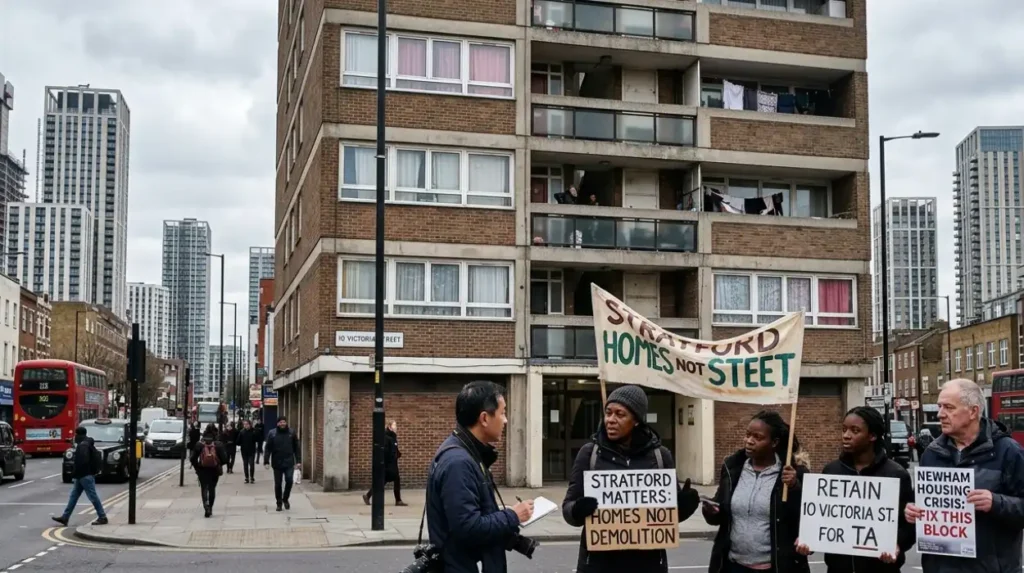
The location at 10 Victoria Street also makes the decision visible. The site sits in a borough where housing policy is closely watched by residents, campaigners, and local media, especially after years of activism around the building’s future.
That visibility increases the political stakes. A demolition decision sends a message about redevelopment and longer-term family housing. A retention decision sends a message about emergency housing need and rapid response.
The Stratford case therefore sits at the intersection of planning, homelessness, and public finance. It shows how one block can shift from being a redevelopment candidate to a strategic temporary accommodation asset when the local housing crisis worsens.
What happens next?
The next step is a revised business case, backed by survey work, that decides whether the tower stays in use, gets refurbished, or returns to a demolition timetable. Newham says no money is currently being spent on demolition while that review continues.
If refurbishment costs are manageable, the council can keep the block in service longer and preserve homes for homelessness use. If the building fails structural or financial tests, demolition could be brought forward again.
The decision will also shape how Newham balances long-term housing supply against immediate crisis response. Rebuilding creates better-specified homes later. Retention creates capacity now. That trade-off defines the current debate.
For East London readers, the key point is simple. The Stratford tower block is no longer only a redevelopment site. It has become a test of whether councils under extreme housing pressure prioritise new-build replacement or the immediate use of existing homes for homeless people.
Why did Newham Council pause the demolition of 10 Victoria Street?
Newham Council paused demolition because it is reviewing whether the 218-home tower could be used as longer-term temporary accommodation for homeless households instead of being rebuilt immediately.