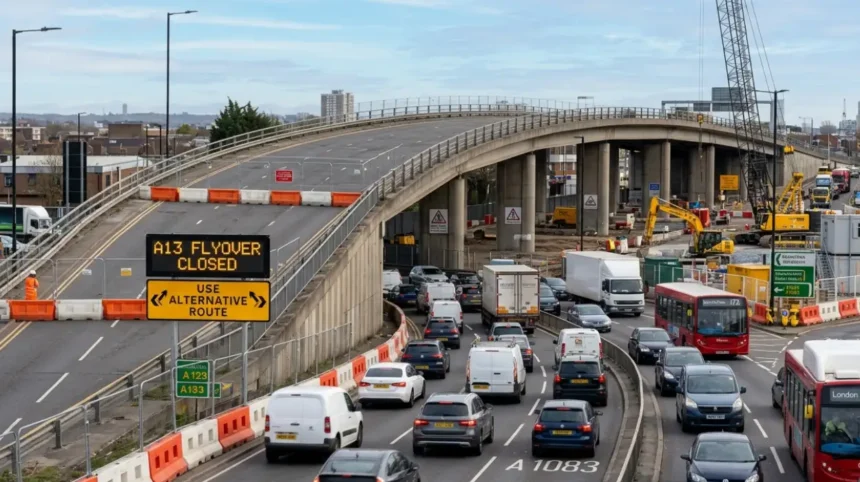
The Ripple Road Flyover closure is part of the wider A13 Lodge Avenue interchange replacement in Barking, and it affects one of east London’s busiest road links. TfL says the flyover will be replaced, the A13 and its slip roads are subject to speed and traffic-management changes, and diversion routes are already shaping local journeys.
- What is Ripple Road Flyover?
- Why is the flyover closed?
- What roads are affected?
- What should drivers expect?
- Which diversion routes matter?
- How long will it last?
- What changed in 2026?
- How does this affect local traffic?
- What do official sources say?
- Why does this matter long term?
- What should drivers do now?
What is Ripple Road Flyover?
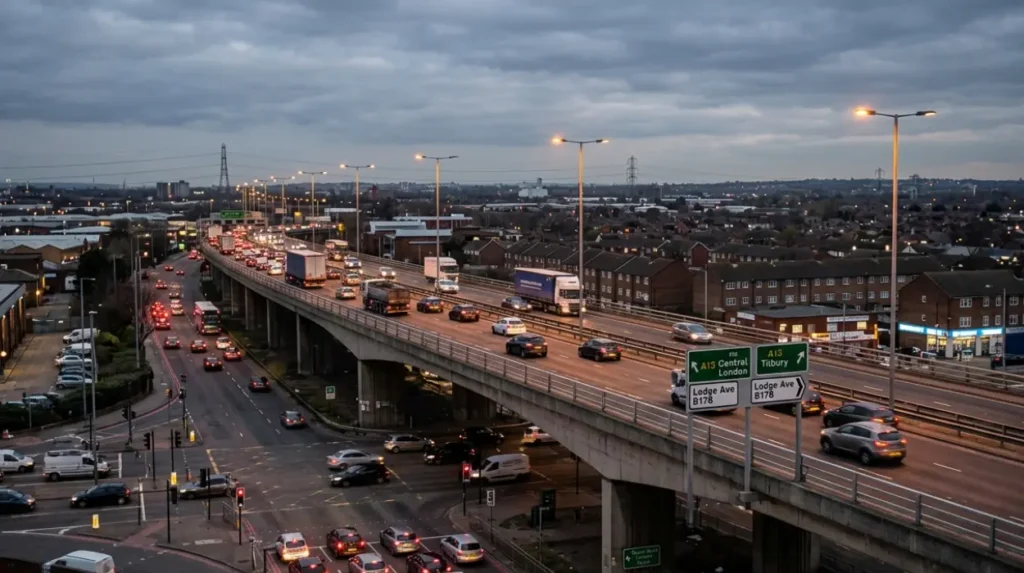
Ripple Road Flyover is the elevated part of the A13 Lodge Avenue interchange in Barking that carries strategic traffic over local roads. It connects the A13 with Ripple Road, Alfred’s Way, Lodge Avenue, and adjoining slip roads used by thousands of vehicles each day.
The structure sits in Barking and Dagenham, part of east London’s road network, and it forms a key junction for traffic heading between inner east London, Essex routes, and local Barking streets. TfL’s official project page describes the scheme as the replacement of the Lodge Avenue Flyover structure that carries the A13.
This matters because flyovers are not ordinary local roads. They are transport assets designed to move high volumes of traffic above a busy junction, and they rely on managed traffic flows, slip roads, and signal-controlled approaches. When a flyover is closed or rebuilt, the effect spreads far beyond the immediate junction.
Why is the flyover closed?
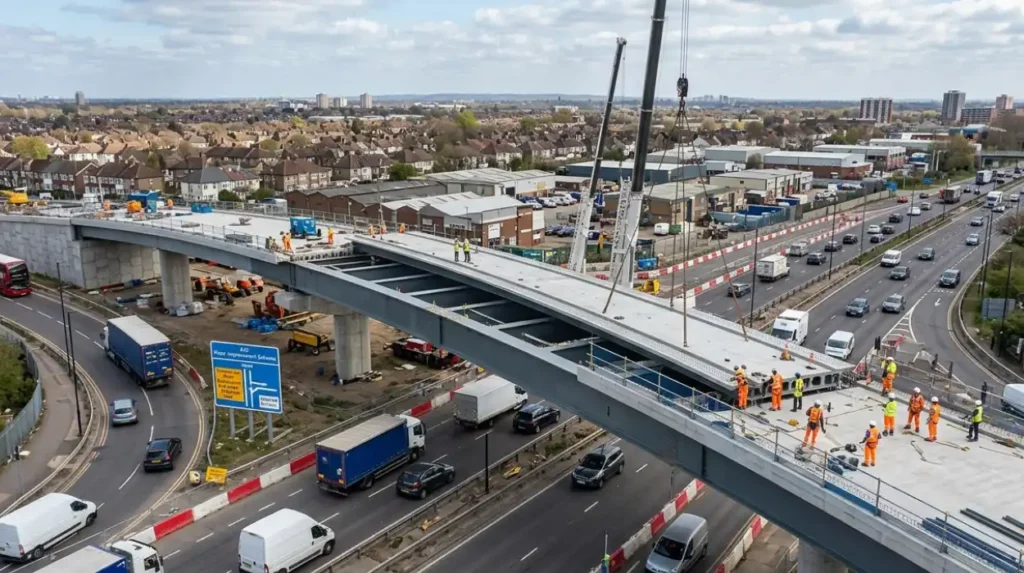
The closure exists because TfL is replacing the Lodge Avenue Flyover as part of a major A13 infrastructure scheme. The work is not a short repair. It is a full replacement programme tied to the wider safety, reliability, and traffic-management changes on the A13 corridor.
TfL’s project information says the flyover is being replaced, and its A12 and A13 works page confirms that essential works are planned in 2025 and beyond to improve safety and reliability on the corridor. That framing places the closure inside a long-term asset renewal programme rather than a temporary maintenance event.
The public notice in The Gazette also shows that the interchange has already been subject to legal traffic-order changes. It proposes a 30 mph limit on parts of A13 Alfred’s Way and Ripple Road, including on- and off-slip roads serving Lodge Avenue interchange. That indicates the project already involves formal regulation of the road layout, not just ad hoc lane closures.
The practical result is straightforward. Drivers lose direct capacity at the flyover while construction, demolition, and replacement work takes place, and traffic is redistributed through diversions, signal changes, and revised access routes.
What roads are affected?
The closure affects the A13 Ripple Road, A13 Alfred’s Way, Lodge Avenue interchange roundabout, and the related on-slip and off-slip roads. Those links form the core route for traffic using the flyover area and adjacent junctions.
The Gazette notice lists several affected parts of the highway network. These include the eastbound and westbound carriageways of A13 Alfred’s Way and Ripple Road, the on-slip road connecting the circulatory traffic system to the eastbound A13, the off-slip road from the westbound A13 to Lodge Avenue roundabout, and the slip roads joining the roundabout to Alfred’s Way.
For drivers, that means the disruption is not limited to one bridge deck. It reaches into approach roads and turn movements, which is why congestion often appears on feeder routes as traffic searches for alternative paths. TfL also warns on its live status page that the A13 corridor can experience delays when works are in place nearby.
That road package matters for bus routes, freight, local residents, and through-traffic. When a junction is redesigned, every movement through it changes: straight-ahead traffic, turning traffic, local access traffic, and vehicles using the slip roads all compete for reduced space.
What should drivers expect?
Drivers should expect closures, diversions, reduced capacity, lower speed limits, and longer journey times around the A13 Lodge Avenue area. The closure reshapes access in both directions, so trips that were once direct now depend on signed alternative routes.
The live TfL traffic page shows that works on London roads commonly produce lane restrictions, temporary signals, road closures, and diversion advice, and the A13 corridor is already listed among active works locations. That pattern is consistent with what drivers face around the flyover area.
In practical terms, the most common impacts are:
- Longer peak-time delays.
- More stop-start traffic on approach roads.
- Queues at nearby junctions.
- Re-routed bus movements.
- Extra pressure on side streets used as short-cuts.
The scale of use also explains the disruption. TfL-related local campaigning and reporting has repeatedly described the A13 Ripple Road flyover and Blue Light roundabout as carrying very high daily volumes of traffic, with one cited estimate of 74,000 to 100,000 vehicles a day. That is a large flow for any junction under reconstruction.
Which diversion routes matter?
Diversion routes matter because the closure displaces traffic onto surrounding east London roads, including nearby A13 sections, local roads in Barking, and broader corridor links used to bypass the junction. TfL also expects route changes to support bus access and general traffic management.
TfL states that the new 287 and 687 routes are expected to begin in spring/summer 2026 as part of the wider scheme. That suggests public transport changes are built into the replacement plan, not added later as an afterthought.
For drivers, diversion planning usually starts with three questions. First, which direction is the trip heading. Second, whether the journey is local or through-traffic. Third, whether the vehicle is a car, van, HGV, or bus, because route suitability changes with size and access restrictions. The flyover replacement scheme is designed around exactly those movements.
A good diversion is not simply the shortest route on a map. It is the route that still works under roadworks, signal changes, access controls, and temporary turn restrictions. In junction schemes of this scale, that distinction matters every day.
How long will it last?
The current scheme is a long-term replacement programme, not a brief overnight closure. Public reporting and project information indicate a multi-stage build lasting around two years, with site set-up, demolition, diversion changes, and construction spread across 2026 and 2027.
TfL’s project page confirms that the Lodge Avenue Flyover is being replaced, and recent reporting about the scheme says the bridge work is expected to take around two years to complete. Another report says site set-up was provisionally scheduled for July 2026, while other coverage points to an opening target around mid-2027 for the new bridge.
That timescale matters for road users because it means drivers need to think in phases. Early phases typically involve site preparation and traffic management. Middle phases usually bring the heaviest disruption, especially during demolition and bridge construction. Later phases often involve commissioning, testing, and final tie-ins before opening.
A long project also changes local travel habits. Once a route is disrupted for months, drivers begin to shift departure times, use unfamiliar roads, or switch modes. That pattern creates secondary congestion on roads that were not originally the main problem.
What changed in 2026?
In 2026, the A13 Lodge Avenue flyover scheme moved into active traffic-routing and partial reopening phases, while the replacement programme continued. That means drivers faced a mix of reopening on some links and restrictions remaining on others.
Recent reporting says parts of a major east London junction reopened after more than a year, while the flyover itself remained under major restrictions. TfL’s live traffic information also shows ongoing A13-related works and corridor disruption in the same period.
This matters because construction schemes do not usually end in a single day. Reopening one movement does not mean the whole interchange is back to normal. For a project of this size, phased openings are standard because they restore some traffic flow while other sections remain under construction.
For drivers, the key message is that a reopened link is not the same as a fully restored junction. The surrounding network can still carry lane closures, signal timing changes, and access restrictions that affect journey time and route choice.
How does this affect local traffic?
Local traffic faces the greatest day-to-day pressure because it depends on short trips, repeated junction use, and access to nearby homes, shops, schools, and services. The closure changes not only long-distance travel but also local circulation around Barking and the A13 corridor.
The A13 Ripple Road and Alfred’s Way corridor links Barking’s local roads with strategic traffic. When the flyover is unavailable, local and through traffic mix more heavily on the remaining surface network. That increases conflict at junctions, slows buses, and lengthens journeys for residents making ordinary trips.
The Gazette order also shows that local speed limits have been formally reduced to 30 mph on sections of the road network affected by the scheme. Lower speed limits are common around major roadworks because they improve safety where lanes, road geometry, or traffic movements are changing.
The result is a broader transport effect. School runs, shopping trips, deliveries, and commuting all take longer, and roads near the junction absorb traffic that previously flowed through the flyover. That is why a single flyover replacement can reshape an entire district’s traffic pattern.
What do official sources say?
Official sources describe the project as a flyover replacement and corridor improvement programme. TfL provides the scheme page and live traffic status, while The Gazette records the legal traffic-order changes that support the road layout and speed-limit changes.
TfL’s project page is the main source for scheme-level information. It states that the Lodge Avenue flyover will be replaced and mentions route changes, including the planned introduction of new 287 and 687 bus routes in spring or summer 2026.
TfL’s traffic status page is the live source for active road restrictions across London. It shows how works are logged, updated, and time-stamped, which is important for drivers checking current conditions before travel.
The Gazette notice provides the legal basis for specific road changes. It confirms the affected roads, the proposed 30 mph limit, and the slip-road adjustments around the A13 Ripple Road and Alfred’s Way junction system.
Why does this matter long term?
This matters long term because the A13 corridor is a strategic transport link, and bridge replacement determines how traffic moves for years after the works finish. The new structure sets the operating pattern for safety, capacity, and reliability well beyond the closure period.
TfL’s broader A12 and A13 works programme says essential works are planned to improve safety and reliability. That wording points to future resilience, not only immediate disruption reduction. For a major road corridor, replacement schemes are meant to reduce structural risk and modernise the network for future demand.
Long-term schemes also shape land use and local movement. Once a junction is redesigned, bus routes, freight patterns, and driver habits often stay changed. That is especially true in dense urban areas like Barking, where the road network, public transport network, and residential streets interact closely.
For residents and regular drivers, the key long-term issue is reliability. A rebuilt flyover aims to restore smoother movement, but the transition period always includes uncertainty, route adaptation, and repeated network changes before the final layout settles.
What should drivers do now?
Drivers should check live TfL traffic updates before setting off, allow extra time, follow signed diversions, and avoid assuming old routes still work. The closure is part of a managed interchange replacement, so road conditions can change quickly as phases progress.
For everyday use, the safest approach is simple:
- Check the route on the day of travel.
- Build in extra time for peak hours.
- Use official diversion signs rather than sat-nav shortcuts.
- Expect local roads to be slower than usual.
- Plan separate routes for commuting, school runs, and deliveries.
The bigger lesson is that this closure is not a short-term nuisance. It is a major east London infrastructure change with legal, engineering, and traffic-management consequences. Drivers who treat it as a one-off disruption will keep getting caught out as the project moves through its next phases.
Why is the Ripple Road Flyover closed?
The Ripple Road Flyover is closed because Transport for London is replacing the aging Lodge Avenue Flyover structure as part of a major A13 infrastructure upgrade in Barking. The project involves demolition, reconstruction, traffic-management changes, and safety improvements across the interchange rather than a simple repair job.