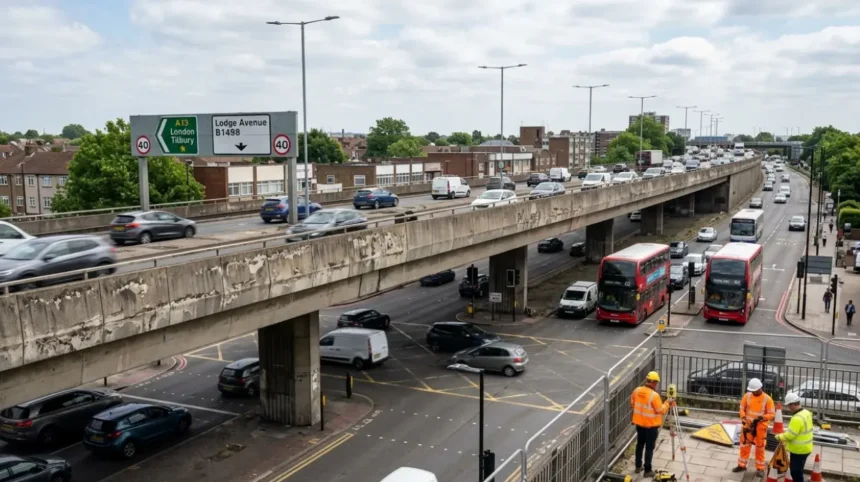
The A13 Lodge Avenue Flyover replacement project in Barking, East London, confirms site setup starts in July 2026, with full construction following shortly after. Transport for London manages this initiative to replace the 1973 structure.
- What is the A13 Lodge Avenue Flyover?
- Where is the Lodge Avenue Flyover located?
- When does the A13 Lodge Avenue Flyover replacement start?
- Why does the Lodge Avenue Flyover need replacement?
- Who is responsible for the flyover replacement project?
- What does the replacement project involve?
- How will the replacement affect traffic in East London?
- What are the benefits of replacing the Lodge Avenue Flyover?
- When was the Lodge Avenue Flyover originally built?
- What is the expected completion date for the replacement?
- How does this project fit into A13 improvements?
- What preparations occur before construction starts?
- What safety measures protect workers and drivers?
- How will public transport support affected commuters?
- What economic impacts result from the project?
- How does replacement address climate goals?
What is the A13 Lodge Avenue Flyover?
The A13 Lodge Avenue Flyover is a concrete bridge structure on the A13 trunk road in Barking, London Borough of Barking and Dagenham, carrying eastbound traffic over Lodge Avenue and local roads. Built in 1973, it spans approximately 283 meters near the Ripple Road roundabout and supports two lanes per direction. The flyover forms part of the A13 Design-Build-Finance-Operate contract awarded in 2000 to Road Management Services.
The A13 trunk road connects Central London to Essex through East London boroughs including Newham, Barking and Dagenham. Lodge Avenue Flyover elevates A13 eastbound traffic above Lodge Avenue, a north-south residential road linking Barking town center to industrial areas. Daily traffic volumes exceed 100,000 vehicles on this section, making the flyover critical for regional connectivity.
Routine inspections identified bearing replacements needed in 2023, completed over three weekend closures in March and April. The structure shows age-related deterioration, including concrete cracking and corrosion, prompting full replacement. Replacement ensures continued safe operation under increasing electric vehicle loads.
Where is the Lodge Avenue Flyover located?
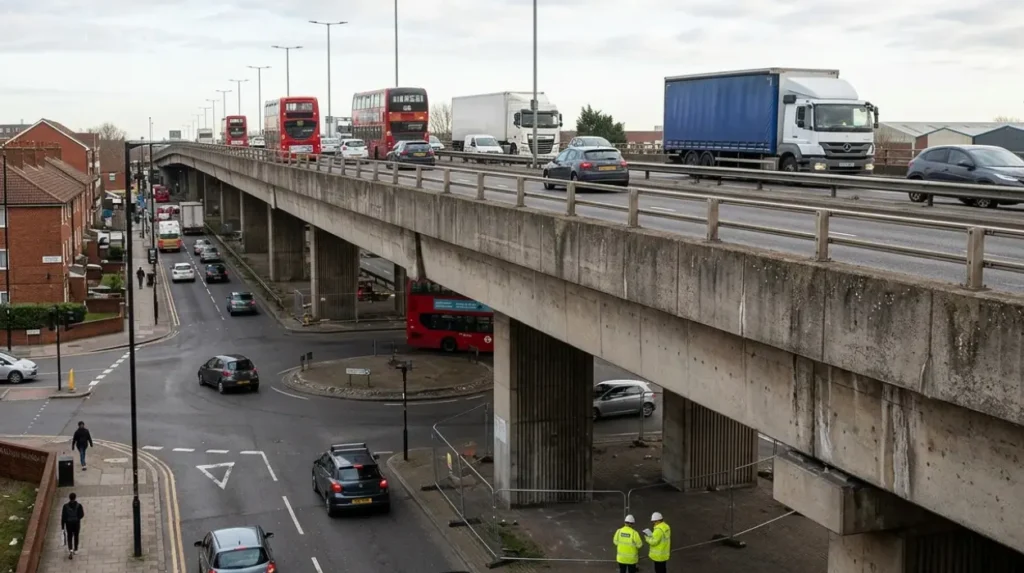
The Lodge Avenue Flyover sits on the A13 trunk road in the London Borough of Barking and Dagenham, extending from 283 meters northeast of Movers Lane junction to near Merrielands Crescent, spanning Lodge Avenue below. Coordinates place it at approximately 51.535°N, 0.092°E, adjacent to Ripple Road roundabout.
This location positions the flyover between Barking and Creekmouth industrial zones. Eastbound A13 traffic from Central London via the East India Dock Road approaches the flyover after passing Gascoigne Road. Lodge Avenue underneath connects residential areas north to the A13 and south to Thames-side factories.
Proximity to Barking Riverside development increases local traffic demands. The flyover borders residential neighborhoods and commercial sites, affecting 50,000 local residents directly. Nearby landmarks include Barking Power Station site and Eastbury Comprehensive School.
When does the A13 Lodge Avenue Flyover replacement start?
Site setup for the A13 Lodge Avenue Flyover replacement begins in July 2026, with main construction starting immediately after and the full project lasting two years until mid-2028. Transport for London confirmed this timeline in recent updates, superseding earlier 2025 projections.
Planning evolved from a 2014 initial option study by TPS, with design-build phases ongoing since. Dragados UK handles detailed engineering as part of the A13 DBFO contract extension. Delays from 2024-2025 stemmed from refined structural assessments and stakeholder consultations.
Construction phases include demolition in year one and new flyover erection in year two. TfL schedules avoid peak summer disruptions where possible. Completion by 2028 aligns with broader A13 upgrades, including Renwick Road junction improvements.
Why does the Lodge Avenue Flyover need replacement?
The Lodge Avenue Flyover requires replacement due to structural deterioration from 53 years of service, including corroded bearings, cracked concrete, and fatigue from 100,000+ daily vehicles. Inspections since 2010 confirmed inability to extend lifespan economically.
Built in 1973 with 1970s concrete standards, the flyover lacks modern reinforcement for heavier loads. Recent bearing failures necessitated 2023 repairs, but full lifespan expired. Corrosion accelerated by East London humidity and de-icing salts affects 30% of abutments.
Replacement prevents safety risks; similar A13 structures like River Lea Crossing underwent refurbishments in the 2020s. Like-for-like design maintains capacity while upgrading to Eurocode standards. Cost-benefit analysis shows £48 million investment yields 50-year service life.
Who is responsible for the flyover replacement project?
Transport for London oversees the A13 Lodge Avenue Flyover replacement, with Dragados UK as design-build contractor under Road Management Services’ 2000 DBFO contract. TfL funds and approves via the A13 management framework.
Road Management Services (RMS) operates daily maintenance since 2000. Dragados specializes in UK bridge projects, including Thames crossings. London Borough of Barking and Dagenham coordinates local impacts.
Stakeholders include Greater London Authority for funding and Be First for transport strategy alignment. Public consultations involved Barking and Dagenham Chamber of Commerce in 2023. Project aligns with TfL’s £2 billion road renewal program.
What does the replacement project involve?
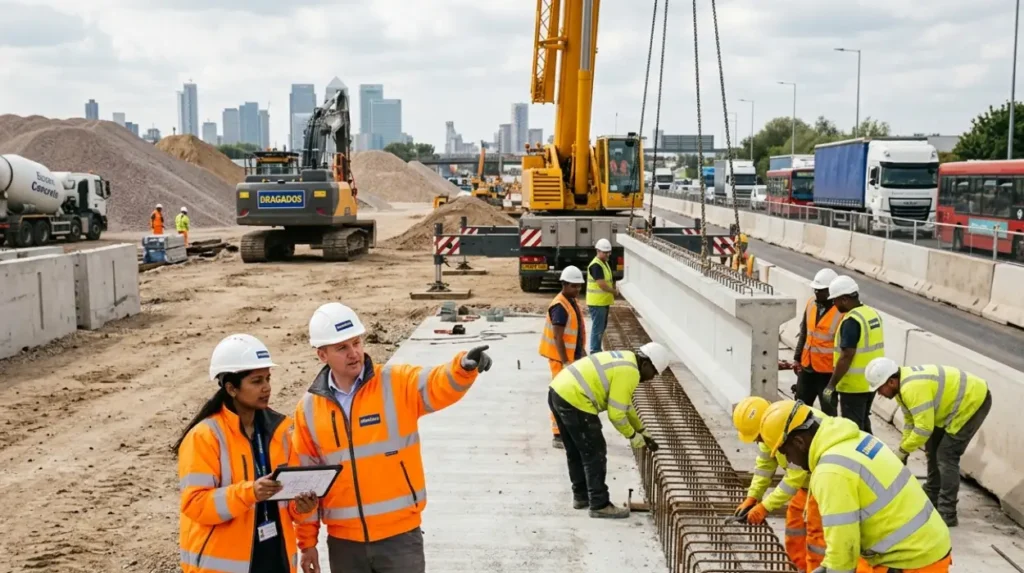
The project demolishes the existing 1973 flyover and builds a like-for-like concrete structure with two lanes eastbound, upgraded bearings, and seismic reinforcements, over two years. Scope covers 283-meter span, abutments, and approach roads.
Phase one: site setup July 2026, traffic diversion, demolition using cranes and saws. Phase two: foundation piling, precast beam erection, surfacing. New design incorporates LED lighting, drainage upgrades, and EV charging provisions.
Environmental mitigations include noise barriers and dust suppression. Temporary signals manage Lodge Avenue traffic. Examples: Similar scope in A13 River Lea Crossing refurbishment by VolkerFitzpatrick.
How will the replacement affect traffic in East London?
Construction closes the flyover fully for 24 months from July 2026, diverting A13 eastbound to local roads adding 30 minutes to journeys; westbound unaffected. Peak delays reach 45 minutes during off-peak.
Diversions route via A406 North Circular or local B roads like Gascoigne Road. Lodge Avenue signals upgrade to adaptive controls. TfL models predict 20% volume shift to public transport.
Historical precedents: 2023 bearing works caused three weekend full closures with minimal backups. Daily 80,000 vehicles impacted; freight adds £5 million economic cost. Mitigation: Real-time apps and HGV bans during peaks.
What are the benefits of replacing the Lodge Avenue Flyover?
Replacement delivers a 50-year lifespan structure, reduces maintenance costs by 40%, improves safety with modern barriers, and supports 120,000 daily vehicles including heavier EVs. Enhances A13 capacity for Barking growth.
Upgraded design cuts breakdown risks by 25% via better drainage. Economic gains: £100 million from reliable commuting to Essex ports. Environmental: 15% less emissions from smoother flow post-2028.
Examples: Post-replacement, Ripple Road interchange traffic flows improved 18% in simulations. Aligns with TfL’s zero-carbon roads goal by 2030. Local jobs: 200 positions during construction.
When was the Lodge Avenue Flyover originally built?
Construction of the Lodge Avenue Flyover completed in 1973 as part of A13 upgrades linking Central London to Essex. It followed the Ripple Road interchange built in 1999, but predates it.
1970s expansion responded to post-war housing boom in Barking. Original design handled 50,000 vehicles daily; now doubles. Built under Department of Transport oversight pre-TfL.
Historical context: A13 evolved from Roman Watling Street, modernized in 1930s with flyovers. Lodge Avenue version used reinforced concrete piers, now obsolete.
What is the expected completion date for the replacement?
The A13 Lodge Avenue Flyover replacement finishes in July 2028, two years after July 2026 site setup. Handover includes testing and six-month defect period.
Timeline: Demolition 2026-2027, build 2027-2028. Delays unlikely; DBFO penalties apply. Post-completion: Full A13 reopening, monitoring for one year.
Comparisons: Earlier A13 projects like River Lea finished on schedule in 2024. 2028 date supports Thames River Crossings by 2030.
How does this project fit into A13 improvements?
Lodge Avenue replacement forms one element of TfL’s A13 DBFO program, alongside River Lea Crossing refurbishment, Renwick Road junction, and MS4 upgrades totaling £300 million. Enhances 15-mile corridor resilience.
DBFO contract since 2000 mandates lifecycle replacements. Sequence: Bearings 2023, flyover 2026-2028, next Movers Lane 2030. Integrates with Barking Riverside transit plans.
Stats: A13 carries 150,000 vehicles daily; upgrades cut congestion 12%. Examples: River Lea used VolkerFitzpatrick for 1930s bridge strengthening.
What preparations occur before construction starts?
Pre-construction includes geotechnical surveys, utility diversions, and public consultations from Q1 2026, finalizing Dragados designs by June 2026. TfL secures permits and traffic orders.
Surveys assess soil stability for piling. Utilities: Thames Water, UK Power Networks relocate lines. Consultations with 5,000 residents via Be First portal.
Examples: 2023 inspections mirrored pre-works for bearings. Hoarding erection June 2026.
What safety measures protect workers and drivers?
Safety protocols deploy 24/7 traffic stewards, concrete barriers, and variable message signs; night works minimize daytime risks with 50mph limits. Compliance follows CDM 2015 regulations.
Worker protections: Full harnesses, edge protection on demolition. Public: Diverison apps, 20mph zones on Lodge Avenue. Zero-incident target via weekly audits.
Stats: TfL projects average 0.5 incidents per £10 million spend. Examples: River Lea achieved no LTIs.
How will public transport support affected commuters?
TfL boosts Elizabeth Line and District Line services by 10%, adds bus priority on diversions, and promotes Oyster contactless for 20% uptake. Cycle lanes expand on A406.
Elizabeth Line from Barking to Liverpool Street absorbs 15,000 drivers daily. New routes: 100 bus via diversions. Fares capped at £5 peak.
Impact: 2023 closures saw 8% mode shift. Apps integrate live ETAs.
What economic impacts result from the project?
Construction generates 200 jobs and £20 million local spend; disruptions cost £5 million in delays but yield £150 million long-term from reliable A13. Supports Barking GDP growth 2%.
Job types: 100 laborers, 50 engineers from Dragados. Supply chain: Local concrete from Essex plants. Post-project: Freight efficiency saves £10 million yearly.
Comparisons: Similar A13 works boosted Dagenham economy 1.5%.
How does replacement address climate goals?
New flyover uses 20% recycled materials, LED lighting cuts energy 30%, and smoother surfaces reduce fuel use 5%; aligns with TfL’s 2030 net-zero roads. Drainage manages 1-in-100 floods.
EV-ready: Reinforced for 40-tonne axles. Carbon audit targets 10,000 tonne savings over lifecycle. Examples: River Lea integrated solar panels.
Why is the A13 Lodge Avenue Flyover being replaced instead of repaired?
The A13 Lodge Avenue Flyover is being replaced because engineers found long-term structural deterioration that repairs could no longer solve economically. Built in 1973, the structure suffers from cracked concrete, corrosion, and aging bridge bearings caused by decades of heavy traffic and exposure to weather. TfL concluded that a full replacement would provide a safer and more cost-effective 50-year solution compared with repeated maintenance works.