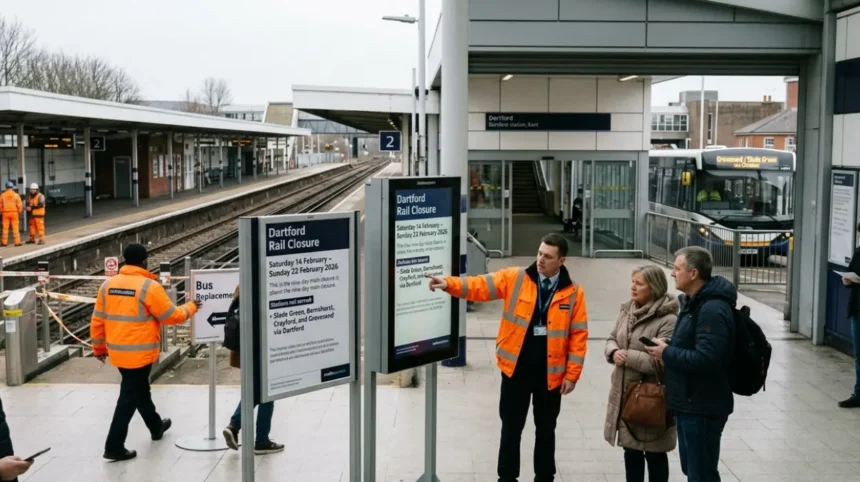
The main Dartford rail closure runs from Saturday 14 February to Sunday 22 February 2026, with preparatory work on Saturday 7–8 February and follow-up work on Sunday 1 March and Sunday 5 April 2026. During the nine-day main closure, no Southeastern or Thameslink trains operate between Slade Green, Barnehurst, Crayford, and Gravesend via Dartford.
- What Is the Dartford Rail Closure and Why Is It Happening?
- Which Exact Dates Will Dartford Rail Services Be Closed?
- What Diversion Routes and Alternative Train Services Are Available?
- Which Stations Are Affected by the Dartford Rail Closure?
- How Should Travelers Plan Their Journeys During the Closure?
- What Ticketing Options and Refunds Apply During theClosure?
- What Long-Term Benefits Will the Dartford Junction Upgrade Deliver?
What Is the Dartford Rail Closure and Why Is It Happening?
The Dartford rail closure is a £10 million track upgrade at Dartford Junction involving renewal of 10 switches and crossings plus 400 yards of new rail to improve reliability for 650 daily trains.
Dartford Junction stands as one of the busiest railway junctions in Kent and the entire country, handling approximately 650 trains every single day. Network Rail initiated this critical infrastructure project to address aging track components that cause delays and service failures across the Kent and South East London network. The £10 million investment specifically targets the movable track sections called switches and crossings, technically known as “points,” which enable trains to change direction between tracks.
The engineering works include installation of 400 yards of new rail and conductor rails between Slade Green and Dartford, plus platform adjustment work at Dartford station to reduce stepping distance between platforms and trains. Station improvements accompany the track renewal, including new tactile paving at Dartford station for accessibility enhancement, damaged fencing replacement at Stone Crossing, refurbished accessible toilets at Greenhithe, deep cleaning at Swanscombe, and new LED lighting plus customer information screens at Northfleet.
Network Rail chose the February half-term period deliberately to minimise disruption when schools are on holiday and fewer people commute daily. This approach consolidates activity into one 9-day closure plus three weekends rather than spreading work across up to 30 separate weekends of disruption. The upgrade strengthens long-term resilience and efficiency at this critical network bottleneck serving tens of thousands of passengers daily.
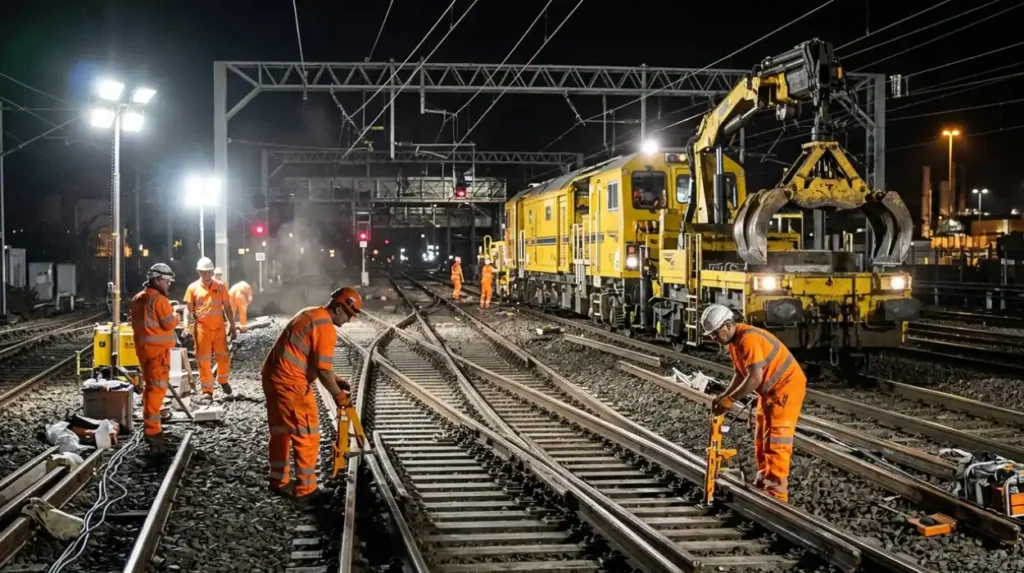
Which Exact Dates Will Dartford Rail Services Be Closed?
Rail services close completely from Saturday 14 February through Sunday 22 February 2026 for the main works, with preparation closures on 7–8 February and follow-up closures on 1 March and 5 April 2026.
The closure schedule contains four distinct phases. Phase one involves preparation work on Saturday 7 February and Sunday 8 February 2026 when no trains operate through Dartford while engineers complete setup activities. Phase two represents the main nine-day closure from Saturday 14 February to Sunday 22 February 2026 encompassing the critical track renewal work. Phase three includes follow-up work on Sunday 1 March 2026 for final testing and restoration. Phase four concludes with additional follow-up work on Sunday 5 April 2026.
Travelers must note all four closure periods when booking tickets in advance through Southeastern or Thameslink online systems. The February 14–22 period falls during winter half-term week, meaning families traveling with children may encounter reduced capacity on replacement services. Peak morning and evening periods on weekdays 17–21 February will experience highest demand for replacement buses, creating potential queues.
Saturday 7–8 February preparation closure means no trains run for the entire weekend before main works begin. Sunday 1 March follow-up work affects only Sunday services, while Sunday 5 April follow-up closure mirrors this pattern with single-day disruption. Passengers checking journey planners on train operator websites or National Rail platforms in autumn 2025 will find revised train and replacement bus times published there.
What Diversion Routes and Alternative Train Services Are Available?
Services continue running normally into London via the Sidcup Line, Bexleyheath Line, and Woolwich Arsenal routes, while replacement buses connect affected stations between Gravesend and Slade Green.
The Sidcup Line operates half-hourly services between Charing Cross and Dartford calling at all stations via Sidcup except Albany Park, which receives no service. The Bexleyheath Line provides half-hourly services between Charing Cross and Dartford calling at all stations via Bexleyheath. The Woolwich route serves passengers via Woolwich Arsenal as an alternative path into London when Bexleyheath services divert.
Replacement bus services operate between Gravesend and Slade Green calling at Northfleet, Swanscombe, Greenhithe, Stone Crossing, and Dartford with journey time approximately 47 minutes. Four buses per hour run Monday through Saturday on this route, while Sunday service reduces to 2 buses per hour. Additional bus routes connect Dartford to Crayford (approximately 8 minutes, 4 buses per hour Monday-Saturday, 2 buses Sunday) and Dartford to Barnehurst (approximately 10 minutes, same frequency). An extra weekday service runs between Dartford and Slade Green taking approximately 14 minutes with 4 buses per hour Monday through Friday.
Highspeed services to and from St Pancras International via Gravesend continue operating normally throughout the closure period without disruption. An hourly Thameslink shuttle train service operates between Gravesend and Rainham since no Thameslink services run between Plumstead and Gravesend. All Southeastern Metro routes passing through Dartford experience schedule changes requiring passenger awareness.
East London commuters should use the Sidcup or Bexleyheath routes via Charing Cross rather than attempting to reach Dartford directly. Services into London along Sidcup, Bexleyheath, and Woolwich routes avoid the closure zone entirely and maintain normal frequencies. Passengers traveling from East London areas including Barking, Dagenham, or Romford should connect via Slade Green using replacement buses or use alternative Tube and Overground routes to reach South East Kent destinations.
Which Stations Are Affected by the Dartford Rail Closure?
Affected stations include Dartford, Stone Crossing, Greenhithe for Bluewater, Swanscombe, Northfleet, Gravesend, Slade Green, Barnehurst, Crayford, Plumstead, and Rainham, with replacement buses serving all locations.
Dartford station receives new tactile paving during closure work to improve accessibility and reduce stepping distance between trains and platforms. Stone Crossing station experiences damaged fencing replacement alongside the track renewal works. Greenhithe station for Bluewater shopping centre receives refurbished accessible toilets during the closure period. Swanscombe station undergoes deep cleaning as part of concurrent improvement works. Northfleet station benefits from new LED lighting installation plus additional customer information screens to aid journey planning.
Gravesend station serves as the northern terminus for replacement bus services and the hourly Thameslink shuttle to Rainham. Slade Green station marks the southern end of the affected section where no Southeastern or Thameslink services operate via Dartford. Barnehurst and Crayford stations lose direct rail connections via Dartford but receive replacement bus service for 8–10 minute journeys from Dartford. Plumstead station loses Thameslink services to Gravesend while maintaining other connections. Rainham station connects to the hourly Thameslink shuttle originating at Gravesend.
Replacement buses stop at all affected stations including Dartford, Stone Crossing, Greenhithe for Bluewater, Swanscombe, Northfleet, plus Gravesend, Slade Green, Barnehurst, and Crayford. Passengers at these stations board accessible replacement buses rather than trains during closure periods. All stations closed for the duration receive repainting to improve overall station environment alongside infrastructure upgrades.
How Should Travelers Plan Their Journeys During the Closure?
Download journey planner information from Southeastern or Thameslink websites, allow extra travel time especially during peak hours, check before traveling, and consider switching to alternative routes via Sidcup, Bexleyheath, or Woolwich.
Passengers must check before traveling and allow extra time for journeys, particularly during peak hours when queuing for replacement buses becomes common. Detailed travel advice including bus timetables and ticketing acceptance information publishes shortly before closure begins on train operator websites. Journey planners on Southeastern and Thameslink websites plus National Rail platforms contain revised train and replacement bus times available from autumn 2025.
Booking tickets in advance through Southeastern or Thameslink online systems requires noting closure dates to avoid purchasing tickets for unavailable services. Travelers should sign up for email updates from Network Rail using their hardship page to receive project notifications and broader Southern region project information. For questions, passengers contact the 24-hour National Helpline on 03457 11 41 41 quoting “Dartford Junction” for specific guidance.
Peak period travel during weekdays 17–21 February 2026 requires additional time allowance due to bus queue delays. East London residents should identify alternative routes using Sidcup, Bexleyheath, or Woolwich Arsenal connections that bypass the closure zone entirely. Highspeed travelers to St Pancras can continue using normal services via Gravesend without disruption. Weekend travelers on 7–8 February, 14–22 February, 1 March, and 5 April must verify specific service changes for their travel date.
What Ticketing Options and Refunds Apply During theClosure?
Ticket refunds are available without admin fees if your planned service gets delayed or cancelled and you choose not to travel, or if you cancel and rebook on a different day not covered by your original ticket.
Thameslink ticket refund rules differ based on purchase date: tickets bought up to and including 31 March 2026 may be refunded up to 28 days after the travel date, while tickets purchased from 1 April 2026 must be refunded by 23:59 the day before travel. Refunds apply only to tickets purchased from Southern, Thameslink, Great Northern, or Gatwick Express ticket offices, ticket vending machines, on-board trains, or official websites.
National Rail policy states refunds incur no admin fee when the planned service experiences delay or cancellation and travelers choose not to travel. Choosing to travel on another day not covered by the original ticket requires no admin fee for refund plus rebooking. Complete journey cancellations for reasons other than delay or cancellation qualify for refunds but may incur admin fees up to £5 maximum.
Southeastern season ticket refunds calculate from the first date of travel to the surrender date when the season ticket returns. Replacement bus services accept standard rail tickets for the affected route sections between Gravesend, Dartford, and Slade Green/Barnehurst/Crayford. Additional travel time costs or alternative transport expenses generally receive no automatic compensation unless service delay exceeds threshold requirements for compensation schemes.

What Long-Term Benefits Will the Dartford Junction Upgrade Deliver?
The £10 million upgrade reduces track failures, improves network resilience, enables more consistent service delivery, and strengthens reliability for the 650 daily trains using Dartford Junction.
Renewal of 10 switches and crossings—the critical moveable track sections enabling direction changes—directly addresses the most common failure points causing delays across the Kent network. Installation of 400 yards of new rail between Slade Green and Dartford replaces aging infrastructure prone to deterioration and inspection failures. Together these interventions reduce failure rates significantly while improving resilience during adverse weather and heavy usage periods.
The upgrade supports more consistent service delivery across the wider Kent and South East London route by eliminating bottlenecks at this critical junction. Passengers traveling between Kent and London experience better journey quality through improved punctuality and reduced cancellation rates. The strengthened infrastructure handles tens of thousands of daily passengers with enhanced dependability for years following completion.
Station improvements complement the track renewal by enhancing accessibility through new tactile paving reducing stepping distances at Dartford station. LED lighting at Northfleet improves safety and security while customer information screens enable better journey planning for passengers. Refurbished accessible toilets at Greenhithe and repainted station environments across all affected stations improve passenger experience beyond the core track works.
Network Rail deliberately consolidated activity into one 9-day closure plus three weekends rather than spreading work across 30 separate weekends, delivering the upgrade faster with less cumulative disruption. This strategic approach demonstrates modern infrastructure project planning that balances passenger impact against engineering efficiency requirements. The project represents one of the first major engineering investments of 2026 on the South East network, signaling continued infrastructure modernization across the region.
When is the main Dartford rail closure happening?
The main closure runs from Saturday 14 February to Sunday 22 February 2026. Additional preparation works take place on 7–8 February, with follow-up engineering works scheduled for 1 March and 5 April 2026.