Key Points
- Electoral Victory: Lutfur Rahman secured a third term as Executive Mayor of Tower Hamlets, winning 35,679 votes (38.8% of the total).
- Political History: Rahman previously served as mayor from 2010 to 2015 before being removed from office by an election court.
- Legal Background: In 2015, Election Commissioner Richard Mawrey found Rahman guilty of “corrupt and illegal practices,” including vote-rigging and bribery.
- Aspire Party Success: Rahman’s Aspire party also gained significant control within the council, displacing Labour’s previous dominance.
- Local Grievances: The campaign was defined by hyper-local issues such as the state of Roman Road Market, housing crises, and perceived neglect of sanitation and safety.
- Polarised Electorate: Despite a five-year ban from holding public office (which expired in 2020), Rahman maintained a loyal base in the East End’s Bangladeshi community.
Tower Hamlets (East London Times) May 18, 2026 — Lutfur Rahman, the politician who was unceremoniously removed from office seven years ago for electoral fraud, has completed a remarkable political comeback by being elected the Executive Mayor of Tower Hamlets for a third time. Representing his own Aspire party, Rahman defeated the incumbent Labour Mayor John Biggs, winning 44.9% of the vote after second preferences were counted. His victory marks a seismic shift in the politics of the East End, signaling a rejection of the Labour establishment in one of its traditional heartlands and raising questions about the efficacy of previous legal interventions intended to bar him from local governance.
- Key Points
- How did Lutfur Rahman secure a third term despite his controversial past?
- What was the scale of the Aspire Party’s victory in the council?
- Why did the 2015 disqualification fail to end Rahman’s political career?
- What are the primary concerns regarding Rahman’s return to power?
- How has the Labour Party responded to the loss of Tower Hamlets?
- Background of the Lutfur Rahman Development
- Prediction: How this development will affect the residents of Tower Hamlets
How did Lutfur Rahman secure a third term despite his controversial past?
As reported by Nadim Baba of Al Jazeera, the atmosphere at the Excel Centre during the count was electric as it became clear that the former solicitor had successfully tapped into deep-seated local frustrations. Rahman’s campaign focused heavily on “bread and butter” issues that resonated with a borough facing some of the highest child poverty rates in the United Kingdom.
While Roman Road Market in Bow was once a bustling high street, it is now described by locals as a dilapidated shadow of its former self, with boarded-up banks and graffiti-covered storefronts.
As noted by Barney Thompson of the Financial Times, residents in the area have “rattled off grocery lists of grievances” regarding housing, sanitation, and safety.
Rahman positioned himself as the only candidate capable of challenging the status quo and addressing the “managed decline” many felt under the previous Labour administration.
What was the scale of the Aspire Party’s victory in the council?
The victory was not limited to the mayoralty alone. The Aspire party, led by Rahman, surged to take overall control of the council. According to reporting by Jessie Mathewson for City AM, the result saw Aspire win 24 seats, an increase that stripped Labour of its majority.
This shift allows Rahman a significant mandate to implement his manifesto, which includes promises to freeze council tax and abolish controversial Low Traffic Neighbourhoods (LTNs).
However, the win has been met with concern from political opponents. As stated by Andrew Boff, a Conservative member of the London Assembly, in an interview with the BBC:
“The people of Tower Hamlets have spoken, but we must ensure that the irregularities of the past are not repeated. The shadow of the 2015 court ruling remains long.”
Why did the 2015 disqualification fail to end Rahman’s political career?
To understand the 2022 result, one must look at the resilience of Rahman’s local support network. As highlighted by Dave Hill of OnLondon, Rahman has consistently maintained a “machine-like” ability to mobilise the borough’s Bangladeshi community, which makes up roughly one-third of the population.
In 2015, Election Commissioner Richard Mawrey issued a scathing 200-page judgment, stating that Rahman had “driven a coach and horses through election law.”
Mawrey found evidence of “spiritual influence” exerted through local imams and the improper distribution of grants to loyalist organisations. Despite these findings, Rahman never faced criminal charges, a point his supporters frequently used to argue that he was a victim of a
“politically motivated witch-hunt.”
As reported by Hannah Al-Othman of The Sunday Times, many voters in the borough viewed the 2015 ruling not as a triumph of justice, but as an undemocratic removal of a leader who stood up for them. One supporter, quoted in the report, stated:
“They took our mayor away in a courtroom, so we brought him back at the ballot box.”
What are the primary concerns regarding Rahman’s return to power?
The return of Rahman has prompted immediate calls for government oversight. Writing for The Spectator, journalist Andrew Gilligan, who was instrumental in exposing the original scandals, argued that
“the return of Rahman is a disaster for the borough’s reputation and its finances.”
Critics point to the fact that during his previous tenure, the Department for Communities and Local Government (DCLG) had to send in commissioners to oversee grant-making and property disposals due to concerns over transparency. Eric Pickles, the former Communities Secretary who initiated that intervention, expressed dismay at the 2022 result, telling the Daily Mail:
“It is a worrying day for local democracy when someone found guilty of such extensive fraud is allowed to take the reigns of a multi-million-pound public budget again.”
How has the Labour Party responded to the loss of Tower Hamlets?
The defeat of John Biggs has sparked an internal post-mortem within the Labour Party. According to Sienna Rodgers of LabourList, the party struggled to counter Rahman’s populist messaging on the cost-of-living crisis. Biggs, in his concession speech, warned that
“the borough faces a divided future” and urged the new administration to
“act in the interests of all residents, not just a selected few.”
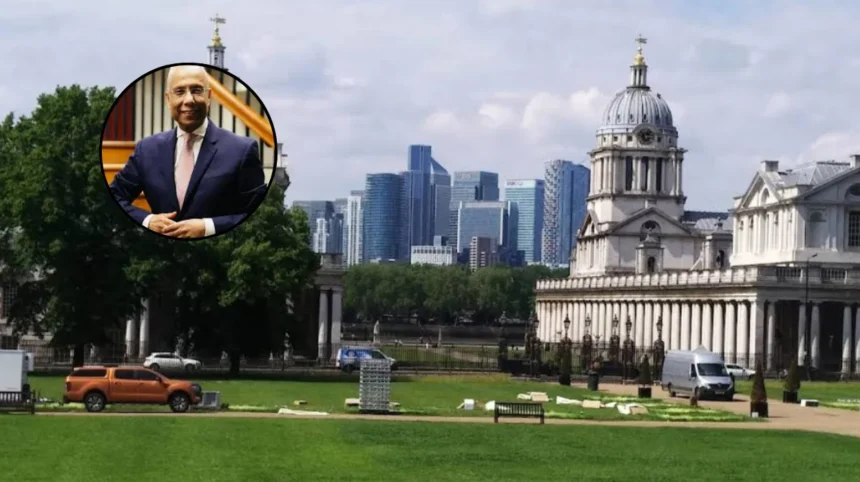
The transition of power comes at a time when Tower Hamlets is undergoing rapid gentrification, creating a stark contrast between the glass towers of Canary Wharf and the social housing estates of Poplar and Stepney. Rahman’s ability to bridge these divides—or perhaps exploit them—remains the central theme of his political identity.
Background of the Lutfur Rahman Development
The political saga of Lutfur Rahman began in 2010 when he became the first directly elected mayor of Tower Hamlets. Initially a member of the Labour Party, he was deselected following allegations of links to extremist groups—claims he has always denied. He subsequently ran as an independent and won.
In 2014, he was re-elected, but the result was challenged by four local voters led by Andy Erlam. This led to a high-profile trial in the Election Court. In April 2015, Commissioner Richard Mawrey QC ruled the election void, citing:
- Bribery: Redirecting council funds to specific community groups to secure votes.
- Spiritual Undue Influence: Using religious figures to tell voters it was a “sin” to vote against him.
- False Statements: Making defamatory claims of racism against his opponent, John Biggs.
Following the ruling, Rahman was barred from holding office for five years and was subsequently struck off the roll of solicitors. The borough was placed under the supervision of government-appointed commissioners until 2017 to restore financial and administrative integrity. His return in 2022 followed the expiration of his ban, during which time he formed the Aspire party, largely comprised of former allies and councillors who remained loyal during his exile.
Prediction: How this development will affect the residents of Tower Hamlets
The re-election of Lutfur Rahman is likely to result in an immediate and radical shift in local policy, specifically regarding urban planning and social spending. For the residents of Tower Hamlets, particularly those in car-owning households, the promised removal of Low Traffic Neighbourhoods (LTNs) will be a significant change, likely easing local driving restrictions but potentially increasing congestion and pollution in residential areas.
For the borough’s youth and low-income families, Rahman’s pledge to restore the Education Maintenance Allowance (EMA) and university grants—funded through the council budget—could provide a localized “safety net” that does not exist elsewhere in London. However, this increased spending may bring the council into direct conflict with central government fiscal constraints.
In the long term, there is a high probability of renewed central government scrutiny. If the Department for Levelling Up, Housing and Communities perceives any return to the “clientelism” or lack of transparency cited in the 2015 report, we can expect the re-imposition of external commissioners. This would effectively strip the local electorate of their autonomy once again, leading to further political instability and legal costs that would ultimately be borne by the local taxpayers. The primary risk for the audience is a return to a “siloed” form of local government, where resources are perceived to be distributed based on political loyalty rather than objective need, further deepening the social and ethnic divisions within the East End.