
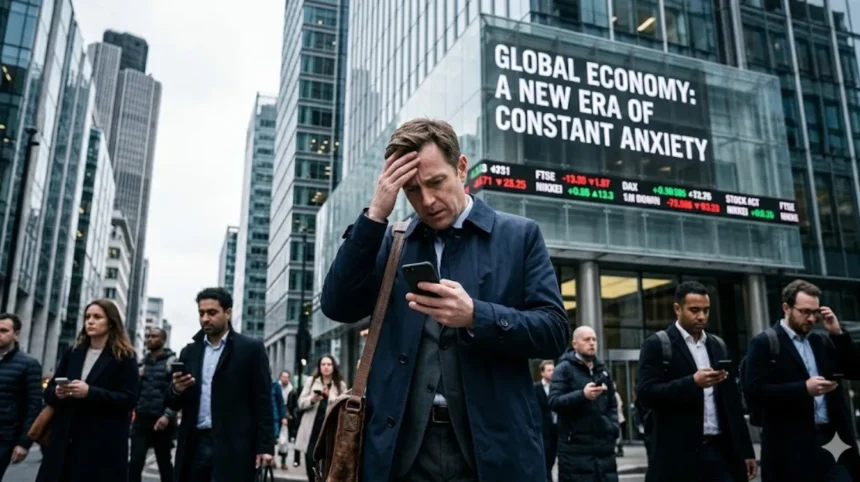
A few years ago, global markets treated crises as temporary disruptions. A political dispute, a military escalation, or an economic shock would dominate headlines for a period of time before markets gradually returned to normal. Today, however, the global economy appears to be adapting to a very different reality: the idea that uncertainty itself may no longer be temporary.
Over the past few years, crises have become more frequent and more interconnected. The world moved from a global pandemic that disrupted entire economies to war in Europe, rising tensions in the Middle East, and an increasingly intense economic rivalry between the United States and China. Each new development has forced governments, companies, and investors to adjust more quickly than before.
Yet adaptation should not be mistaken for stability.
Behind the surface, there is growing concern that uncertainty has become deeper and more structural than many expected. In the past, companies focused primarily on expansion, efficiency, and reducing production costs. Today, many businesses are asking a different question altogether: how can risk be managed in a world where disruption is becoming constant?
That shift in thinking says a great deal about the current state of the global economy.
Many international companies have started reassessing their supply chains, not only for economic reasons but also because of political and security concerns. Investors have become more cautious toward volatile markets, while some firms are relocating parts of their operations to countries considered more stable in the long term.
Even the language surrounding globalisation has changed. For decades, economic interdependence was viewed as a guarantee of growth and stability. Recent events, however, have revealed that interconnectedness can also create vulnerability. When trade routes are disrupted or energy prices surge in one region, the consequences quickly spread across global markets.
This partly explains why governments are increasingly talking about “economic security.” The conversation is no longer only about growth, but also about resilience — the ability to absorb shocks without severe long-term damage. As a result, many countries are now investing more heavily in domestic industries and trying to reduce dependence on external suppliers in sensitive sectors such as energy, technology, and food production.
Financial markets themselves have also changed their behaviour. In the past, geopolitical tensions often triggered immediate panic. Today, reactions are more measured, not necessarily because the risks are smaller, but because markets have become more accustomed to operating under pressure.
Still, this growing sense of adaptation may carry its own dangers. Learning to live with crises does not mean the global economy has become healthier or more secure. It may simply mean that businesses and governments are becoming used to functioning under constant stress.
Developing economies are particularly vulnerable in this environment. High interest rates, volatile energy prices, and weaker foreign investment flows continue to create serious challenges for countries already struggling with debt and slower growth.
At the same time, many emerging economies are attempting to build more flexible economic models by diversifying trade partnerships and reducing reliance on any single market or political bloc.
What remains striking is that despite all the discussion about artificial intelligence, digital transformation, and technological progress, global economics is still heavily influenced by geography and geopolitics. Events in strategic maritime routes or conflict zones can still reshape shipping costs, energy markets, and investment decisions within days.
The real question today is no longer when crises will end. Instead, it is whether the global economy can continue adapting to this persistent level of uncertainty without eventually paying a much higher price.
So far, markets appear determined to adjust. But it is becoming increasingly clear that the world economy is entering a phase where resilience and risk management matter far more than the traditional assumptions of endless stability and uninterrupted growth.