
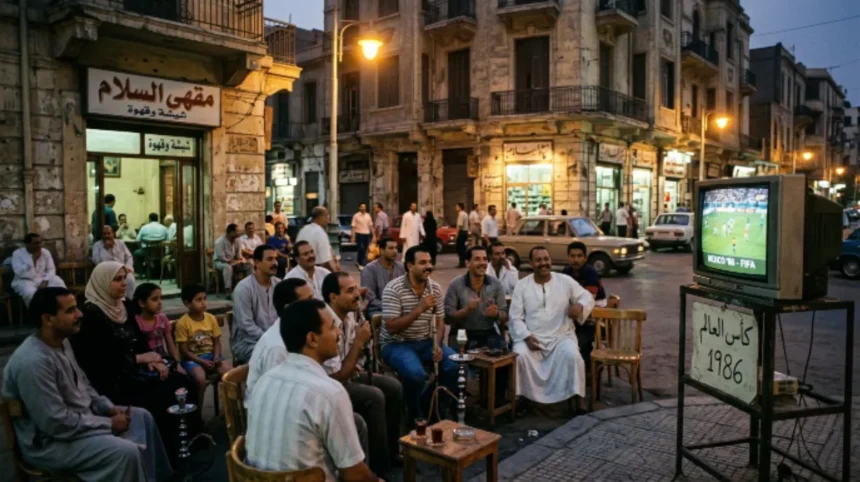
I have covered politics, economics, and international affairs for years, but the first story that ever shaped my understanding of the world was not told in a newsroom. It unfolded in a small café across the street from my childhood home in Cairo.
Every city has places that quietly shape the people who grow up within them. They rarely appear in travel guides or history books, yet they become part of who we are. For me, that place was Roxy in Korba, Heliopolis, Cairo.
Before I became a journalist—before interviews with ministers, economists, and diplomats—Roxy was simply home. My parents built our family house there, and the streets formed the landscape of my childhood. I walked them every morning to school, knew the shopkeepers by name, and grew up in a neighborhood that moved with a familiar, unspoken rhythm.
Across the street stood a modest place called Afternoon Café.
It was never famous. It did not appear in guidebooks, and no visitor ever came searching for it. To passersby, it was just a neighborhood café where men gathered over coffee and conversation. But to us, it was something else entirely. It was where the neighborhood came alive—where birthdays were celebrated without invitations, where arguments were settled over tea, and where everyone gathered when something important was happening in the world.
Nothing, however, compared to the summer of 1986.
I was sixteen years old when the FIFA World Cup took place in Mexico. At that time, football in Egypt was more than entertainment—it was a shared language. During the tournament, Afternoon Café transformed. Chairs spilled onto the pavement, televisions were brought out, and people arrived long before kickoff to secure their places. There was something unforgettable about those nights.
The sound of the commentator rose above the café, mixing with the clinking of cups and the murmur of anticipation. I remember sitting beside my father, both of us watching in silence as the match unfolded, the atmosphere shifting with every attack. It was not just a game on a screen; it felt like the entire street was breathing with it.
What struck me most was not the football itself. It was the people.
Shopkeepers stood beside students. Taxi drivers debated with engineers. Neighbors who rarely exchanged more than greetings suddenly shared opinions, emotions, and laughter. Differences did not disappear, but they stopped mattering. For ninety minutes, everyone belonged to the same moment.
Looking back now, I realize I was witnessing something I could not yet name: the quiet power of shared experience to dissolve distance between people.
Then came Diego Maradona.
I had seen great players before, but Maradona felt different. There was a kind of intensity in the way he played—defiant, effortless, and entirely unpredictable. Every touch of the ball seemed to carry possibility.
Watching him during that World Cup, I understood that football could be more than competition. It could be imagination in motion.
Even from thousands of kilometers away, sitting in a small café in Cairo, his presence felt enormous. He was not just playing matches; he was shaping memories.
But what stayed with me was not only his brilliance.
It was what he created around him.
In that café, every match became a collective emotional journey. Strangers celebrated together, argued passionately over refereeing decisions, and then laughed minutes later as if nothing had happened. Victory belonged to everyone. So did disappointment.
Years passed. Life moved forward, as it always does.
I left school, pursued higher education, and eventually built a career in journalism and strategic communications. My work took me into newsrooms, television studios, and interviews with ministers, diplomats, and economists. I wrote about politics, business, and international affairs.
But over time, I began to notice something. My understanding of people did not begin in journalism. It began in that café.
Without realizing it, I had been learning long before I studied the profession: how people react under pressure, how opinions are formed, how emotions spread in a room, how stories are shared without being written down. I was observing humanity before I ever wrote about it.
And journalism, I realized, is not only about reporting events.
It is about understanding people.
Perhaps that is why those World Cup evenings have never left me. They revealed something simple but lasting: behind every headline is a human experience, and behind every statistic is a life that matters.
Football was simply my first classroom.
Today, the game is unrecognizable in scale compared to those nights in Roxy. Stadiums are larger, broadcasting is global, and every moment is analyzed in real time across social media. The sport has become a multi-billion-dollar industry, shaped by sponsorships, broadcasting rights, and global audiences.
Yet despite all of that change, something essential has remained the same.
Football still creates moments where strangers feel less like strangers. In a world increasingly defined by division and speed, those moments matter more than ever. Whenever a World Cup begins, my mind does not go first to fixtures or teams. It goes back to Roxy.
I remember the walk across the street, the sound of chairs being arranged outside Afternoon Café, the anticipation before kickoff, and the roar that followed unforgettable goals.
Many of the faces I remember are gone now. The neighborhood has changed. The café itself exists more clearly in memory than in reality. But the lesson remains. Places are not defined by fame. They are defined by the people who gather within them.
Afternoon Café was never just a café. It was where a neighborhood became a community. It was where football became a shared language.
And for me, it was where a sixteen-year-old girl first understood that stories are what connect us most deeply. That understanding has never left me.
Even now, whenever I write about politics, economics, or international affairs, I try to return to that simple truth. The café across the street taught me that long before journalism ever did.