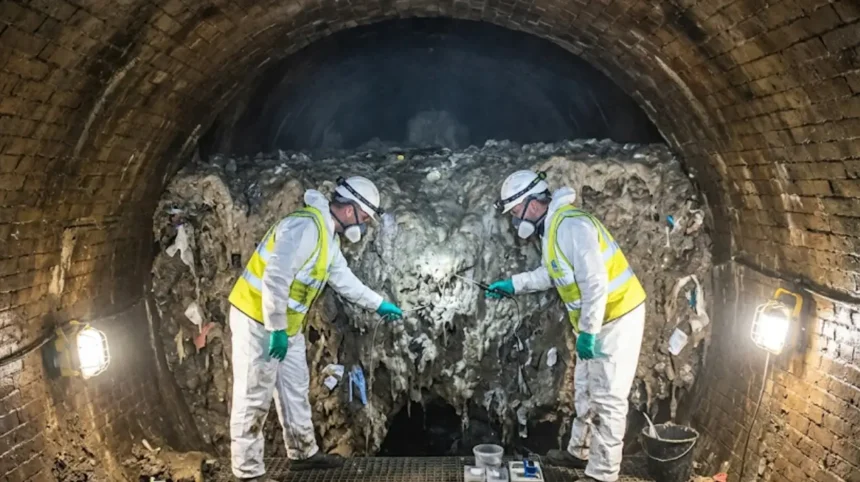
A 100-tonne fatberg measuring 100 metres was discovered in December 2025 beneath Whitechapel, East London, in a Victorian-era sewer tunnel. Thames Water engineers identified the blockage as congealed fats, oils, grease, and non-flushable waste, primarily wet wipes, forming through saponification and crystallisation processes in the sewer network.
- What is a fatberg and where was the East London fatberg found?
- How large was the Whitechapel fatberg compared to previous East London blockages?
- What causes fatbergs to form in East London sewers?
- How do Thames Water engineers remove fatbergs from sewers?
- What impact do fatbergs have on East London infrastructure and environment?
- How can East London residents prevent fatbergs from forming?
- What historical context explains fatberg prevalence in East London?
- What future measures will reduce fatberg formation in East London?
What is a fatberg and where was the East London fatberg found?
A fatberg is a solid mass of congealed cooking fat, oil, grease, and non-flushable items such as wet wipes, sanitary products, and nappies that blocks sewer pipes. The December 2025 East London fatberg was located in a Victorian sewer tunnel beneath Whitechapel Road, stretching approximately 100 metres and weighing an estimated 100 tonnes.
Fatbergs form when fats, oils, and grease (FOG) from household and commercial kitchens cool and solidify inside sewer pipes. These solidified deposits then trap non-biodegradable materials flushed down toilets or washed down sinks. The Whitechapel location sits within East London’s historic Victorian sewer infrastructure, originally constructed in the 19th century to serve a rapidly industrialising population.
The December 2025 discovery followed Thames Water’s routine inspection programme. Engineers identified the blockage before it caused complete obstruction or sewage overflow into streets and properties. Thames Water described this fatberg as the “grandchild” of the notorious 2017 Whitechapel fatberg, which measured 250 metres and weighed 130 tonnes.
Whitechapel lies in the London Borough of Tower Hamlets, a densely populated area with high residential density and significant commercial food service activity. The Victorian sewer beneath Whitechapel Road forms part of Thames Water’s wider London network, which serves approximately 15 million customers across the capital and Thames Valley.
How large was the Whitechapel fatberg compared to previous East London blockages?
The December 2025 Whitechapel fatberg measured 100 metres in length and weighed approximately 100 tonnes, making it smaller than the 2017 record-breaking 250-metre, 130-tonne blockage but still among the largest discovered in East London. Thames Water engineers estimated removal would take several weeks to complete.
The 2017 Whitechapel fatberg remains the largest ever recorded in the United Kingdom, weighing 130 tonnes, equivalent to 11 double-decker buses, and extending 250 metres, approximately the length of four football pitches or Tower Bridge. That blockage took nine weeks to fully remove and cost £220,000 in clearance operations.
Other notable East London fatbergs include a 35-tonne mass removed from Abbey Mills in 2024, requiring 11 days and 20 engineers to clear. A 2021 Canary Wharf fatberg, described as weighing the same as a small bungalow, took two weeks to extract from beneath Yabsley Street.
Thames Water removes approximately 75,000 blockages annually from its sewer network, with wet wipes identified as the primary cause. The company extracts 3.8 billion wet wipes each year at an operational cost of £18 million. During the festive period from December to January, clearance costs rise to £2.1 million due to increased FOG disposal from holiday cooking.
The 100-tonne December 2025 fatberg represents a significant but not unprecedented blockage. Its size reflects ongoing challenges with household and commercial waste disposal practices, particularly during seasonal periods when cooking activity increases substantially across East London households and food service establishments.
What causes fatbergs to form in East London sewers?
Fatbergs form through chemical reactions between fats, oils, grease, and calcium compounds in sewage, combined with accumulation of non-flushable materials like wet wipes, creating hardened deposits through saponification, crystallisation, and calcium aggregation. Five distinct processes drive fatberg formation in sewer systems.
The first mechanism involves fat solidification. When liquid cooking fats and oils enter sewers, they cool and transition from liquid to solid state, adhering to pipe walls. This process accelerates in older Victorian sewers with rough surfaces, cracks, or root intrusions that provide anchoring points for accumulating deposits.
Free fatty acid saponification represents the second pathway. Fatty acids from decomposed fats react with alkaline substances, particularly calcium from concrete pipe erosion and biological processes, forming soap-like compounds. These saponified materials create hard, concrete-like structures that resist normal wastewater flow and mechanical removal.
Biofilm formation constitutes the third mechanism. Microbial cells and trace organic or inorganic compounds in sewage create sticky biofilm layers on pipe surfaces. These biofilms trap additional FOG particles and non-flushable debris, accelerating deposit growth and creating complex layered structures within the sewer network.
Protein precipitation and starch aggregation represent additional contributing factors. Proteins from food waste and starch from carbohydrate-rich wastewater interact with FOG deposits, adding structural complexity and mass to developing fatbergs. These processes explain why fatbergs contain diverse organic and inorganic materials beyond simple cooking grease.
Research published in 2011 in Environmental Science & Technology first recreated fatberg deposits in laboratory conditions, confirming the chemical mechanisms behind their formation. More recent 2025 studies in PubMed highlight that while saponification receives most research attention, crystallisation and calcium-based aggregation pathways remain underrepresented in modelling frameworks despite their significant contribution to blockage formation.
East London’s high restaurant density intensifies fatberg risk. Areas with concentrated food service establishments contribute larger volumes of FOG into sewer systems. The Borough of Tower Hamlets, including Whitechapel, contains hundreds of restaurants, cafes, and commercial kitchens that collectively discharge substantial quantities of cooking waste into the Victorian sewer infrastructure.
How do Thames Water engineers remove fatbergs from sewers?
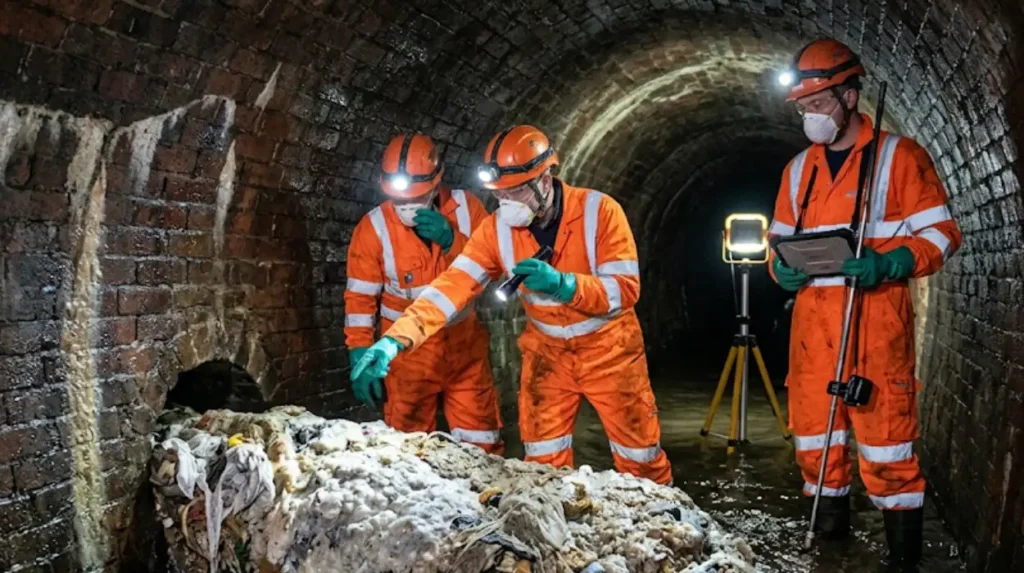
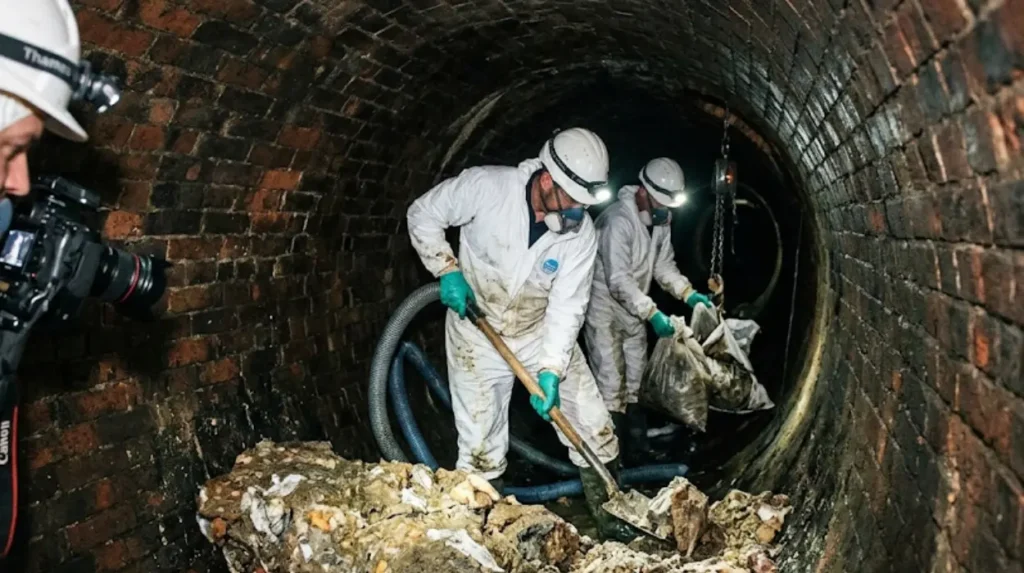
Thames Water engineers remove fatbergs using high-pressure water jets, mechanical cutting tools, and manual extraction with shovels, typically requiring teams of 20 or more workers over periods ranging from 11 days to nine weeks depending on fatberg size and location. The removal process demands specialised equipment and significant labour investment.
The extraction operation begins with site assessment and safety preparation. Engineers access the sewer through manholes or inspection chambers, deploying ventilation equipment to manage hazardous gases including methane and hydrogen sulphide that accumulate in blocked sewer sections. Personal protective equipment, including respiratory protection and waterproof clothing, is mandatory for all personnel.
High-pressure water jetting constitutes the primary removal method. Engineers deploy industrial-grade water jets operating at pressures exceeding 3,000 psi to break apart fatberg material and flush fragmented deposits toward extraction points. This technique works effectively on softer FOG deposits but requires supplementary methods for hardened saponified sections.
Mechanical cutting tools supplement water jetting for hardened fatberg sections. Engineers use specialised sewer-cutting equipment with rotating blades or chains to fragment concrete-like saponified deposits that water pressure alone cannot dislodge. These tools enable systematic reduction of fatberg mass into manageable pieces for removal.
Manual extraction becomes necessary for final clearance and delicate sections. Workers enter the sewer equipped with shovels, buckets, and hand tools to remove remaining fatberg material. The 2017 Whitechapel fatberg removal required manual scooping for the final stretch, with engineers describing the work as “gut-wrenching” due to the physical demands and unpleasant working conditions.
The 2024 Abbey Mills fatberg removal exemplifies typical operations. A team of 20 engineers worked over 11 days to clear a 35-tonne mass near the historic Abbey Mills pumping station. The operation combined high-pressure jetting, mechanical cutting, and manual extraction to fully restore sewer capacity.
Extracted fatberg material undergoes recycling where possible. The 2017 Whitechapel fatberg was converted into 10,000 litres of biodiesel, sufficient to power a Routemaster bus for one year. This recycling approach transforms waste into renewable energy while reducing landfill disposal requirements.
What impact do fatbergs have on East London infrastructure and environment?
Fatbergs cause sewer overflows, property flooding, environmental pollution, and infrastructure damage, with Thames Water spending £18 million annually on blockage removal and £220,000 on single large fatberg clearance operations that ultimately increase customer water bills. The environmental and economic consequences extend across multiple domains.
Sewer overflows represent the most immediate infrastructure threat. When fatbergs block Victorian-era tunnels, wastewater backs up through manholes and into streets, creating public health hazards and requiring emergency response. The 2021 Canary Wharf fatberg threatened to spill sewage into residential and commercial properties beneath Yabsley Street before engineers intervened.
Property flooding causes direct financial damage to homeowners and businesses. Blocked sewers force wastewater back through ground-floor drains, toilets, and sinks, contaminating interiors with raw sewage. Cleanup costs, property damage, and business interruption claims from fatberg-related flooding add substantial expenses beyond Thames Water’s clearance operations.
Environmental pollution affects local waterways and ecosystems. Sewer overflows discharge untreated wastewater into the River Thames and its tributaries, introducing pathogens, nutrients, and pollutants that harm aquatic life and degrade water quality. Fatbergs contribute significantly to sanitary sewer overflows, posing serious environmental and public health risks documented in 2025 PubMed research.
Infrastructure damage accelerates deterioration of Victorian sewers. The 2017 Whitechapel fatberg damaged the one-metre-high Victorian tunnel, requiring structural repairs beyond simple blockage removal. Older sewers, constructed with brick and mortar, prove particularly vulnerable to fatberg-induced stress and corrosion from trapped wastewater.
Economic costs fall on Thames Water customers through increased water bills. The £220,000 clearance cost for the 2017 Whitechapel fatberg, plus £18 million annual blockage removal expenditure, factors into customer tariffs. Thames Water states that blockage costs “get reflected in your water bills,” directly linking household waste disposal practices to utility expenses.
Carbon emissions from removal operations add environmental impact. Diesel-powered pumps, heavy machinery, and transport vehicles required for fatberg extraction generate greenhouse gas emissions. The 2024 Abbey Mills operation, involving 20 personnel over 11 days with multiple equipment deployments, exemplifies the carbon footprint associated with reactive fatberg management.
Public health risks emerge from sewage exposure. Overflow events release pathogens including E. coli, salmonella, and norovirus into public spaces, creating infection risks for residents, pedestrians, and emergency workers. Fatberg prevention directly protects community health by maintaining sewer capacity and preventing wastewater discharge into populated areas.
How can East London residents prevent fatbergs from forming?
Thames Water’s “Bin it – don’t block it” campaign advises residents to dispose of cooking fat, oil, and grease in bins rather than sinks, and to flush only the three Ps: pee, poo, and toilet paper, avoiding wet wipes, sanitary products, and other non-flushable items. Simple behavioural changes prevent fatberg formation at source.
Kitchen fat disposal requires proper cooling and containment. After cooking, residents should allow fats, oils, and grease to cool completely, then pour into sealed containers or mix with absorbent materials like cat litter before placing in household waste bins. Thames Water specifically warns against pouring gravy, custard, and roasting fats down sinks during festive periods.
Wet wipes and sanitary products must go in bins regardless of “flushable” labelling. Even products marketed as flushable do not break down adequately in sewer systems and contribute to fatberg structure. Thames Water removes 19 billion wet wipes from sewers every five years at costs exceeding £90 million, making wipes the number one cause of blockages.
The three Ps rule provides clear guidance for toilet use. Only urine, faeces, and toilet paper should enter the sewer system through toilets. Condoms, nappies, dental floss, cotton buds, and other personal items belong in household waste bins to prevent accumulation in sewer pipes.
Restaurant and commercial food service compliance reduces FOG discharge. Thames Water has visited over 5,000 restaurants, pubs, and food establishments since April 2024, installing grease management systems and educating business owners on proper fat disposal. Commercial kitchens contribute disproportionately to sewer FOG loads, making business compliance critical for East London prevention efforts.
Chemical and solvent disposal requires specialist handling. Paint, engine oil, cleaning chemicals, and medicines should not enter sewers. Residents should take these materials to local refuse sites or pharmacies for safe disposal, preventing chemical reactions that accelerate fatberg formation and protecting wastewater treatment processes.
Community education programmes target behavioural change. Thames Water’s personalised video campaigns, addressing customers directly about how their behaviours feed fatbergs, achieved up to 31% reduction in blockages in targeted areas compared to 4% increases in control regions. Localised messaging proves effective in driving prevention outcomes.
Seasonal awareness campaigns intensify during high-risk periods. Thames Water launches festive fatberg prevention initiatives each November and December, highlighting risks from Christmas cooking and increased household waste. The December 2025 Whitechapel fatberg discovery prompted renewed warnings about holiday waste disposal practices across East London.
What historical context explains fatberg prevalence in East London?
Fatbergs emerged as a recognised phenomenon in London during the 2010s, with the 2017 Whitechapel fatberg becoming a cultural reference point, while underlying causes include dietary changes increasing oil consumption, Victorian sewer infrastructure limitations, and modern disposable product usage patterns. Historical developments illuminate current fatberg challenges.
The term “fatberg” entered public discourse following a 2013 discovery in Kingston upon Thames, where a bus-sized mass blocked drains under London Road. Media coverage of subsequent discoveries, particularly the 2017 Whitechapel monster, cemented fatberg in public vocabulary as shorthand for severe sewer blockages.
Dietary changes over recent decades increased FOG discharge into sewers. The British diet became oilier as cooking methods shifted toward frying and oil-based preparation. Households no longer retain or recycle cooking oil as in previous generations, instead disposing of it directly down drains, substantially increasing FOG loads in sewer networks.
Victorian sewer infrastructure, designed for 19th-century population densities and waste profiles, struggles with modern demands. The Whitechapel sewer where the 2025 fatberg was discovered dates to the Victorian era, constructed with one-metre-high brick tunnels that cannot accommodate contemporary waste volumes or compositions.
Wet wipes and disposable product proliferation accelerated from the 1990s onward. Single-use personal care products, marketed for convenience, enter sewers in unprecedented quantities. Thames Water’s extraction of 3.8 billion wet wipes annually reflects the scale of modern disposable consumption incompatible with Victorian sewer design parameters.
Urban population growth intensified sewer loading. East London’s population density increased substantially since Victorian construction, with Tower Hamlets among London’s most densely populated boroughs. Higher residential and commercial density concentrates FOG and waste discharge into fixed-capacity sewer infrastructure, amplifying fatberg formation risk.
Cultural recognition of fatbergs grew through media coverage and museum exhibitions. The London Museum acquired a section of the 2017 Whitechapel fatberg for permanent display, transforming a public health nuisance into a cultural artefact documenting contemporary urban infrastructure challenges. This institutional recognition elevated fatberg from technical sewer issue to broader symbol of modern waste management problems.
What future measures will reduce fatberg formation in East London?
Thames Water’s future fatberg reduction strategy combines expanded business engagement, enhanced public education campaigns, infrastructure upgrades, and recycling initiatives including biodiesel conversion, targeting 80% of blockages caused by sewer abuse through prevention rather than reactive clearance. Integrated approaches address fatberg formation at multiple levels.
Business engagement programmes will expand beyond the 5,000+ restaurants visited since April 2024. Thames Water plans systematic outreach to remaining food service establishments across East London, installing grease traps and management systems that capture FOG before it enters sewers. Commercial sector compliance offers substantial fatberg reduction potential given disproportionate FOG contribution from food businesses.
Public education campaigns will intensify personalisation and localisation. Building on the 31% blockage reduction achieved through targeted video messaging, Thames Water will deploy more granular community-specific campaigns addressing neighbourhood disposal patterns. Hyperlocal messaging connects individual behaviours to visible local consequences, strengthening prevention motivation.
Infrastructure modernisation will gradually increase sewer capacity. Thames Water’s long-term investment plans include upgrades to Victorian tunnels in high-risk areas like Whitechapel, though complete network replacement remains economically unfeasible. Strategic improvements at known fatberg hotspots will reduce blockage frequency and severity.
Recycling and energy recovery from extracted fatbergs will expand. The biodiesel conversion model demonstrated with the 2017 Whitechapel fatberg will apply to future large-scale removals, transforming waste into renewable energy. Energy recovery offsets carbon emissions from removal operations while creating economic value from otherwise problematic materials.
Monitoring and early detection systems will improve through sensor deployment. Research into fatberg formation mechanisms, including 2025 studies on crystallisation and calcium aggregation pathways, informs development of predictive models and real-time monitoring tools. Early detection enables intervention before blockages reach critical size, reducing clearance costs and environmental impacts.
Regulatory frameworks may strengthen around wet wipes and disposable products. Ongoing policy discussions consider restrictions on non-biodegradable personal care products and mandatory labelling requirements. Legislative changes could reduce the volume of fatberg-forming materials entering sewers through consumer product reformulation and disposal guidance.
Community partnership initiatives will expand local prevention capacity. Thames Water collaborates with East London councils, community groups, and schools to embed fatberg prevention in local environmental education. Grassroots engagement builds sustained behavioural change beyond periodic campaign cycles, creating cultural norms around responsible waste disposal.
The December 2025 Whitechapel fatberg discovery reinforces the urgency of these measures. As Thames Water continues clearing 75,000 blockages annually at £18 million cost, prevention strategies offer the only sustainable path toward reducing fatberg prevalence in East London’s sewer network.
What is the Whitechapel fatberg?
The Whitechapel fatberg was a 100-tonne, 100-metre blockage discovered beneath Whitechapel Road in East London in December 2025. It consisted of hardened fats, oils, grease (FOG), and non-flushable waste, mainly wet wipes, that had accumulated inside a Victorian sewer.