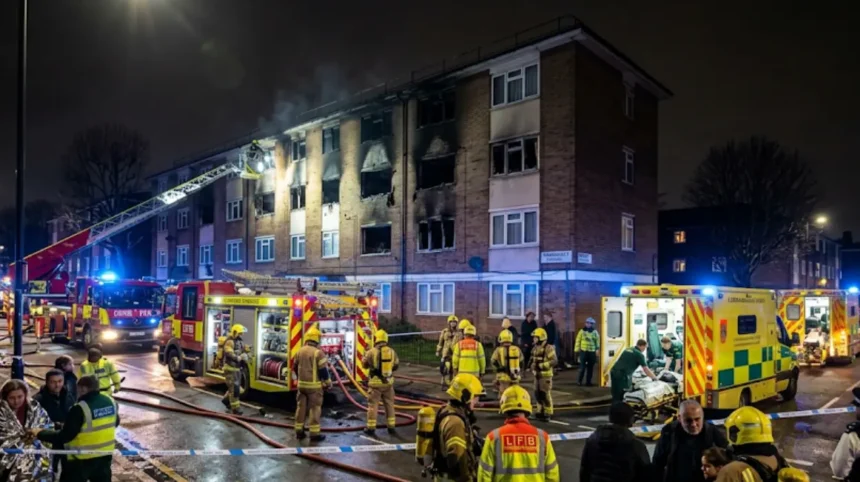
The Bethnal Green fire on 9 April 2025 started when a lithium-ion battery for an e-bike or e-scooter failed and ignited inside a flat at Bradbeer House on Cornwall Avenue, triggering a rapid blaze that spread through three floors and required evacuation of all 18 flats in the block. Approximately 60 firefighters from the London Fire Brigade attended, rescued seven people using breathing apparatus and fire escape hoods, and brought the fire under control by 01:05 BST. The London Ambulance Service treated 17 patients on scene and took 11 to hospital, while Tower Hamlets Council opened a rest centre and arranged emergency housing for displaced residents.
- What started the Bethnal Green fire on Cornwall Avenue?
- Definition and background of lithium-ion battery fires
- Specific cause findings for the Cornwall Avenue fire
- Historical context of e-bike and e-scooter fires in London
- How did the fire spread through Bradbeer House?
- Building layout and occupancy
- Fire dynamics and smoke propagation
- Extent of damage
- What was the emergency response by London Fire Brigade?
- Initial call and mobilisation
- Firefighting and rescue operations
- Command and coordination
- How did London Ambulance Service and hospitals respond?
- Pre-hospital care and triage
- Patient numbers and outcomes
- Hazardous Area Response Team role
- What support and housing response followed the fire?
- Rest centre and immediate welfare support
- Emergency housing and hotel placements
- Recovery and return to homes
- What are the wider implications for e-bike safety in East London?
- Statistical and trend context
- Safety guidance and behavioural changes
- Policy and regulatory implications
- What lessons does the Bethnal Green fire hold for residents and landlords?
- Lessons for residents
- Lessons for landlords and housing providers
- System-wide implications for East London
What started the Bethnal Green fire on Cornwall Avenue?
The fire began when a lithium-ion battery pack for an e-bike or e-scooter malfunctioned and entered thermal runaway inside a ground-floor flat at Bradbeer House, Cornwall Avenue, Bethnal Green, shortly before midnight on 9 April 2025. Investigators concluded the incident was accidental, with the most probable cause being failure of a lithium-ion battery associated with an e-bike or e-scooter, consistent with a pattern of similar fires across London.
Definition and background of lithium-ion battery fires
Lithium-ion batteries are rechargeable power sources commonly used in e-bikes, e-scooters, mobile phones, and laptops. They store high energy density in compact cells. When damaged, defective, or improperly charged, they can enter thermal runaway, a self-sustaining chain reaction where internal temperature rises rapidly.
In thermal runaway, electrolyte inside the battery vaporizes and ignites, producing intense heat, toxic smoke, and in some cases explosion. London Fire Brigade has stated that a failing e-bike battery can compromise a good-sized double bedroom in 10 to 15 seconds. This speed limits escape time and increases risk in multi-occupancy buildings.
Specific cause findings for the Cornwall Avenue fire
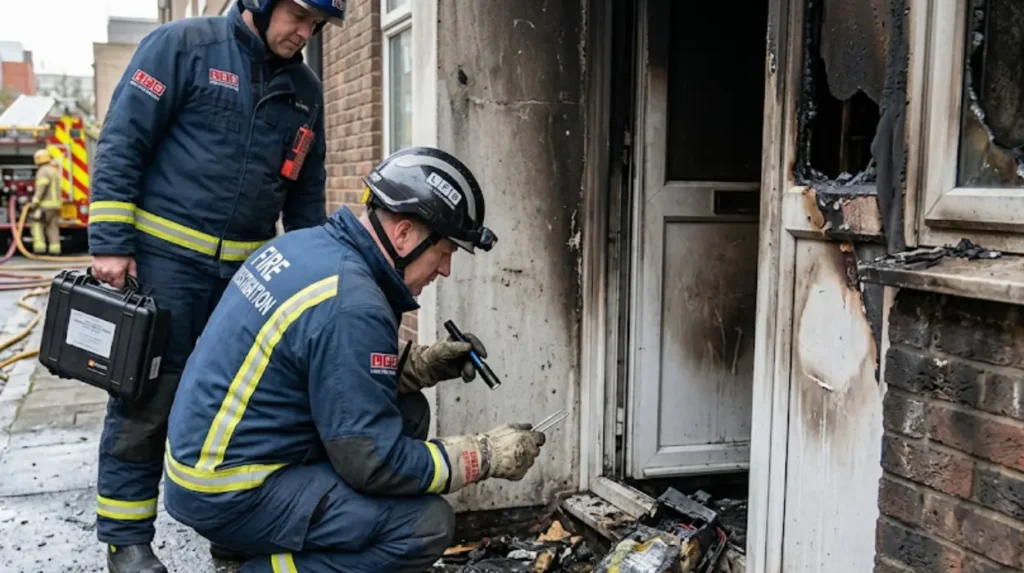
London Fire Brigade’s Fire Investigation team examined the scene at Bradbeer House after the 9 April 2025 fire. Their assessment identified the most probable cause as failure of a lithium-ion battery linked to an e-bike or e-scooter. The brigade treated the fire as accidental, not deliberate.
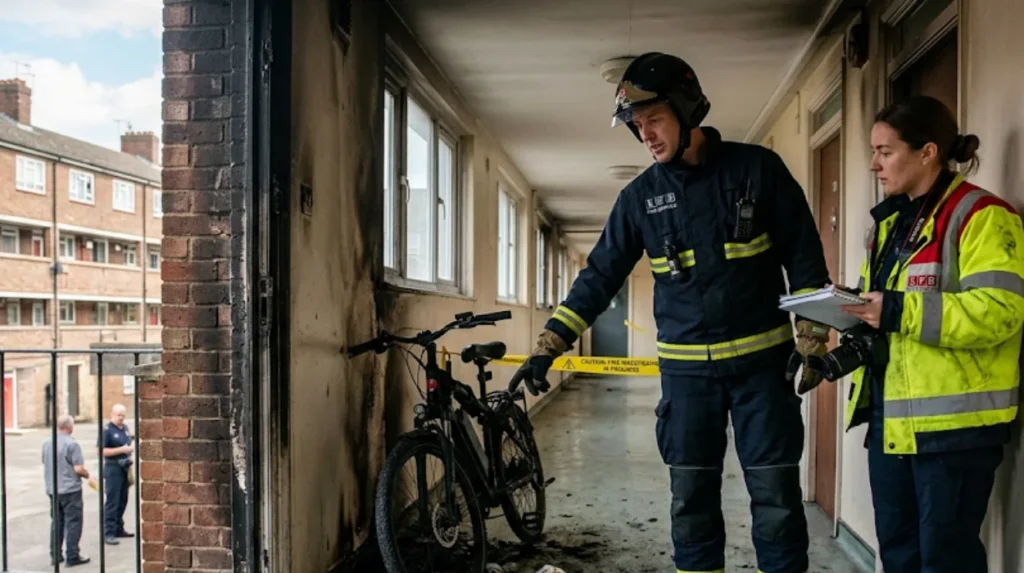
Witness accounts and local reporting indicated two second-hand e-bikes were being charged in the flat where the fire started. Neighbors reported the fire may have been sparked by lithium batteries from an electric bike before flames engulfed part of the building. The severity of fire damage complicated investigation, but the technical evidence pointed to battery failure rather than electrical fault in fixed wiring or other ignition sources.
Historical context of e-bike and e-scooter fires in London
The Bethnal Green fire occurred within a wider trend of lithium-ion battery fires in London. By April 2025, fire chiefs reported e-bike and e-scooter fires happening “every other day” across the capital. The Cornwall Avenue incident followed other serious battery-related fires in different boroughs, prompting renewed safety warnings from London Fire Brigade.
In 2023, former deputy commissioner Dom Ellis told the London Assembly that a bulging or swelling battery, or a strong unusual smell from a battery, are common signs of impending failure. The Brigade’s #ChargeSafe campaign advised users not to leave batteries charging while asleep, to keep escape routes clear, and to store e-bikes and e-scooters outdoors or in rooms with closable doors where possible.
How did the fire spread through Bradbeer House?
The fire spread vertically through the ground, first, and second floors of Bradbeer House, damaging three flats and generating heavy smoke that affected all 18 flats in the residential block, forcing full evacuation. Intense heat and smoke compromised internal stairways and common areas, requiring firefighters to conduct rescue operations using breathing apparatus and fire escape hoods.
Building layout and occupancy
Bradbeer House is a residential block on Cornwall Avenue in Bethnal Green, Tower Hamlets, East London. The building contains 18 flats across multiple floors. On the night of 9 April 2025, the building was fully occupied, with residents asleep in multiple units when the fire started just before midnight.
The fire originated in a ground-floor flat and rapidly extended upward through the first and second floors. London Fire Brigade reported that part of three flats spread between the ground, first, and second floors suffered fire damage. Smoke and heat permeated the building beyond the directly burnt flats, affecting conditions throughout the block.
Fire dynamics and smoke propagation
Lithium-ion battery fires produce fast-developing heat and large volumes of toxic smoke. Once the battery in the ground-floor flat entered thermal runaway, flames and hot gases spread to nearby combustible materials such as furniture, furnishings, and internal finishes.
Smoke rose through stairwells and vertical shafts, reducing visibility and air quality on upper floors. This dynamic is typical in purpose-built flats where internal corridors and staircases act as chimneys during fire. The rapid smoke spread meant residents on floors above the origin faced life-threatening conditions within minutes, even if flames did not directly reach their flats.
Extent of damage
London Fire Brigade confirmed that three flats across three floors were completely gutted by the fire. All 18 flats in Bradbeer House sustained damage from fire, heat, or smoke to varying degrees. Structural elements remained sound, but internal decoration, electrical systems, and personal property in many units were destroyed or contaminated by smoke and soot.
The concentration of damage on the ground, first, and second floors reflected the fire’s vertical progression from its origin. Smoke logging in upper floors and common areas rendered the building temporarily uninhabitable, requiring full evacuation and later professional cleaning and repair before residents could return.
What was the emergency response by London Fire Brigade?
London Fire Brigade mobilised eight fire engines and around 60 firefighters from Bethnal Green, Poplar, Shadwell, Shoreditch, and surrounding stations, arriving shortly after 23:38 on 9 April 2025 and bringing the fire under control by 01:05 BST. Crews used breathing apparatus to enter smoke-filled areas, rescued seven people using fire escape hoods, and coordinated with London Ambulance Service and Tower Hamlets Council to manage evacuation and casualty care.
Initial call and mobilisation
London Fire Brigade received the first emergency call at 23:38 on 9 April 2025 reporting a fire at a flat on Cornwall Avenue, Bethnal Green. Control officers took 36 calls in total and provided fire survival guidance to three residents on how to stay safe before firefighters arrived.
The incident was categorised as a flat fire in a multi-storey residential block. Standard mobilisation for this category in London includes multiple fire engines, specialist breathing apparatus crews, and senior officers. Units from Bethnal Green, Poplar, Shadwell, and Shoreditch fire stations attended, along with surrounding stations to meet resource requirements.
Firefighting and rescue operations
Approximately 60 firefighters worked at the scene. Teams wearing breathing apparatus entered the building to locate the fire, search for occupants, and conduct rescues. Fire escape hoods were used to protect residents during evacuation through smoke-filled corridors and stairways.
Firefighters rescued seven people from the building using these methods. Attack crews deployed hose reels and main jets to suppress the fire in the affected flats. The combination of direct attack on the seat of the fire and ventilation control allowed crews to contain the blaze and prevent further spread to other parts of the block.
The fire was declared under control at 01:05 BST on 10 April 2025, 87 minutes after the first call. This timeframe reflects the intensity of the fire and the need to ensure all hot spots were extinguished and the building made safe before handing over to building management and council teams.
Command and coordination
Senior officers established an incident command system on arrival, coordinating fire suppression, search and rescue, and liaison with other agencies. Control room staff maintained communication with crews inside the building and monitored resource levels to ensure adequate rotational relief for breathing apparatus users.
London Fire Brigade’s techniques and procedures for high-rise and multi-occupancy fires include pre-planned resource allocation, breathing apparatus management, and evacuation support. The Cornwall Avenue incident followed these established protocols, adapted to the specific layout and conditions at Bradbeer House.
How did London Ambulance Service and hospitals respond?
London Ambulance Service dispatched multiple resources including ambulance crews, advanced paramedics, and a Hazardous Area Response Team, treating 17 patients at the scene and transporting 11 to hospital, while six were assessed and discharged on site. Hospital teams received the casualties for further assessment and treatment of smoke inhalation, burns, and other injuries.
Pre-hospital care and triage
London Ambulance Service received the emergency call at 23:38 on 9 April 2025, matching the time of the first fire brigade call. The service deployed a range of resources to Cornwall Avenue, including standard ambulance crews, advanced paramedics capable of delivering enhanced pre-hospital care, and members of the Hazardous Area Response Team trained to operate in hazardous environments such as active fire scenes.
On arrival, paramedics established a casualty clearing area near the incident. They conducted primary triage, assessing airway, breathing, circulation, and level of consciousness for each patient. Common presentations included smoke inhalation, respiratory distress, minor burns, and exacerbation of pre-existing conditions such as asthma or heart disease triggered by stress and smoke exposure.
Patient numbers and outcomes
London Ambulance Service treated 17 patients in total at Bradbeer House. Of these, 11 were transported to hospital for further care. Six patients were assessed, treated, and discharged at the scene, indicating less severe injuries or symptoms that resolved after oxygen therapy and basic interventions.
Among the 11 hospital patients were residents of various ages, including at least one firefighter who sustained injuries during rescue operations. Hospital treatment focused on managing smoke inhalation, monitoring for delayed respiratory complications, and treating any burns or trauma. Specific hospital names were not disclosed publicly, but major trauma and burns-capable hospitals in East London would typically receive such casualties.
Hazardous Area Response Team role
The Hazardous Area Response Team (HART) is a specialist unit within London Ambulance Service trained to enter dangerous environments, including smoke-filled buildings, chemical incidents, and confined spaces. HART paramedics can provide advanced life support while wearing protective equipment and coordinating closely with fire service crews.
At the Cornwall Avenue fire, HART members supported casualty extraction from inside the building and delivered immediate care in the presence of ongoing fire and rescue operations. Their involvement reduced time to treatment for patients trapped or overcome by smoke, improving survival and reducing severity of injury.
What support and housing response followed the fire?
Tower Hamlets Council opened a rest centre to provide immediate support to affected residents, while Clarion Housing, the building’s managing organisation, arranged emergency hotel placements and alternative housing for displaced households, with vulnerable residents receiving specialised care. Recovery efforts focused on enabling residents to return safely to their homes after repairs and smoke clearance.
Rest centre and immediate welfare support
Tower Hamlets Council activated its emergency planning arrangements following the fire. A rest centre was established to offer immediate assistance to residents evacuated from Bradbeer House. Rest centres provide a safe, warm environment, basic refreshments, information updates, and access to welfare and housing officers.
Council staff prioritised vulnerable residents, including elderly people, those with disabilities, and families with young children. Specialist care included help with medication, mobility support, and safeguarding arrangements where needed. The council coordinated with London Fire Brigade and London Ambulance Service to ensure accurate information about missing or injured persons.
Emergency housing and hotel placements
Clarion Housing, the organisation responsible for managing Bradbeer House, deployed staff to the scene from early morning on 10 April 2025. Their teams assisted residents, documented displaced households, and arranged emergency accommodation. Many residents received hotel placements as an immediate solution while the building remained unsafe for occupation.
Rob Lane, Clarion’s chief property officer, stated that staff were present at Bradbeer House since the early morning hours, assisting residents and arranging emergency housing. The housing provider worked alongside Tower Hamlets Council to ensure that all displaced households had temporary accommodation and that longer-term rehousing options were considered where flats required extensive repair.
Recovery and return to homes
Clarion Housing took the lead on recovery initiatives, with council support to help residents return safely to their homes. Recovery work included structural inspections, electrical safety checks, smoke and soot remediation, and repairs to fire-damaged flats and communal areas.
Residents whose flats were directly affected by fire faced longer timelines before return, requiring full refurbishment. Others with smoke damage only could return sooner after professional cleaning and safety certification. The council and housing provider maintained communication with residents throughout this process, providing updates and support for those unable to return immediately.
Explore More Help & Resources
London Data Centres CO2 Concern What City Hall Is Doing
East Havering Data Centre Plans What It Means for the Borough
What are the wider implications for e-bike safety in East London?
The Bethnal Green fire reinforced London Fire Brigade’s warning that e-bikes and e-scooters represent London’s fastest-growing fire risk, with incidents occurring every other day and capable of causing severe injury, death, and large-scale property damage in dense urban housing. The incident prompted renewed emphasis on safe charging practices, storage guidance, and potential regulatory measures to reduce lithium-ion battery fire risk in multi-occupancy buildings.
Statistical and trend context
By April 2025, fire chiefs reported e-bike and e-scooter fires happening “every other day” in London. The Cornwall Avenue fire was one of several severe e-bike-related incidents in a short period, with three homes gutted in one week across different parts of the city later in 2025. These patterns indicate a growing public safety challenge linked to increased e-bike adoption and variable battery quality.
London Fire Brigade data show that lithium-ion battery fires often start during charging, especially overnight or when devices are left unattended. Second-hand or non-certified batteries and chargers carry higher risk due to unknown history and potential internal damage.
Safety guidance and behavioural changes
Following the Bethnal Green fire, London Fire Brigade reiterated key safety messages. Users should avoid leaving e-bikes or e-scooters charging while asleep or unattended. Batteries should be stored outdoors or in a secure shed where possible, or in rooms with closable doors to contain any fire.
Warning signs of battery failure include bulging or swelling, unusual smells, excessive heat during charging, and visible damage to the casing. Users are advised to use only manufacturer-approved chargers, avoid overcharging, and replace batteries showing signs of degradation. The #ChargeSafe campaign provides detailed guidance on these points.
Policy and regulatory implications
The frequency and severity of e-bike fires have prompted calls for stronger regulation of battery imports, sales, and second-hand markets. Policymakers and fire safety experts argue for mandatory safety standards, clearer labelling, and restrictions on indoor charging in certain building types.
In high-density areas like Bethnal Green, Whitechapel, and Poplar, where many residents live in flats with limited outdoor space, safe storage and charging infrastructure remain challenging. The Cornwall Avenue fire highlighted the need for building-level solutions, such as designated external charging areas and improved fire detection and suppression systems in communal spaces.
What lessons does the Bethnal Green fire hold for residents and landlords?
The Bethnal Green fire demonstrates that single-point failures in lithium-ion batteries can escalate into building-wide emergencies, requiring robust fire safety measures, clear evacuation plans, and proactive risk management by both residents and landlords in multi-occupancy housing. Effective response depends on early warning, safe escape routes, and coordinated action between fire services, ambulance crews, councils, and housing providers.
Lessons for residents
Residents in flats should avoid charging e-bikes or e-scooters inside living spaces, especially overnight. Where indoor charging is unavoidable, it should occur in rooms with closable doors, away from sleeping areas and escape routes. Regular inspection of batteries and chargers for damage or swelling is essential.
Households should maintain clear escape routes, test smoke alarms regularly, and know how to respond if a fire starts in their flat or a neighboring unit. London Fire Brigade’s fire survival guidance, delivered during emergency calls, emphasises staying low in smoke, closing doors to contain fire, and only evacuating when it is safe to do so.
Lessons for landlords and housing providers
Landlords and housing associations must ensure that fire risk assessments account for emerging risks such as e-bike and e-scooter charging. This includes reviewing policies on indoor charging, providing safe external storage options where feasible, and installing appropriate fire detection and suppression systems in communal areas.
Clear communication with residents about fire safety, including specific guidance on battery charging and storage, reduces risk and supports compliance. Post-incident reviews, like those conducted after the Cornwall Avenue fire, inform updates to building-level emergency plans and resident engagement strategies.
System-wide implications for East London
The Bethnal Green fire underscores the interconnected nature of fire safety in dense urban environments. Individual household practices affect whole-building risk. Emergency response effectiveness depends on building design, maintenance, and resident behaviour.
For East London, where many communities live in high-density social housing, the incident reinforces the need for coordinated action between Tower Hamlets Council, housing providers, London Fire Brigade, and residents. Investment in education, infrastructure, and regulation around lithium-ion battery safety will shape fire risk profiles in the borough for years to come.
What happened during the Bethnal Green fire on Cornwall Avenue?
The fire broke out shortly before midnight on 9 April 2025 at Bradbeer House on Cornwall Avenue in Bethnal Green after a lithium-ion battery associated with an e-bike or e-scooter failed inside a ground-floor flat. The blaze spread rapidly through three floors of the building, forcing the evacuation of all 18 flats. Around 60 firefighters attended and brought the fire under control by 1:05am on 10 April 2025.