Havering independence refers to a political movement seeking to detach the London Borough of Havering from the Greater London Authority and rejoin Essex as a self-governing unitary council. The proposal, championed primarily by Reform UK figures including Romford MP Andrew Rosindell, promises residents a referendum on leaving London governance. Supporters argue this restores historical identity and local control, while opponents warn of funding losses and service disruptions. The movement gained prominence during 2026 local election campaigns.
- What Is the Havering Independence Movement?
- What Does Havering Independence Want to Achieve?
- Who Backs the Havering Independence Proposal?
- Who Opposes Havering Independence and Why?
- What Legislation Would Enable Havering Independence?
- What Practical Changes Would Independence Bring?
- When Could a Havering Independence Vote Occur?
- Could Havering Independence Trigger Other Borough Exits?
- What Is Reform UK’s Wider Local Government Strategy?
What Is the Havering Independence Movement?
The Havering independence movement, dubbed “Hexit,” seeks to remove Havering from Greater London Authority control and establish it as an independent unitary authority within Essex county. This proposal requires primary legislation from Westminster, as boroughs cannot unilaterally exit the GLA. The concept mirrors Brexit terminology, combining “Havering” with “exit.” Advocates frame it as democratic restoration following the 1965 incorporation into Greater London.
Havering comprises the London Borough of Havering in East London, formed in 1965 under the London Government Act 1963. The borough merged the former Romford Borough Council and Hornchurch Urban District, both previously part of Essex county. The area covers 112 square kilometres with a population exceeding 260,000 residents. More than 50% of Havering’s land remains Metropolitan Green Belt-protected, maintaining its suburban and semi-rural character distinct from inner London boroughs.
The Royal Liberty of Havering, also known as Havering-atte-Bower, existed as an ancient liberty and royal manor from medieval times until 1865. This historical jurisdiction granted Havering significant autonomy from Essex county administration. The liberty’s abolition integrated the area fully into Essex before the 1965 creation of Greater London. Independence advocates cite this precedent as evidence of Havering’s traditional self-governance rights.
What Does Havering Independence Want to Achieve?
Havering independence aims to restore local control over planning, housing, transport, and policing by exiting Greater London Authority jurisdiction and rejoining Essex county governance structures. The movement seeks to eliminate Ultra Low Emission Zone charges affecting Havering residents. Proponents argue this shift would reduce council tax burdens while increasing democratic accountability to local voters rather than City Hall. The proposal includes transitioning to Essex County Council elections instead of London Assembly polls.
Andrew Rosindell, Reform UK MP for Romford since 2001, articulated specific objectives at a February 2026 rally in Romford. Rosindell stated Havering would regain control over town centre development, currently subject to London-wide planning frameworks. The removal of ULEZ represents a central demand, with Rosindell describing the zone as “dividing families and communities.” Rosindell emphasised that policies affecting Havering should be decided by Havering residents, not the Mayor of London.
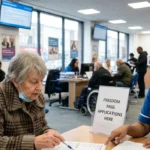
The movement proposes establishing Havering as a unitary authority, a single-tier council overseeing all local services including social care, education, housing, and waste collection. Unitary authorities operate independently from county councils, providing streamlined governance. Havering would “buy in” certain services currently provided through the GLA, such as Freedom Pass travel concessions for pensioners and disabled residents. The Metropolitan Police service would require separate negotiation or replacement with Essex Police jurisdiction.
Financial implications remain contested. Reform UK estimates suggest £20 million annual savings from exiting GLA precepts and levies. Critics warn of reduced funding for schools, Transport for London services, and cross-borough infrastructure projects. The Greater London Authority distributes approximately £1 billion annually across 32 boroughs through various funding mechanisms. Havering currently receives net benefits from this pooling arrangement despite contributing council tax revenue.
Who Backs the Havering Independence Proposal?
The Havering independence proposal receives primary backing from Reform UK politicians, including MP Andrew Rosindell, three defecting former Conservative councillors, and local party activists organising grassroots support. Romford MP Andrew Rosindell defected from the Conservative Party to Reform UK in January 2026, becoming the movement’s most prominent parliamentary advocate. Three Havering councillors—Christine Vickery, Robert Benham, and Keith Prince—switched from Conservatives to Reform during the 2026 election campaign, strengthening the party’s local representation.
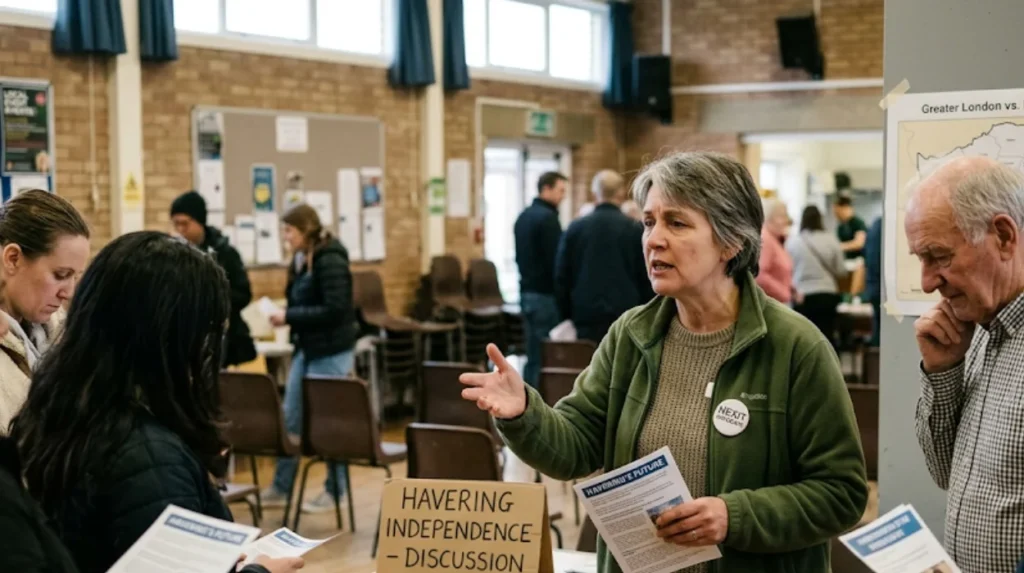
Graham Williamson, a Reform UK councillor in Havering, publicly endorsed the independence proposal. Williamson stated the referendum would “empower Havering folk to decide their future, free from City Hall meddling.” Local Reform UK activists organised town hall meetings starting March 2026 to build momentum for the referendum pledge. The party’s internal polling claims 55% resident support for leaving London, though independent verification of these figures remains unavailable.
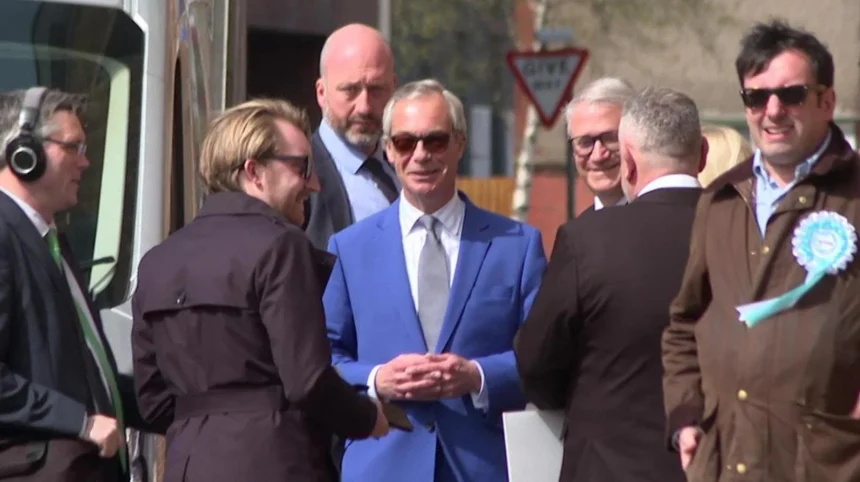
Nigel Farage, Reform UK leader and prospective Prime Minister candidate, endorsed the Havering independence proposal at the February 2026 Romford rally. Farage’s presence signalled national party commitment to the policy as part of Reform’s wider devolution agenda. Laila Cunningham, Reform UK’s London mayoral candidate and former Westminster councillor, echoed local control themes in campaign communications. Cunningham emphasised councils’ authority over housing allocation, arguing current policies prioritise “new arrivals over British families and veterans.”
Essex County Council leadership expressed cautious openness to welcoming Havering. Kevin Bentley, an Essex county councillor, stated integration would require “careful planning” but indicated receptivity. Essex leaders noted Havering’s historical and cultural ties to the county, including postal addresses and regional identity. However, Essex County Council maintains a neutral official position pending formal consultation processes. The logistical complexity of merging Havering’s 260,000 residents into Essex’s existing governance framework presents significant administrative challenges.
Who Opposes Havering Independence and Why?
Havering independence faces opposition from Labour Party representatives, the Greater London Authority, the Mayor of London’s office, and residents concerned about funding losses and service disruptions. Damian White, Havering Labour leader, warned that leaving London would risk “slashing funding for schools and tubes” that Essex cannot match. Labour argues the GLA funding pool provides net benefits to Havering despite local tax contributions. The party emphasises integrated transport networks and cross-borough service coordination as advantages of remaining within Greater London.
The Greater London Authority formally opposes the “Hexit” proposal through London Assembly statements. The Assembly argues Havering should remain part of Greater London to continue benefiting from and contributing to London-wide decision-making and public services. The GLA oversees strategic services including transport, policing, fire and emergency planning, and economic development across all 32 London boroughs. A London Assembly statement released in July 2026 explicitly stated “No ‘Hexit’ for Havering,” rejecting the feasibility and desirability of separation.
Mayor of London Sir Sadiq Khan’s office dismissed the independence proposal as “gimmickry” during the 2026 election campaign. Khan criticised Reform UK politicians for painting a “dystopian picture of London as a city that’s fallen.” Khan defended London’s diversity and progressiveness, contrasting with Reform’s characterisation of capital governance. The Mayor’s office highlighted falling crime statistics, noting Scotland Yard reported murders in London dropped to the lowest per capita level since records began.
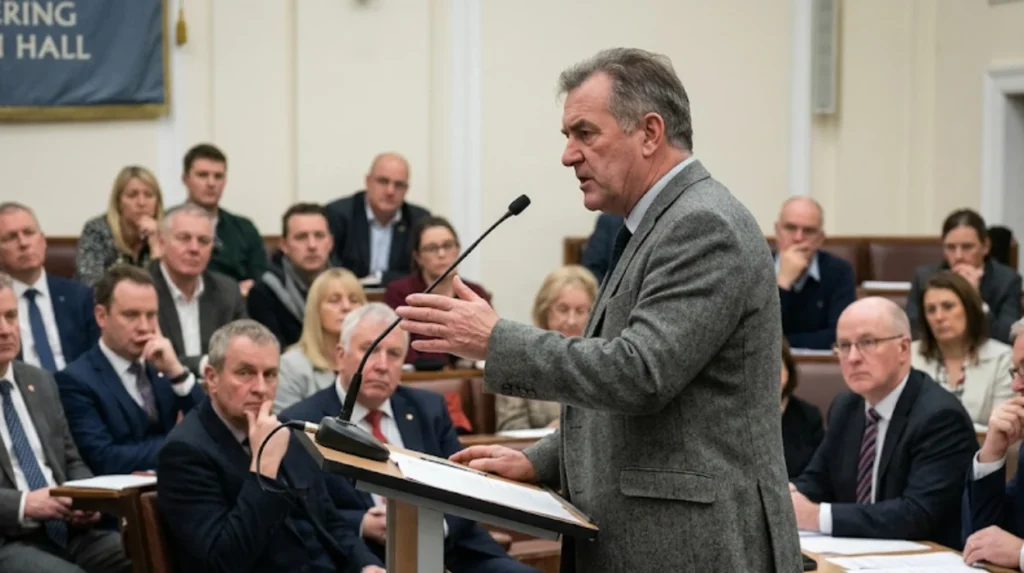
Previous Conservative administrations in Havering also opposed independence before their 2026 electoral defeat. The Conservatives, prior to their total wipeout in the May 2026 elections, agreed with the Havering Residents Association that Hexit would be a “risk too far.” Keith Prince, despite defecting to Reform UK, explicitly rejected pursuing Hexit in his maiden speech as new Reform council leader. Prince stated research showed residents would be “significantly worse off financially” from leaving London, citing Freedom Pass travel costs and service procurement expenses.
What Legislation Would Enable Havering Independence?
Havering independence requires primary legislation from the UK Parliament, as the London Government Act 1963 legally binds the borough within Greater London boundaries. Boroughs cannot unilaterally exit the Greater London Authority through local council decisions or referendums alone. The legislation would need to amend the 1963 Act or pass new primary legislation specifically addressing Havering’s status. This mirrors historical precedents where boundary changes required Westminster approval, such as the 1990s unitary authority reforms under John Major’s government.
Andrew Rosindell explicitly acknowledged that “legislation” is necessary to change Havering’s status within Greater London. Rosindell stated the next Reform UK government under Prime Minister Nigel Farage would introduce such legislation if elected. The proposed referendum would offer residents a binary choice: remain within the Greater London Authority or become a self-governing unitary authority in Essex. However, the referendum itself would be advisory unless accompanied by implementing legislation.
The Boundary Commission for England would require involvement in any boundary reorganisation affecting Havering. The Commission reviews local government structures and makes recommendations to Parliament on boundary changes. Somerset’s transition to unitary authority status in the 2020s provides a recent precedent, with full implementation taking until 2023 following initial proposals. Similar timelines suggest Havering’s transition, if approved, might extend to 2032 or beyond.
Legal experts note that Greater London Authority creation in 1965 involved complex statutory instruments and parliamentary approval. Reversing this status would face similar procedural hurdles. The GLA’s strategic functions, including Transport for London and the Metropolitan Police, operate across borough boundaries. Separating Havering would require renegotiating service agreements or establishing parallel institutions. The financial settlement would need to address Havering’s share of GLA assets and liabilities, estimated in the hundreds of millions of pounds.
What Practical Changes Would Independence Bring?
Havering independence would transition the borough from a London authority to a unitary council within Essex, altering elections, service provision, transport funding, and policing arrangements. Residents would vote in Essex County Council elections instead of Greater London Authority and London Assembly polls. The Freedom Pass, providing free travel for pensioners and disabled residents across London, would require separate negotiation or replacement with Essex concessions. Council tax precepts currently paid to the GLA would be redirected to Havering’s unitary budget.
Transport for London services currently operating in Havering would face uncertainty. The borough’s bus routes, funded through TfL contracts, might transfer to Essex County Council procurement. Romford railway station and other National Rail services would remain unchanged, as these operate independently of the GLA. However, integrated ticketing systems like Oyster and contactless payment caps might not extend to an independent Havering. ULEZ removal would eliminate daily charges for non-compliant vehicles within the borough, a key Reform UK pledge.
The Metropolitan Police currently provides policing across all London boroughs, including Havering. Independence would require either continuing Met Police coverage through a service agreement or transferring to Essex Police jurisdiction. Essex Police operates under different governance structures and funding arrangements than the Met. The transition would affect operational coordination, particularly for cross-border crime and emergency response. Havering would need to establish its own police and crime commissioner or integrate into Essex’s existing PCC framework.
Housing and planning policies would shift from London-wide frameworks to local Havering control. The London Plan, setting strategic development targets across all boroughs, would no longer apply. Havering could set its own housing targets without GLA oversight, potentially altering Green Belt development pressures. Social housing allocation policies might prioritise local residents over pan-London waiting lists, as Laila Cunningham suggested in campaign materials. However, this could reduce access to housing stock across London for Havering residents seeking to move elsewhere.
School funding currently flows through the Dedicated Schools Grant, distributed by the Department for Education via the GLA. Independence would require direct funding arrangements between Havering and central government. The transition risk involves potential short-term funding gaps during the handover. Special educational needs provision and sixth-form college coordination might require renegotiation with Essex authorities. Transport for London’s school travel schemes would need replacement to maintain current entitlements.
When Could a Havering Independence Vote Occur?
A Havering independence referendum could occur only after Reform UK forms a national government and passes enabling legislation, with earliest estimates suggesting a vote within two years of a general election victory. Andrew Rosindell tied the referendum pledge to Reform UK winning power at Westminster, not merely controlling Havering Council. The 2026 local elections saw Reform UK gain control of Havering Council with at least 28 of 55 seats, but this does not grant authority to hold a binding referendum. National legislation remains the prerequisite for any ballot.
Rosindell outlined plans for town hall meetings starting March 2026 to build grassroots momentum for the referendum proposal. These consultations would inform campaign strategy but would not constitute an official vote. The timeline for legislation depends on Reform UK’s general election prospects, with the next scheduled election due by January 2025 or potentially earlier if called. Assuming Reform UK formed a government in 2026 or 2027, legislation might pass by 2028, with a referendum following in 2029 or 2030.
The Scottish independence referendum of 2014 provides a procedural template, requiring an Order in Council from Westminster to authorise a devolved referendum. However, Havering’s status as an English borough differs fundamentally from Scotland’s devolved parliament. The UK government could pass primary legislation directly without requiring devolved consent. The Electoral Commission would need to approve referendum wording and conduct oversight, adding further procedural steps.
Full transition from referendum to operational independence would extend significantly beyond the vote itself. Somerset’s unitary authority transition, approved in 2019, achieved full implementation only by April 2023. Similar complexity suggests Havering’s separation might not complete until 2032 or later. The transition would involve establishing new institutions, transferring staff, and renegotiating hundreds of service contracts. Legal challenges from opponents could further delay implementation through judicial review processes.
Could Havering Independence Trigger Other Borough Exits?
Havering independence could establish a precedent for other outer London boroughs to seek separation from the Greater London Authority, potentially fragmenting London’s governance structure. Rosindell’s proposal hints at pilot status for Havering, with potential expansion to Bexley, Bromley, or other Essex-bordering boroughs. Reform UK’s decentralisation agenda positions localism as a national priority beyond Havering alone. Success in Havering might encourage similar movements in boroughs with strong historical county identities or suburban characteristics.
Bexley and Bromley share similar geographic and demographic profiles with Havering, including Green Belt land and suburban housing. Both boroughs voted strongly for Brexit in 2016, suggesting potential receptivity to independence rhetoric. However, neither borough has active political movements currently advocating separation. The logistical complexity and financial risks demonstrated in Havering’s transition might deter copycat proposals. The GLA’s integrated transport and policing systems would face increasing strain with multiple borough exits.
The creation of Greater Essex Strategic Mayoral Authority, proposed alongside Havering’s potential transfer, would establish a new regional governance tier. Other councils might seek inclusion in this authority rather than remaining in Greater London. Boundary tinkering could encourage gerrymandering concerns similar to American politics. The precedent could extend beyond London, with other English regions seeking boundary adjustments based on historical or cultural identities.
Scottish independence advocates might leverage Havering’s precedent to argue for their own referendum rights. The asymmetry of allowing English boroughs to exit while denying Scotland a vote could face political challenges. However, the scale and constitutional status of Scottish independence differs fundamentally from borough-level reorganisation. The UK government would likely distinguish between devolved nations and local authority boundaries to maintain this distinction.
What Is Reform UK’s Wider Local Government Strategy?
Reform UK’s wider local government strategy targets control of councils across England, using Havering as a flagship for devolution and localism policies ahead of national elections. The party recruited approximately 1,800 candidates for the May 2026 borough elections, focusing on housing, planning, and social care issues. Reform’s London mayoral candidate Laila Cunningham emphasised councils’ daily impact on residents’ lives through bin collection, parking enforcement, and social housing allocation. The party frames local elections as stepping stones toward national government control.
Reform UK captured Havering Council in May 2026, securing at least 28 of 55 seats and displacing the previous Havering Residents Association majority. The party also gained control of Essex County Council, strengthening its regional footing. Nigel Farage described the results as an “historic shift in British politics,” asserting Reform is now the most national party. Farage rejected claims that support represents merely protest voting, arguing Labour and Conservatives face eradication in traditional strongholds.
The party’s local manifesto emphasises “good value for money” in council spending, acknowledging financial constraints without promising miracles. Reform pledges to prioritise British families and veterans over “new arrivals” in social housing allocation. The party criticises current London councils for prioritising migrants over long-term residents, a theme echoed in Cunningham’s campaign communications. Crime reduction and street safety feature prominently in Reform’s local messaging, contrasting with Mayor Khan’s declining murder rate statistics.
Reform’s devolution agenda extends beyond Havering to include broader localism reforms. The party advocates transferring powers from central government and regional authorities to individual councils. This includes planning decisions, housing targets, and transport funding currently controlled by the GLA or Whitehall. Success in Havering would demonstrate Reform’s ability to implement these policies at local level, building credibility for national proposals. The strategy mirrors UKIP’s approach in the 2010s, using local elections to build momentum for national influence.