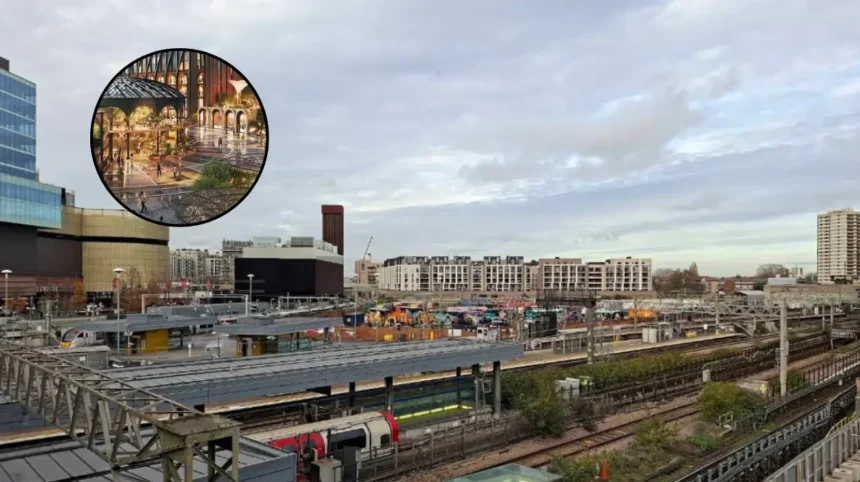
A major regeneration proposal could dramatically transform Stratford Junction into one of East London’s largest mixed-use neighbourhoods, with plans unveiled for around 2,000 new homes, a hotel, offices, cultural venues and a vibrant public square. The ambitious masterplan represents another significant chapter in Stratford’s continuing evolution following the legacy of the London 2012 Olympic Games.
Property developer Hallmark Property Group has revealed proposals for the large-scale development on land close to Stratford Station and the Queen Elizabeth Olympic Park. The site had previously been linked with proposals for a Las Vegas-style entertainment Sphere, but the latest vision instead focuses on creating a new residential, commercial and cultural destination for East London.
According to the plans, the development would include buildings rising to 47 storeys, alongside approximately 2,000 homes, a new hotel, flexible office space, restaurants, cafés, shops and landscaped public areas. The masterplan also proposes a dedicated cultural quarter featuring exhibition spaces, performance venues, creative studios and public art designed to attract visitors throughout the year.
A central feature of the proposal is a new public piazza, intended to become a focal point for community events, outdoor performances and cultural festivals. Developers say the public space would improve connections between Stratford Station, nearby residential neighbourhoods and the Olympic Park while encouraging greater pedestrian activity throughout the area.
The scheme reflects Stratford’s continuing transformation from a historic railway hub into one of London’s fastest-growing commercial and residential districts. Since the 2012 Olympics, billions of pounds have been invested in regeneration projects including Westfield Stratford City, new housing developments, business districts and the East Bank cultural campus, home to institutions such as V&A East, Sadler’s Wells East, the BBC Music Studios and University College London East.
Developers believe the latest project would complement these existing investments by creating another destination where people can live, work and enjoy arts and entertainment within walking distance of one of London’s busiest transport interchanges. Stratford Station already provides connections via the Elizabeth line, Central and Jubilee Underground lines, London Overground, Docklands Light Railway, Greater Anglia and Southeastern services, making it one of the capital’s best-connected locations.
The proposed hotel and commercial space are also expected to support Stratford’s growing visitor economy, which has expanded considerably since the Olympic Games. New businesses, cultural attractions and international events have helped establish East London as an increasingly important destination for tourism, investment and creative industries.
Supporters of the scheme argue it would deliver much-needed housing while creating employment opportunities during both construction and long-term operation. The inclusion of cultural facilities is also intended to strengthen Stratford’s identity as a creative hub, building on the success of nearby East Bank and the area’s expanding arts community.
Like all major developments, the proposals will need to progress through the planning process before construction can begin. Local authorities will assess issues including transport capacity, affordable housing, environmental impact, building heights and public infrastructure before making any final decision.
If approved, the project would become one of the largest regeneration schemes currently proposed for East London and further cement Stratford’s position as a major centre for housing, business, culture and leisure.
As London continues to accommodate a growing population and demand for new homes, developments of this scale are expected to play a key role in shaping the capital’s future. For Stratford, the latest vision represents another step in its remarkable transformation from an industrial railway district into one of Europe’s most dynamic urban neighbourhoods.