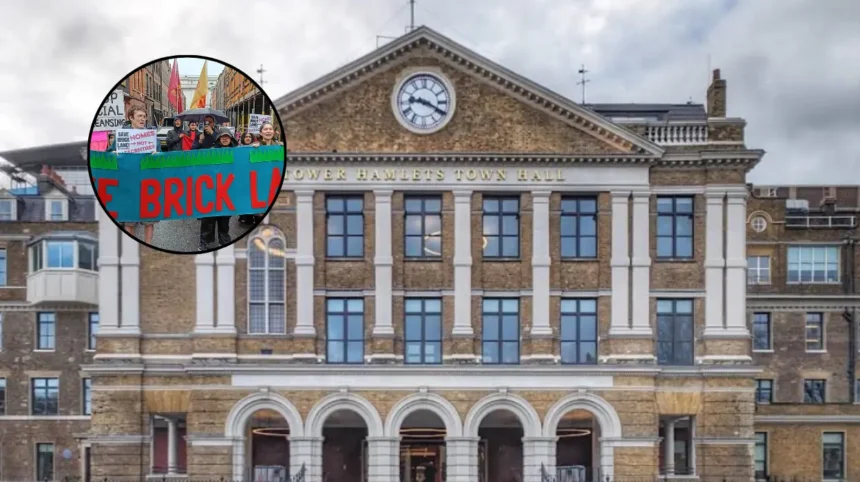
The UK Government has approved a controversial redevelopment scheme for Brick Lane in East London, overriding objections from Tower Hamlets Council, local campaigners and community groups. The project will transform several sites around the historic Old Truman Brewery into a mixed-use development featuring offices, a cinema, retail space, a data centre and 44 new homes, despite criticism that it fails to provide enough affordable housing and threatens the area’s unique cultural identity.
The plans, submitted by Truman Estates and Zeloof LLP, cover three sites around Brick Lane, including the Truman Brewery complex, Ely’s Yard and Grey Eagle Street. The redevelopment includes new office buildings, a supermarket, market space, cinema and a data centre designed to improve internet connectivity for financial businesses in the nearby City of London.
Only 44 homes are included in the scheme, with six designated for social rent. Critics argue that this falls well short of addressing the housing needs of one of London’s most overcrowded boroughs.
The decision was made by Housing Minister Matthew Pennycook on behalf of Deputy Prime Minister and Housing Secretary Angela Rayner, following a planning appeal by the developers. The application was taken out of Tower Hamlets Council’s control after developers argued the authority had failed to determine the planning application within the required timeframe.
In the published decision, the Government acknowledged the strong local opposition and recognised the significance of Brick Lane, Spitalfields and Banglatown, which are home to one of the UK’s largest Bangladeshi communities.
Pennycook said the Government had carefully considered concerns about the impact on local residents and businesses. However, he concluded there was insufficient evidence to show that an alternative development focused primarily on housing could realistically be delivered.
The decision also noted that the six social-rent homes had been specifically designed to accommodate larger Bangladeshi heritage families, reflecting the area’s demographic needs.
Despite those assurances, Tower Hamlets Mayor Lutfur Rahman criticised the approval, describing it as a “missed opportunity” for the borough.
He pointed out that Tower Hamlets currently has more than 30,000 households on its housing waiting list, with thousands of families living in overcrowded accommodation.
According to Rahman, approving a major redevelopment that delivers only six social-rent homes does little to address the borough’s severe housing shortage.
The council had previously identified the site within its draft Local Plan as suitable for a housing-led development capable of delivering around 800 homes. However, because the Local Plan has not yet completed the formal examination process, the Government gave it only limited planning weight.
Campaigners also warned that increasing office space and commercial development could accelerate rising property prices and rents around Brick Lane, potentially forcing out long-established residents, independent traders and the area’s famous Bangladeshi curry restaurants.
Many argued that Brick Lane’s international reputation has been built on its multicultural heritage, independent businesses and creative community, and feared the redevelopment could gradually change the character of the neighbourhood.
Supporters of the scheme, however, say the project will bring significant economic benefits. Government documents highlight that additional office space could attract investment and create jobs, while increased visitor numbers are expected to benefit shops, restaurants and local businesses throughout Brick Lane.
Particular emphasis was placed on the proposed data centre, which would provide ultra-fast digital infrastructure serving financial firms in the City of London. Ministers described the public benefits of the facility as “very significant indeed”, arguing it would strengthen London’s position as a global financial and technology hub.
Mayor Rahman disagreed, arguing that the data centre would contribute little to the area’s street life or cultural vibrancy compared with housing or community facilities.
The approval marks the end of a lengthy planning dispute that has attracted widespread public attention and demonstrates the continuing tension between economic development and preserving East London’s historic communities.
As construction moves closer, debate is likely to continue over whether the regeneration will deliver lasting benefits for local residents or fundamentally alter one of London’s most culturally significant neighbourhoods.