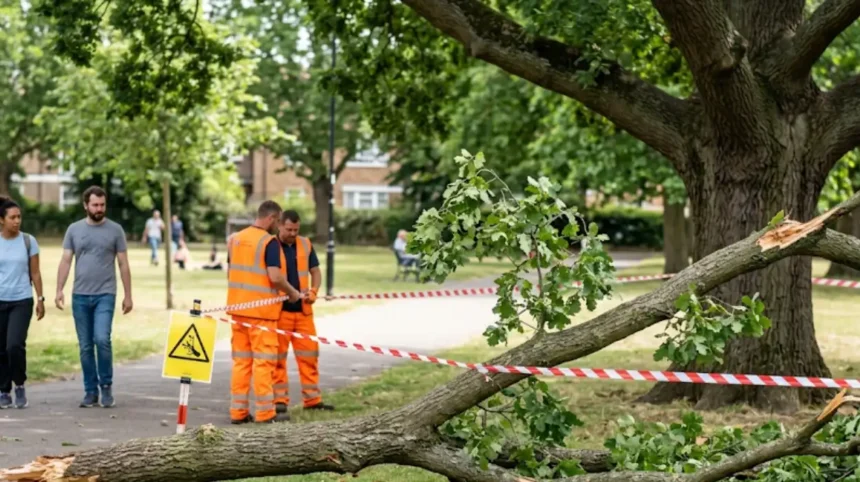
Hot weather tree branch drop, also known as Sudden Branch Drop Syndrome or Summer Branch Drop, occurs when large, seemingly healthy branches fall from mature trees during prolonged dry, hot periods—often in calm conditions with no warning signs. This phenomenon has become increasingly common across East London during recent heatwaves, prompting councils including Tower Hamlets, Newham, and Hackney to issue public safety warnings advising residents not to sit, play, or gather beneath large trees. Understanding the causes, risks, and practical safety measures is essential for anyone using parks, gardens, and tree-lined streets across the capital during summer months.
- What causes branches to drop during hot weather?
- Which tree species are most at risk of sudden branch drop?
- How does drought and heat stress trigger branch failure?
- What are the warning signs of a tree at risk of dropping branches?
- When is the risk of branch drop highest during hot weather?
- What safety precautions should East London residents take during heatwaves?
- How do UK councils manage tree safety during extreme heat?
- What long-term solutions exist for reducing branch drop risk in urban trees?
- How does climate change affect tree branch drop frequency in East London?
- What should you do if you encounter a fallen branch in a public park?
- What statistical data exists on tree-related fatalities in the UK?
What causes branches to drop during hot weather?
Branches drop during hot weather because trees under severe water stress shed limbs as a survival mechanism, reducing water demand on the main trunk and preventing total hydraulic failure. This self-amputation process, driven by drought conditions and extreme heat, causes branches to fail even without wind or visible decay. The risk increases after prolonged dry spells followed by sudden heavy rain, particularly in the early afternoon.
During extended periods of hot, dry weather, trees lose more water through their leaves than they can absorb from the soil. This imbalance places trees under significant water stress, altering the physical properties of their tissues and reducing their margin of safety against mechanical failure. Large branches become more likely to fail under their own weight, even in calm conditions with no external force.
The underlying biological mechanism involves a process called hydraulic segmentation. When water supplies become limited, tiny air bubbles known as embolisms form within the tree’s xylem—the vascular tissue responsible for water transport. This phenomenon, called cavitation, creates blockages that impede water flow to the canopy.
To protect the main trunk and root system, trees sacrifice peripheral branches. This strategy, known as hydraulic segmentation, allows the tree to localise emboli to distal, expendable organs while protecting larger, carbon-intensive structures that take years to grow. Some trees effectively cut off water supply to specific branches, causing them to die and eventually detach.
Research indicates that branch drop risk peaks during critical periods: after dry spells lasting three to four weeks, particularly in the early afternoon, often in calm weather immediately following the first heavy rainfall after the drought. The sudden change in moisture levels can increase internal pressure within the tree, triggering failure.
Which tree species are most at risk of sudden branch drop?
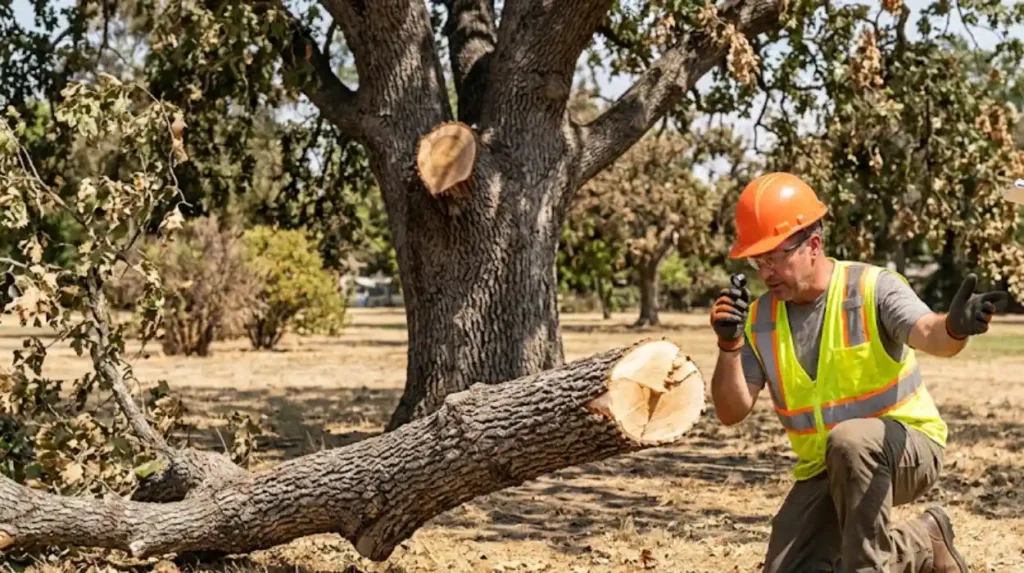
Oak, beech, horse chestnut, cedar, willow, and poplar trees are most susceptible to sudden branch drop, with large mature individuals of these species accounting for the majority of recorded incidents in the UK. Historical fatality data shows oak trees involved in 19 incidents, beech in 17, and poplar, ash, and horse chestnut each in 7 incidents between 1997 and 2025. Mature trees planted singly in direct sunlight face elevated risk compared to those in shaded groups.
Analysis of tree-related fatalities across the UK from 1997 to 2025 recorded 126 separate incidents resulting in 139 deaths. Oak trees were involved in 19 incidents, beech in 17, poplar in 7, ash in 7, horse chestnut in 5, willow in 3, and pine, maple, cypress, cedar, birch, cherry, Leylandii, lime, and plane each in 1 or 2 incidents.
Sudden Branch Drop Syndrome appears more frequent in large mature oak, beech, horse chestnut, and cedar trees, although it does occur in other species. The risk profile includes trees with long, heavy, horizontal limbs overhanging fixed, high-occupancy targets such as benches, paths, playgrounds, or car parks.
Trees planted individually in direct sunlight face greater risk than those in groups or partial shade. Older trees with extensive canopies and heavy limbs are particularly vulnerable. Telltale signs of at-risk trees include scorched leaves, cracked soil around the base, and heavy overhanging or drooping branches.
East London’s urban forest includes many mature oaks, horse chestnuts, and plane trees in parks such as Victoria Park in Tower Hamlets, Mile End Park, and green spaces across Newham and Hackney. These species, while valuable for biodiversity and shade provision, require heightened vigilance during heatwave conditions.
How does drought and heat stress trigger branch failure?
Drought and heat stress trigger branch failure through hydraulic failure and cavitation, where air bubbles block water transport in the xylem, forcing trees to sacrifice branches to preserve the main trunk. This process intensifies during prolonged dry spells exceeding three to four weeks, particularly when followed by sudden heavy rain. The combination of water deficit and rapid moisture changes creates internal pressure that exceeds branch structural integrity.academic.
Trees maintain water transport through xylem vessels under constant tension. When soil moisture becomes limited during drought, the tension increases to the point where water columns break, forming embolisms. These air bubbles block water flow, preventing hydration from reaching distal branches and leaves.
As embolisms accumulate, the tree experiences hydraulic failure—water can no longer reach the canopy effectively. This causes branches or entire crown sections to die back. The tree responds by shedding these compromised limbs, reducing overall water demand and protecting the main stem from complete failure.
The 2022 heatwave, which saw temperatures exceed 40°C across southern England, caused catastrophic tree mortality at Royal Botanic Gardens, Kew. Approximately 400 to 460 trees died during that summer, with many more exhibiting canopy thinning and branch loss. A dead oak tree, known as the “climate-changed oak,” was left standing as a memorial to climate change impacts on British trees.
During the 2025 and 2026 heatwaves, London experienced multiple red extreme heat warnings, with temperatures reaching 33°C to 35°C across the capital. The Environment Agency confirmed that more than half of England entered drought conditions by July 2026, significantly increasing branch drop risk across urban and rural areas.weather.
What are the warning signs of a tree at risk of dropping branches?
Warning signs of branch drop risk include scorched or browning leaves, cracked dry soil around the tree base, heavy overhanging or drooping branches, and visible cracks in limbs—though branches often fall with no visible defects. Trees under stress may exhibit premature leaf drop, canopy thinning, and deadwood accumulation. However, Sudden Branch Drop frequently occurs in apparently healthy trees with no external indicators of failure.
External inspection often reveals limited warning. Leaves may appear scorched, brown, or prematurely shed. Soil around the base becomes dry and cracked, indicating severe moisture deficit. Branches may droop or show signs of dieback at the tips.
Despite these indicators, Sudden Branch Drop is characterised by branches breaking from large mature trees with no obvious visible defects. The phenomenon is poorly researched and unpredictable, making it impossible to reliably identify which specific branches will fail.
Arborists recommend professional tree health inspections, especially during and after prolonged drought. External warning signs are not obvious, and tree health professionals must assess trees that pose a threat to the public. Regular inspections help identify structural weaknesses, canopy stress, and growth patterns that may indicate elevated risk.
East London councils including Tower Hamlets, Newham, and Hackney regularly inspect trees in parks and highways, arranging necessary safety management works. However, due to the unpredictable nature of Sudden Branch Drop Syndrome, it is not possible to determine which trees may drop branches. Residents are advised to avoid sitting, playing, or congregating under large trees during hot, dry periods.
When is the risk of branch drop highest during hot weather?
The risk of branch drop peaks in the early afternoon during calm weather, particularly immediately following the first heavy rainfall after a prolonged dry spell lasting three to four weeks or longer. This critical period represents the highest probability of failure, with anecdotal records showing failures occurring most frequently under these specific conditions.
Research and incident analysis indicate that branch drop risk increases as the length of prolonged dry spells extends. Failures appear most common early in the afternoon, often in calm conditions with no wind, immediately after heavy rain breaks an extended drought.
The mechanism behind this timing involves rapid moisture changes. After weeks of drought, trees adapt to low water availability. Sudden heavy rain increases soil moisture quickly, causing roots to absorb water faster than the tree can redistribute it. This creates internal pressure within the xylem, potentially triggering embolism expansion and branch failure.
During the 2025 and 2026 heatwaves, multiple UK parks and councils issued warnings specifically tied to these conditions. Normanby Hall Country Park, Royal Parks, and Harrow Council all advised visitors not to sit under trees during heatwaves, noting that extended periods of heat and drought heightened the likelihood of branches unexpectedly breaking off.
Met Office heat health alerts and UKHSA data dashboards flagged significant impacts across health and social care services during late July 2026, with temperatures expected to reach 33°C in parts of southern England. These conditions aligned with documented peak risk periods for branch drop.weather.
What safety precautions should East London residents take during heatwaves?
East London residents should avoid sitting, playing, or gathering under large mature trees during heatwaves, particularly oak, beech, horse chestnut, and cedar species, and seek alternative shaded areas away from tree canopies. Councils across Tower Hamlets, Newham, and Hackney have issued explicit warnings advising against using tree shade for recreation during prolonged hot, dry weather. Park staff and Royal Parks have removed deckchairs and restricted access beneath vulnerable trees.
Harrow Council reported an uptick in Sudden Branch Drop Syndrome during the 2025 heatwave, attributing occurrences to exacerbating effects of extreme heat and drought. Safety notices were issued after branches fell in Stanmore, Hatch End, and Pinner, with no injuries reported but precautionary measures implemented.
Royal Parks, managing eight parks and public green spaces across London including those bordering East London, advised staff not to leave deckchairs under trees over fears branches would fall during hot weather. A spokesperson acknowledged “summer branch drop” as a recognised risk during prolonged dry, hot weather, particularly when heat periods are interspersed with heavy rain.
Practical precautions include: avoiding older, singularly planted trees with overhanging branches, browning leaves, or dry cracked soil around the base; finding alternative shaded areas such as buildings, pergolas, or trees planted in groups; keeping children and pets away from large tree canopies during heat alerts; and monitoring local council and Met Office warnings for heat-related tree safety advice.
East London boroughs maintain tree management policies aligned with National Tree Safety Group guidance. Residents can report concerns about specific trees to their local council, though councils note that Sudden Branch Drop cannot be predicted through routine inspection alone.
How do UK councils manage tree safety during extreme heat?
UK councils manage tree safety during extreme heat through regular tree inspections, targeted pruning of long branches, public warnings via signage and social media, and temporary access restrictions beneath vulnerable trees during critical risk periods. Management follows National Tree Safety Group and Health and Safety Executive guidance, balancing public access with risk reduction.cdn.
The Health and Safety Executive recognises that the risk of being struck and killed by a falling tree is “extremely low,” firmly in the “broadly acceptable” category. Annual statistics show approximately 5 to 6 fatalities in the UK from falling trees or branches, with around 3 occurring in public spaces. This represents a one in 10 million chance of death from a falling tree in areas of high public use.cdn.
Despite low overall risk, councils implement proportionate measures during heatwaves. The London Urban Forest Plan 2025 outlines priority actions to protect, manage, and enhance London’s trees, woodlands, and woody vegetation. Actions include drought response protocols, targeted tree inspections, and public communication strategies.
Management interventions likely to reduce Sudden Branch Drop risk include: pruning to reduce the length of the longest branches on vulnerable trees; restricting access to vulnerable trees with barriers during critical periods; placing notices at public entrances or close to vulnerable trees warning of risk; and communicating risk through website and social media posts.
Duty holders must factor Sudden Branch Drop into normal risk assessment procedures, considering vulnerable trees, access levels, and elevated risk during critical periods. Due to uneven distribution of summer rainfall, critical periods vary across the country. Managers monitor local weather patterns and remain vigilant shortly after heavy rain follows prolonged dry periods.
What long-term solutions exist for reducing branch drop risk in urban trees?
Long-term solutions include planting drought-tolerant tree species, implementing regular professional tree health inspections, strategic pruning to reduce limb weight, improving soil moisture retention through mulching, and diversifying urban tree populations to enhance climate resilience. These measures address both immediate risk and long-term adaptation to changing climate conditions.
The 2022 heatwave at Kew Gardens, which killed 400 to 460 trees, prompted urgent reassessment of urban tree species selection. Experts warned that half of Kew’s tree collection faces risk of death as climate warms, necessitating prioritisation of resilient species for future planting.
Rising temperatures threaten UK trees, but certain species demonstrate greater resilience. Drought-tolerant species including certain oaks, Mediterranean-origin trees, and climate-adapted cultivars offer improved survival rates under future heat and drought scenarios. Urban planners and garden managers increasingly prioritise these species in new plantings.
Regular tree inspections by qualified arborists assess overall health, check for stress signs, and observe branch growth patterns. Recommended inspection frequency is annual for trees near buildings, paths, or public areas, with spring inspections allowing time for remedial work before summer risk peaks.
Pruning large branches that overhang highly frequented areas reduces leverage and load on susceptible limbs. Reduction pruning—cutting back to healthy laterals rather than topping—lowers branch weight and opens dense canopies, reducing humidity and stress. Best practice schedules major structural pruning during dormancy in fall and winter.
Soil management improves tree resilience. Mulching around tree bases retains moisture, reduces evaporation, and moderates soil temperature. Avoiding sudden heavy watering after prolonged drought prevents rapid moisture changes that can increase internal tree pressure.
How does climate change affect tree branch drop frequency in East London?
Climate change increases tree branch drop frequency in East London by intensifying heatwave duration, severity, and drought conditions, creating more frequent critical periods where trees experience severe water stress and hydraulic failure. The 2022, 2025, and 2026 heatwaves demonstrate escalating impacts, with Kew Gardens alone losing 400 to 460 trees in 2022 and widespread branch drop reported across London in subsequent years.
Extreme heat and drought cause stress that native UK tree species cannot withstand, posing significant short-term survival risks. Mature trees shedding limbs and branches during intense hot weather, canopy thinning, and outright mortality represent visible signs of longer-term decline processes unfolding inside trees.
The “climate-changed oak” at Kew Gardens—a dead oak tree left standing and painted as a skeleton—serves as a stark reminder that climate change is already taking its toll on Britain’s trees. This tree succumbed during the 2022 heatwave, one of 400 to 460 tree fatalities recorded at Kew that summer.
Heat Ready London, a strategy from London City Hall, acknowledges that London’s exposure to heat risk is more pronounced than elsewhere in the UK. The plan sets benchmarks for preparing and managing heat impacts, including tree stress and urban forest resilience.
Projections indicate that heatwaves will become more frequent, intense, and prolonged across southern England. East London’s urban forest, dominated by mature oaks, horse chestnuts, and plane trees, faces elevated risk without adaptation measures. Diversifying species composition, improving soil moisture management, and implementing proactive pruning regimes form core components of long-term resilience strategies.
What should you do if you encounter a fallen branch in a public park?
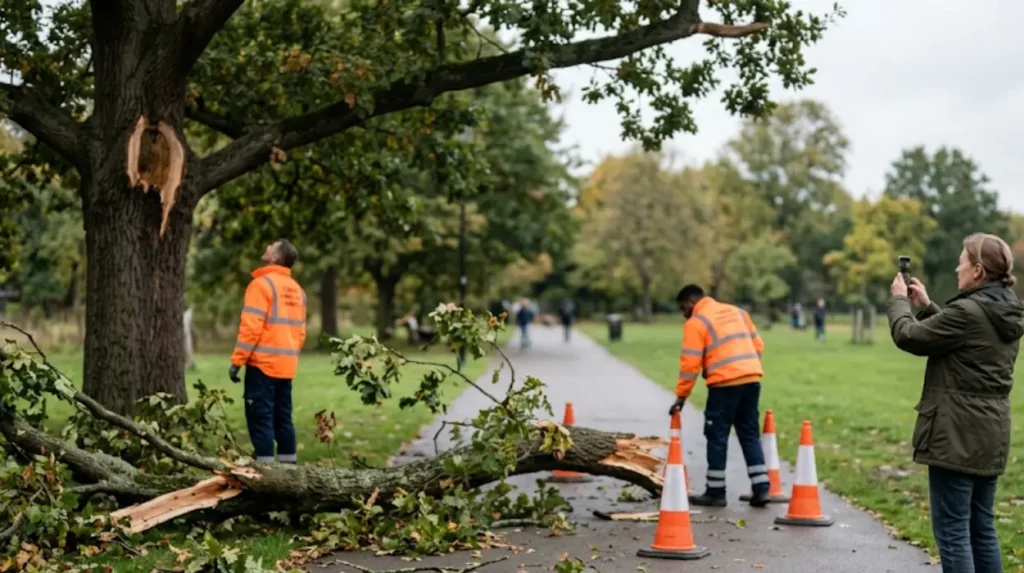
If you encounter a fallen branch in a public park, avoid the area, do not attempt to move large or unstable branches yourself, and report the incident immediately to the relevant council or park authority via their website, phone line, or on-site staff. Councils maintain tree management teams responsible for clearing debris and assessing remaining tree safety.
First, ensure personal safety by moving away from the fallen branch and the tree it came from. Large branches may be unstable, and additional limbs could follow. Keep children and pets at a safe distance.
Second, do not attempt to move the branch yourself if it is large, heavy, or appears unstable. Improper handling risks injury or further damage. Leave debris removal to trained council staff or arborists with appropriate equipment.
Third, report the incident promptly. East London boroughs including Tower Hamlets, Newham, and Hackney provide online reporting forms for tree issues, including fallen branches, dangerous trees, or concerns about tree health. Park staff on-site can also log incidents directly.
Councils investigate reported issues and arrange necessary safety management works. While routine inspections occur, the unpredictable nature of Sudden Branch Drop means public reporting plays a vital role in rapid response. Prompt reporting helps councils prioritise high-risk locations and prevent further incidents.
What statistical data exists on tree-related fatalities in the UK?
Statistical data shows approximately 5 to 6 people killed annually by falling trees or branches in the UK, with around 3 fatalities occurring in public spaces, representing a one in 10 million annual risk of death from falling trees in areas of high public use. Between 1997 and 2025, 139 fatalities occurred across 126 separate incidents, with oak and beech trees accounting for the largest share of species-specific incidents.cdn.
From 1997 to end of 2025, 139 fatalities were recorded from falling or fallen trees, averaging about 4.8 per year across 126 separate incidents. Species breakdown shows oak involved in 19 incidents, beech in 17, poplar in 7, ash in 7, horse chestnut in 5, willow in 3, and pine, maple, cypress, cedar, birch, cherry, Leylandii, lime, and plane each in 1 or 2 incidents. Unknown or unspecified species accounted for 54 incidents.
The Health and Safety Executive notes that around half of all fatalities due to falling trees or branches occur in public spaces such as parks or beside roads. Non-fatal injuries are exceedingly rare, with approximately 55 A&E cases per year attributable to being struck by trees, compared to roughly 2.9 million leisure-related A&E cases annually.
Overall risk estimates indicate a one in 10 million chance of an individual being killed by a falling tree or branch in any given year, or a one in 150 million risk per tree across Britain. For trees in or adjacent to areas of public use, risk rises to approximately one in 10 million.
Despite low absolute risk, the unpredictable nature of Sudden Branch Drop and concentration of incidents during heatwaves warrant precautionary measures. Public awareness, targeted tree management, and adherence to safety guidance during critical periods reduce already-low risk further.