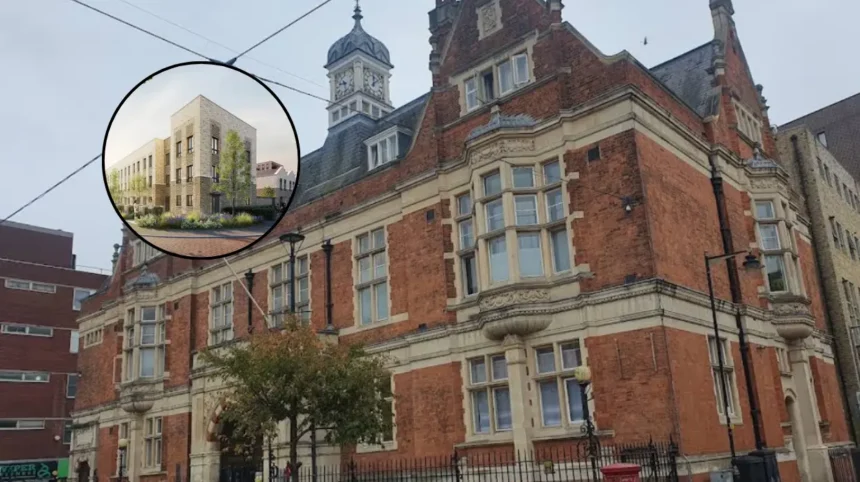
Key Points
- A major planning submission has been lodged for the next phase of the multi-million-pound Beam Park regeneration scheme in Dagenham, focusing on safety compliance.
- The application (Ref: 26/01124/AOD) covers Phase C Cores C1, C4, and C5 on the former Ford assembly plant site to satisfy Condition 60 regarding ‘Secure by Design’ principles.
- Additional planning submissions across the London Borough of Barking and Dagenham address ground contamination, educational infrastructure, telecommunications, and residential expansions.
- Environmental details have been submitted for land to the rear of 181–193 Becontree Avenue under Condition 4 (Contaminated Land).
- Riverside Bridge School on Thames Road is seeking permission for two single-storey temporary classroom buildings to manage educational space over the next five years.
- Telecommunications upgrades are proposed at Dagenham Fire Station on Rainham Road North, featuring six antennas, two transmission dishes, and ground-level equipment cabinets.
Dagenham (East London Times) August 12, 2026 – A comprehensive slate of new planning applications has been officially submitted to the London Borough of Barking and Dagenham, highlighted by a major detail-approval submission for the ongoing, multi-phase Beam Park regeneration scheme. As reported by the news team of the Barking and Dagenham Post via the Public Notice Portal, the primary application relates to specific details required under existing outline planning permissions for new residential structures situated on the historic former Ford Assembly Plant site along Thames Avenue in Dagenham.
- Key Points
- What Details Have Been Submitted For The Latest Phase Of The Beam Park Development?
- What Other Strategic Development Submissions Have Been Lodged In Dagenham And Barking?
- What Residential Planning Applications Are Being Considered Across The Borough?
- What Is The Background Of The Particular Development After The News?
- What Is The Prediction For How This Particular Development Will Affect Residents, Businesses, And Local Infrastructure?
The latest submission for Beam Park, registered under reference number 26/01124/AOD, formally requests the approval of details relating to Condition 60, widely known within UK municipal planning frameworks as the ‘Secure by Design’ standard.
This specific submission governs Phase C Cores C1, C4, and C5 of the wider development under the primary planning consent 22/01048/OUTSRM. The submission represents a critical technical milestone for developers seeking to progress construction across one of East London’s largest brownfield housing initiatives, ensuring that crime prevention, layout safety, and physical security measures meet stringent metropolitan police and council guidelines prior to full occupancy.
What Details Have Been Submitted For The Latest Phase Of The Beam Park Development?
The submission concerning the Beam Park development site on Thames Avenue marks a further step in translating outline permissions into operational, safely designed residential communities. Under reference 26/01124/AOD, the application specifically addresses Phase C Cores C1, C4, and C5, which form a vital component of the high-density residential buildings planned for the location.
As documented in official planning registers released by the local planning authority, fulfilling Condition 60 requires developers to demonstrate that physical layout, entry controls, communal lighting, and surveillance pathways meet official Secure by Design standards.
As reported by local authority planning officers in public documentation, the broader Beam Park site encompasses a massive 31-hectare footprint spanning the boundary of Barking and Dagenham and the neighboring London Borough of Havering.
The overarching master plan envisions the creation of over 3,900 energy-efficient homes, alongside extensive public realm improvements, healthcare facilities, commercial retail spaces, and dedicated community hubs.
The current submission focuses strictly on discharge-of-condition requirements, ensuring that building cores C1, C4, and C5 adhere to modern structural safety, secure access, and community protection protocols before vertical construction completes and residential handovers begin.
What Other Strategic Development Submissions Have Been Lodged In Dagenham And Barking?
Beyond the flagship Beam Park site, several key institutional, commercial, and remediation submissions have been lodged with Barking and Dagenham Council. Notably, a significant environmental discharge application has been recorded for the land situated to the rear of 181–193 Becontree Avenue, Dagenham (Ref. No: 26/01123/AOD).
As reported in municipal planning records, the applicant has submitted full technical details to satisfy Condition 4, which directly governs contaminated land assessment and site remediation protocols under planning consent 24/01570/FULL.
This step ensures that historic ground contaminants are thoroughly tested, treated, and validated before any above-ground building work takes place.
Simultaneously, educational infrastructure developments are making progress in Barking. At Riverside Bridge School, located at 40 Thames Road, Barking (Ref. No: 26/01103/FULL), a full planning application has been submitted requesting permission for the installation of two single-storey classroom buildings.
As detailed by the municipal planning department, these structures are intended for temporary educational use for up to five years, complete with associated groundworks and access paths, aimed at managing pupil capacity demands within the local special educational needs infrastructure.
Furthermore, critical civic infrastructure upgrades are under review at Dagenham Fire Station on Rainham Road North (Ref. No: 26/01115/COM).
The London Fire Brigade site is subject to a telecommunications planning application proposing the installation of six antennas mounted on standoff bracketry, two transmission dishes fitted onto new tripod frames, one ground-level equipment cabinet, and ancillary equipment including 12 Remote Radio Units (RRUs) to bolster local network capacity.
What Residential Planning Applications Are Being Considered Across The Borough?
Alongside large-scale institutional and strategic redevelopment projects, individual property owners across Dagenham have submitted various householder planning requests to adapt existing residential spaces. These applications reflect ongoing investment by local residents in expanding living accommodation to suit changing family requirements.
As recorded in the council’s public register, key residential submissions include:
- 538 Becontree Avenue, Dagenham (Ref. No: 26/01119/CLUP): An application for a Lawful Development Certificate for a proposed hip-to-gable roof extension, rear dormer, two front roof lights, and a side window to allow a loft conversion.
- 538 Becontree Avenue, Dagenham (Ref. No: 26/01118/PRIEXT): A prior notification submission proposing a single-storey rear extension projecting 5 metres from the original rear wall, with a maximum height of 3 metres.
- 40 Haydon Road, Dagenham (Ref. No: 26/0109/HSE): A householder planning proposal seeking permission to construct a part two-storey, part single-storey rear extension.
- 227 Reede Road, Dagenham (Ref. No: 26/01108/CLUP): An application for a Lawful Development Certificate to construct a rear dormer, two front roof lights, and a Juliette balcony to accommodate a loft conversion.
Explore More Barking and Dagenham News
MP Margaret Mullane Backs Disposable Barbecue Ban: Havering 2026
Mecca Bingo Dagenham Drops 24-Hour Bid Amid Policy Shift — Dagenham 2026
What Is The Background Of The Particular Development After The News?
The Beam Park project represents one of the most prominent brownfield regeneration initiatives in East London’s Thames Gateway corridor. Situated on the site of the former Ford Dagenham assembly plant, which ceased vehicle production in the early 2000s, the land sat underutilised for years before being designated as a strategic housing zone by the Greater London Authority and local councils.
In September 2018, the Greater London Authority approved the master hybrid planning application for the cross-boundary development, delivered as a joint venture partnership between developer Countryside Partnerships and housing association L&Q.
The overarching plan encompasses up to 3,900 new homes across multiple phases, with 50 percent designated as affordable housing under shared ownership and affordable rent tenures.
Phase 1 welcomed its initial residents in late 2020, delivering 640 homes alongside a primary school and parkland. Subsequent phases have progressively brought forward further residential blocks, commercial amenities, medical infrastructure, and expansive public open spaces.
The technical submissions regarding ‘Secure by Design’ conditions for Phase C Cores C1, C4, and C5 reflect the formal procedural transition of the development from high-level approval down to granular building compliance and safety delivery.
What Is The Prediction For How This Particular Development Will Affect Residents, Businesses, And Local Infrastructure?
The continued progression of Beam Park and surrounding municipal planning approvals will have direct, long-term impacts on local residents, local businesses, and regional transport networks across Barking, Dagenham, and Havering.
For local residents, the discharge of safety and environmental planning conditions ensures that incoming building stock adheres to stringent urban safety and health metrics. Fulfilling ‘Secure by Design’ criteria minimizes potential blind spots, enhances natural surveillance, and incorporates secure access mechanisms that reduce opportunist crime in high-density housing blocks.
Similarly, discharging land contamination conditions on sites such as Becontree Avenue mitigates long-term environmental hazards, reassuring neighbouring communities that brownfield redevelopment is executed safely.
For local businesses and the regional economy, the ongoing construction phases at Beam Park generate sustained employment in skilled trades, civil engineering, and site management.
Once occupied, the influx of thousands of new residents will significantly increase local household expenditure, providing a reliable customer base for nearby retail centres, food establishments, and commercial service providers along the A13 and Rainham corridors.
However, the rapid growth in population highlights ongoing pressure on social and physical infrastructure. While temporary classroom additions at Riverside Bridge School offer short-term relief for educational capacity, the cumulative effect of thousands of new households underscores the urgent need for timely delivery of permanent community infrastructure, healthcare facilities, and promised public transit enhancements to prevent congestion and service strain across the borough.