Key Points
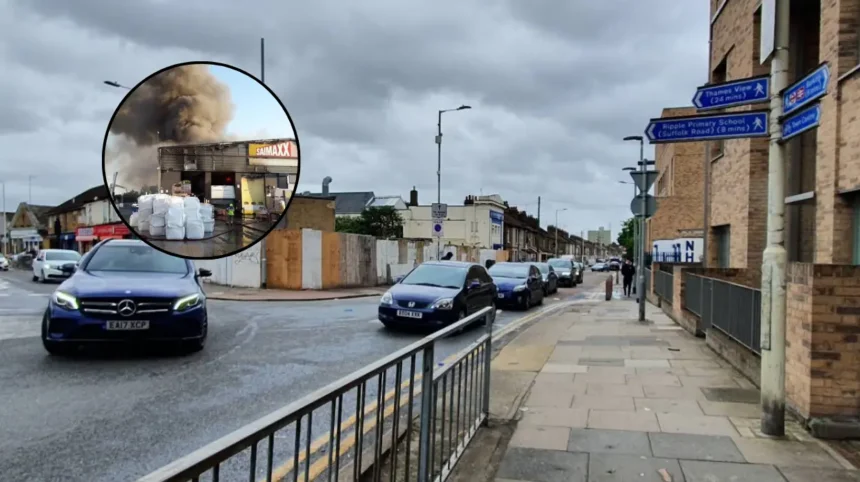
- Around 125 firefighters and 20 fire engines were deployed to tackle a major industrial estate fire on Ripple Road in Barking.
- The London Fire Brigade’s Control Office received the first of 15 emergency calls regarding the blaze at 12:47 pm.
- The fire severely impacted a two-storey warehouse within the commercial property.
- High temperatures and intense heat led to the mobilization of additional personnel to allow rotating crews to take mandatory cool-off breaks.
- A number of potentially volatile gas cylinders were successfully removed from the scene and cooled down to prevent explosion risks.
- The building was completely evacuated prior to the arrival of emergency services, and no injuries have been reported.
- A 32-metre turntable ladder was deployed to fight the flames from above and provide aerial surveillance.
- Local residents and businesses were strongly advised to keep all windows and doors firmly closed due to heavy, toxic smoke blowing across the local area.
- Significant travel disruption struck East London, resulting in a partial closure of the A13.
Barking (East London Times) August 12, 2026 —As reported by Louis Dargavel of MyLondon, a major fire broke out at an industrial estate on Ripple Road in Barking, East London. As detailed by Olivia Carter of London Now, the London Fire Brigade’s Control Office took the first of 15 emergency calls reporting the escalating emergency at 12:47 pm.
The unfolding emergency mobilized roughly 125 firefighters utilizing 20 fire engines dispatched from surrounding stations including Barking, Dagenham, and Ilford.
The blaze severely impacted a two-storey warehouse situated inside the commercial property, sending a colossal plume of thick black and grey smoke billowing into the East London skyline. The smoke was reportedly visible from miles away and across the River Thames.
How Are Firefighters Tackling the Blaze and Managing Safety Risks?
According to official incident updates from the London Fire Brigade, extreme ambient weather conditions combined with the intense heat generated by the warehouse fire prompted commanders to scale up the response.
By deploying extra firefighters to the scene, crews could rotate effectively, ensuring personnel received crucial rest and cool-off breaks.
Furthermore, hazardous materials management became an immediate priority. Fire crews successfully located and removed a number of industrial cylinders from the burning structure. These cylinders were rapidly cooled to an ambient temperature to eliminate the risk of catastrophic explosions when exposed to extreme thermal radiation.
To combat the flames from an elevated position, a specialized 32-metre turntable ladder engine was brought in, providing the Incident Commander with a vital aerial view to dynamically adapt firefighting tactics.
Were There Any Casualties or Evacuations Reported?
According to statements released by the London Fire Brigade, swift action ensured public safety prior to the arrival of emergency crews.
The commercial building was completely evacuated before firefighters arrived on the scene. Emergency services confirmed that there have been no injuries reported in connection with the incident.
How is the Fire Affecting Local Traffic and Residents?
As reported by Olivia Carter of London Now, the incident caused widespread travel chaos, forcing a partial closure on the westbound approach of the A13 near the Goresbrook Interchange. The London Fire Brigade and local news outlets warned drivers and commuters to expect severe gridlock and significant delays across East London, urging motorists to seek alternative routes.
Residents living and working in the immediate vicinity were strongly advised to keep all doors and windows securely shut to prevent heavy smoke inhalation.
Public health guidelines emphasized avoiding the active zone entirely while emergency responders worked deep into the afternoon and evening to secure the location.
Explore More Barking News
Why Is Eastbury Manor House Called Hampton Court of East Barking 2026
Teenager Stabbed Near Station on Salisbury Avenue: Full Details Barking 2026
Background of the Development
Industrial estate fires involving multi-storey commercial warehouses present severe logistical and tactical challenges for metropolitan fire services. Facilities of this scale often house complex materials, packaging, and potentially hazardous pressurized equipment such as gas cylinders, which elevate the risk profile during structural collapses.
Urban environments like Barking, which combine dense commercial warehousing with major arterial transport corridors like the A13, are particularly vulnerable to widespread disruption when major incidents occur.
The concentration of industrial properties in East London has historically required robust multi-station responses from the London Fire Brigade, leveraging regional resources, aerial ladder platforms, and specialized hazardous material protocols to mitigate property damage and protect neighboring residential zones.
Prediction and Impact on the Local Community
This major industrial fire and subsequent partial closure of the A13 will likely cause prolonged commuter delays, freight logjams, and public transport adjustments throughout East London during the afternoon and evening peak hours.
For local residents, the immediate aftermath will involve ongoing air quality monitoring, lingering smoke odors, and potential temporary disruptions to local business operations surrounding the Ripple Road industrial estate.
Looking forward, local authorities and commercial landlords in the area are expected to face heightened scrutiny regarding industrial fire safety compliance, storage regulations for volatile materials, and emergency evacuation protocols to prevent similar disruptions to critical regional infrastructure.