
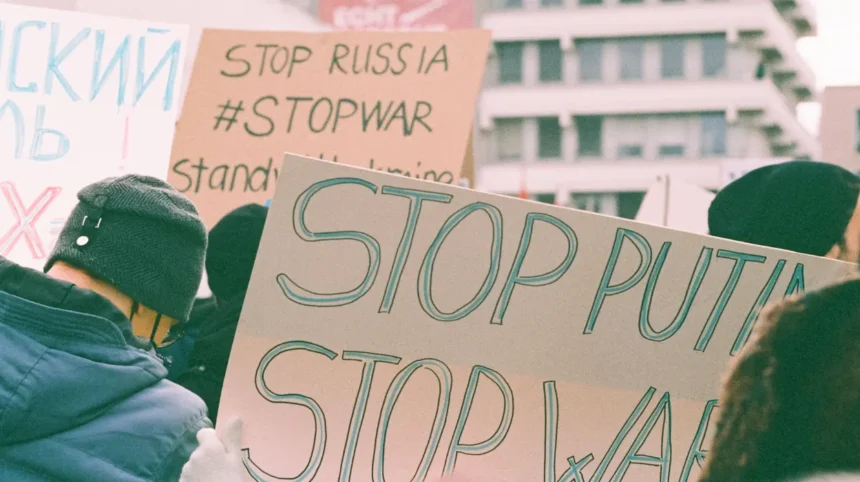
Before writing this op ed I was prompted to refer to a book on the life of Edward R Murrow, probably the greatest American journalist of the twentieth century, after I had read the latest report from the Atlantic Council in Washington. It was a critical report about the war in Ukraine and western policy which reminded me of certain aspects of a chapter in my latest book Instruments of Peacemaking 1919-1941: The Failure of Diplomacy. My chapter on appeasement in the 1930s analyses a series of political failures in ignoring intelligence reports and military advice regarding the Nazi threat. Also like 1940-41 when Britain suffered the blitz, but aided by American Lend Lease assistance, Ukrainian cities suffer constant nightly missile bombardment, fighting alone, as did Britain, who in Ed Murrow’s words: “alone defended democracy in Europe.”
On the 11th of August the ‘Ukraine Alert’ published by the Atlantic Council in Washington DC gave an important warning that Russian forces could attack a NATO country “within weeks.” The warning is based on several U.S. intelligence assessments. These reports are consistent with several recent warnings from NATO capitals. The warnings and reports suggest that Russia’s aim would be to break the deadlock of their Ukrainian campaign. It is suggested that any such action would be of limited scope to test NATO’s resolve, possibly by a minor border incursion in the Baltic region. The Atlantic Council’s ‘Ukraine Alert’ Editor argues that if NATO members failed to make a robust response this would place NATO’s future in doubt. That argument has considerable force when considered in the context of Russia’s war and the recent series of incidents/provocations in Eastern Europe.
Anyone who has read the diplomatic history of the late 1930s as I referred to in my recent book could not help to appreciate the danger of ignoring aggression as President Kennedy once suggested that “aggression left unchecked and unchallenged ultimately leads to war.” Kennedy in those days was addressing a the Soviet Unions’ provocative policy on Cuba by establishing missiles on the island in 1962. On that occasion Kennedy backed up his warnings to the Soviets by implementing a quarantine on shipping bound for Cuba. By this action and by certain diplomatic means the missiles were removed and the crisis ended. The United States was simply not prepared to appease Russia inserting nuclear weapons in their hemisphere. If one contrasts that with the position of France and Britain with regard to Nazi Germany in 1938 and the appeasement at Munich it is proof that appeasement led to Hitler’s confidence in annexing the whole of Czechoslovakia in March 1939 and further to advance his military preparations in order to attack Poland. Interestingly in that context President Kennedy wrote his master’s dissertation at Harvard on the lessons of Munich later published in his book: Why England Slept. Kennedy, unlike his Ambassador father Joe Kennedy was well aware of the cost of appeasement and in 1962 fortunately chose the right course.
If, however, we contrast the approach of President Kennedy with President Trump there is clearly a considerable divergence. One trusts that whoever is the American president the overriding American interest in Europe which has a history of over 80 years and whose security is dependent on Europe being a friendly ally would be maintained. It is therefore heartening that our colleagues in the American branch of the Atlantic Council strongly support a strong policy of deterrence which most Americans would support. In terms of President Trump’s admonition of his NATO allies regarding defence expenditure his view in the context of the current threat level has considerable weight.
In his ‘Alert’ the Editor states that when Russia invaded the Crimea in 2014 the West made a “feeble response.” That in his view was a signal that Russia could exploit the situation by extending its “special operation” into the Ukraine mainland. It is suggested further that instead of a robust response the reaction was ineffective and undermined because certain European states preferred to deepen their dependence on cheap Russian energy exports.
As in all cases the facts speak for themselves history and experience suggest that the protests of diplomats and statesman against Russian aggression have little or no effect on Russian intentions. It was Dean Atchison who reminded President Kennedy that when dealing with Russia you do not mince words, you act. The key lesson that western statesman continually forget is part of that lesson of Munich that appeasement never deters the aggressor. In this case the fact is that in recent months Russia has made certain incursions into Eastern European states especially Romania and Poland. More recently a Russian-made drone was found on a military airfield in Germany. Such instances obviously have an intention which may be discerned as provoking NATO to test the effectiveness of its alliance. If you place these operations in the context of cyber-attacks, failed nuclear threats, and a wide range of sabotage operations intensified in the last year, a certain dangerous pattern emerges. That sequence of events gives further force and credibility to the American intelligence warnings recorded by the Atlantic Council. The ‘Ukraine Alerts’ by the Atlantic Council stand as notice to western leaders that having embraced the policies of appeasement in a bid to avoid provoking Russia it concludes that it should now be abundantly clear that nothing is more likely to provoke Russia than western weakness.
Dr Michael Reynolds is a member of the Atlantic Council (UK)
The views expressed in this article are the author’s own and do not necessarily reflect (East London Times) editorial policy.