Tower Hamlets forms a major part of London’s historic East End, combining medieval and early-modern heritage with docks, markets, museums, parks, immigrant communities and modern Canary Wharf. The borough stretches along the northern bank of the River Thames and contains some of London’s most recognisable historic landmarks.
- What makes Tower Hamlets important to London’s historic East End?
- Which historic landmarks should visitors see in Tower Hamlets?
- How can visitors explore Tower Hamlets markets?
- Where can visitors learn about Tower Hamlets’ docklands history?
- What can visitors see in Whitechapel and Spitalfields?
- Which parks and green spaces are worth visiting in Tower Hamlets?
- How can visitors explore Tower Hamlets by neighbourhood?
- What cultural experiences make Tower Hamlets distinctive?
- How should visitors plan a Tower Hamlets travel itinerary?
- Is Tower Hamlets suitable for a weekend visit to London?
- Why does Tower Hamlets remain important for understanding modern London?
The borough takes its name from the hamlets historically associated with the Tower of London. Its geography includes Tower Hill, Wapping, Whitechapel, Spitalfields, Bethnal Green, Stepney, Mile End, Poplar, the Isle of Dogs and Canary Wharf.
Tower Hamlets is also one of the most densely populated parts of England. Its population increased from 254,096 in 2011 to 310,300 in 2021, a 22% increase. By mid-2023, the estimated population had reached 328,626.
For visitors, this density creates an unusually concentrated travel destination. Historic streets, waterfront landmarks, markets, museums and green spaces sit within a relatively compact area. The result is a practical base for exploring London while focusing on the East End’s distinctive history and culture.
What makes Tower Hamlets important to London’s historic East End?
Tower Hamlets is important because it connects the Tower of London, historic docks, East End markets, immigrant communities, industrial heritage and modern Canary Wharf within one London borough. Its streets document centuries of trade, migration, manufacturing, housing and urban redevelopment.
Tower Hamlets represents several stages in London’s development. The Tower of London established an important landmark beside the River Thames. The surrounding settlements developed through trade, river activity, industry and population growth.
The borough’s relationship with the Thames became particularly important when London’s docks expanded. The West India Docks, London Docks and other waterfront facilities transformed parts of the East End into major centres of international commerce.
The East End also became a destination for successive migrant communities. Huguenots, Jewish communities, Irish migrants, South Asian communities and other groups shaped local streets, businesses, religious buildings and food traditions.
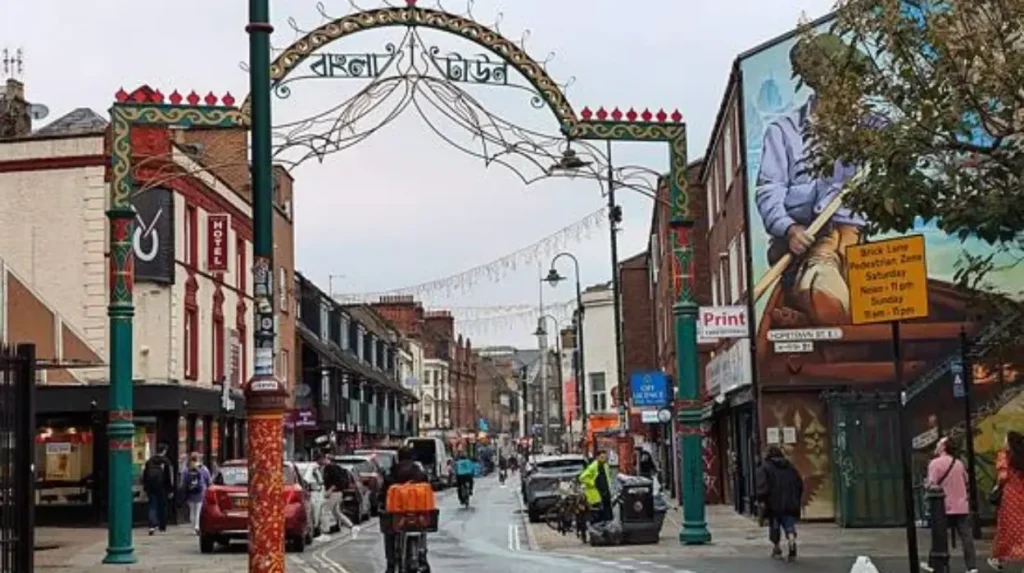
Brick Lane provides one of the clearest examples of this layered history. The street has connections with Huguenot settlement, Jewish migration and the Bangladeshi community. Today, its food businesses, shops, markets, galleries and religious buildings reflect that continuing cultural transformation.
Tower Hamlets therefore works best as a historical landscape rather than a single attraction. Travellers can move between royal history, maritime history, migration history, industrial history and contemporary London within the same visit.
Which historic landmarks should visitors see in Tower Hamlets?
Visitors should prioritise the Tower of London, Tower Bridge, St Katharine Docks, Christ Church Spitalfields, historic Brick Lane, Old Spitalfields Market and surviving dockland buildings to understand the borough’s royal, religious, commercial and maritime heritage.
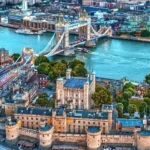
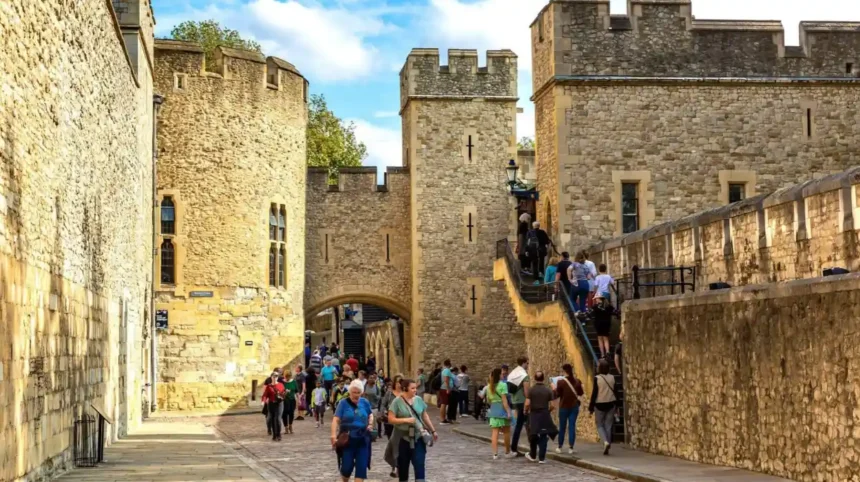
The Tower of London is the most internationally recognised historic landmark in Tower Hamlets. Founded after the Norman Conquest, the fortress developed over centuries as a royal residence, prison, armoury and ceremonial site. It is also home to the Crown Jewels.
Nearby Tower Bridge opened in 1894. Its bascule design allowed large vessels to reach London’s upstream docks while providing a major road crossing of the Thames.
St Katharine Docks sits immediately east of the Tower of London. The docks opened in the 19th century and formed part of London’s expanding commercial waterfront. Their surviving warehouses and basin provide a direct connection between historic port infrastructure and modern hospitality.
Further east, Christ Church Spitalfields is a major 18th-century landmark. Architect Nicholas Hawksmoor designed the church, which was completed in 1729. Its architecture reflects the rapid expansion of London’s East End during the Georgian period.
Fournier Street provides another important architectural connection. Its surviving Georgian houses sit close to Christ Church and Brick Lane, illustrating the residential environment created around Spitalfields.
The Old Spitalfields Market represents another layer of commercial history. The market has operated in the Spitalfields area since the 17th century and remains a major destination for shopping, food and cultural activity.
As you explore these modern visitor sites, you are crossing land with a deep heritage. Read about the full to understand how the borough developed from historic hamlets into a major part of London.
How can visitors explore Tower Hamlets markets?
Markets provide one of the clearest ways to experience everyday East End culture. Brick Lane, Columbia Road, Roman Road, Chrisp Street, Whitechapel and Petticoat Lane connect food, shopping, migration, local trade and historic streets.
Tower Hamlets Council identifies ten street markets across the borough, including Brick Lane, Bethnal Green Road, Chrisp Street, Columbia Road, Petticoat Lane, Roman Road, Roman Road Square, Sclater Street, Watney Market and Whitechapel Market.
Brick Lane Market is particularly significant for visitors interested in East End culture. The market dates from the late 19th century in its established form and occupies a street strongly associated with successive migrant communities. Sunday trading combines food, fashion, art, vintage goods and general merchandise.
Columbia Road Flower Market provides a different experience. The Sunday market specialises in flowers and plants. The surrounding street contains independent shops, galleries, cafés and pubs, making it suitable for combining shopping with architectural and neighbourhood exploration.
Roman Road Market serves a different part of the borough. Roman Road follows an ancient route and the market operates on Tuesdays, Thursdays and Saturdays. Its stalls include clothing, household products, jewellery, food and other everyday goods.
Chrisp Street Market is located in Poplar. Its Victorian origins connect it with the development of the surrounding dockland community. Visitors find food, household goods, clothing and local businesses within a pedestrianised setting.
Market schedules can change, particularly around public holidays and special events. Visitors should check the current council information before planning a market-focused day.
Where can visitors learn about Tower Hamlets’ docklands history?
The Museum of London Docklands is the strongest starting point for understanding Tower Hamlets’ maritime past. It explains London’s port, the River Thames, global trade, slavery, migration, warehouses and the transformation of the Docklands into a modern financial district.
The Museum of London Docklands occupies a historic warehouse at West India Docks. Its collections explain the development of London’s port and the economic systems that connected the Thames with international trade.
The West India Docks opened in 1802. Their construction reflected the increasing scale of London’s international commerce. Large warehouses were built alongside controlled dock basins to improve the handling and storage of imported goods.
The surrounding Isle of Dogs became closely associated with London’s maritime economy. Dock workers, warehouse employees, merchants and supporting businesses shaped the area’s communities.
The docks later declined as shipping technology changed. Containerisation required larger vessels and different port infrastructure, reducing the commercial importance of London’s central docks.
The resulting redevelopment created one of the most dramatic urban changes in modern London. Canary Wharf emerged as a major commercial district dominated by high-rise offices, transport infrastructure, retail facilities and public spaces.
The contrast between historic warehouses and contemporary towers is one of Tower Hamlets’ defining geographical characteristics. A visitor can therefore study the physical remains of the port while seeing how the same waterfront has been adapted to a service-based economy.
What can visitors see in Whitechapel and Spitalfields?
Whitechapel and Spitalfields combine religious buildings, markets, Georgian architecture, migration history, museums, galleries and surviving streetscapes. Together they provide one of the most concentrated areas for understanding the social history of London’s East End.
Whitechapel has long been a major gateway into the East End. Its history includes manufacturing, medicine, charitable institutions, migration and commerce.
The Royal London Hospital Museum documents healthcare history in the East End. The museum provides context for medical services and the changing population of the surrounding neighbourhood.
Whitechapel Gallery provides a contemporary cultural dimension. Founded in 1901, it became an important public art institution in London’s East End and continues to present modern and contemporary exhibitions.
Nearby Altab Ali Park occupies the former churchyard of St Mary’s Church. The park carries the name of Altab Ali, a Bangladeshi garment worker murdered in 1978 in a racially motivated attack. His death became a significant event in the history of the local Bangladeshi community and anti-racist activism.
Spitalfields provides another layer of history. Huguenot refugees settled in the area after fleeing religious persecution in France. Their influence remains visible in surviving Georgian buildings and street layouts.
The area’s religious history is also visible in Brick Lane Jamme Masjid, a building that reflects the changing religious communities of the neighbourhood. The building was originally associated with Huguenot worship before later serving Jewish and Muslim communities.
This concentration of historical evidence makes Whitechapel and Spitalfields especially useful for travellers seeking a walking-based East End itinerary.
Which parks and green spaces are worth visiting in Tower Hamlets?
Victoria Park, Mile End Park and Tower Hamlets Cemetery Park provide the strongest combination of recreation and heritage. They show how public open space developed in response to population growth, overcrowding, health concerns, war damage and urban planning.
Tower Hamlets contains more than 120 parks and green spaces, including parks, gardens, squares and smaller open areas. Fourteen parks hold Green Flag Awards according to the council.
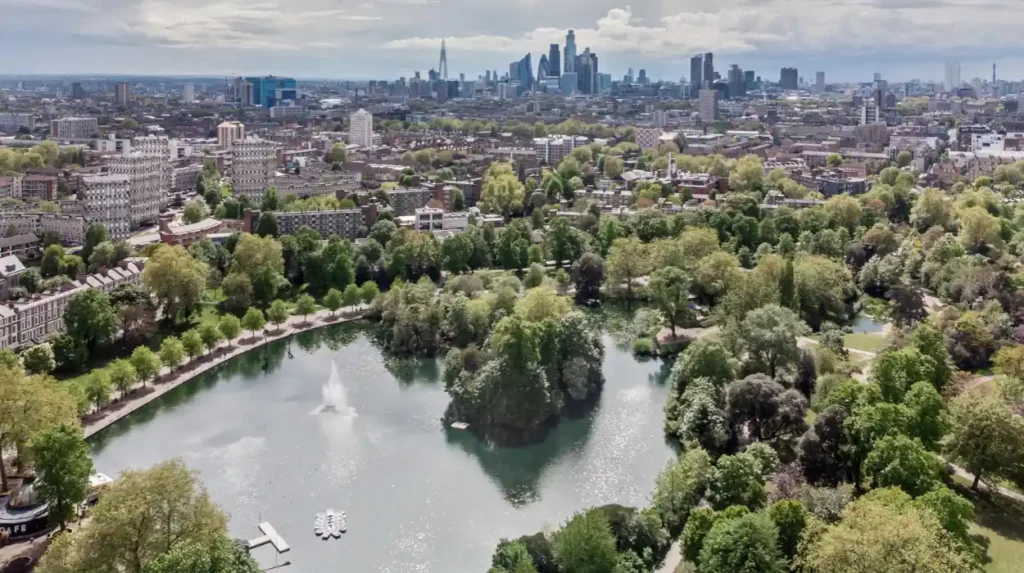
Victoria Park is the most historically significant. It opened in 1845 after campaigns for better public open space in the rapidly growing East End.
The park was created partly in response to severe overcrowding and poor environmental conditions. A petition signed by 30,000 local residents in 1840 supported the creation of a royal park for the area.
The park contains historic lakes, a pagoda, the Burdett Coutts Memorial, a bandstand and other features. The Chinese-style pagoda arrived in 1847 after being used at the Chinese Exhibition at Hyde Park Corner.
Mile End Park provides another important green corridor. Its development is closely connected with 20th-century planning, post-war reconstruction and the creation of public recreational space.
Tower Hamlets Cemetery Park has a particularly distinctive history. It opened as a commercial cemetery in 1841 and later became neglected. After closure to burials, the site was transformed into public open space. The council identifies it as a wooded park and local nature reserve.
These green spaces provide useful breaks between museums, markets and dense urban streets.
How can visitors explore Tower Hamlets by neighbourhood?
Visitors can divide Tower Hamlets into practical heritage zones: Tower Hill and Wapping for royal and riverside history, Whitechapel and Spitalfields for migration and markets, Bethnal Green for culture, and Docklands for maritime and modern London.
Tower Hill and Wapping work well for a riverside-focused visit. The Tower of London, Tower Bridge and St Katharine Docks create a concentrated historic area.
Whitechapel and Spitalfields are strongest for architecture, markets, migration history, galleries and food. Brick Lane provides a useful central route between several attractions.
Bethnal Green combines residential East End streets with museums, parks and cultural venues. The Young V&A, formerly the Museum of Childhood, provides a major cultural attraction for families.
Mile End and Bow offer a mixture of parks, canals, markets and residential heritage. Roman Road provides a traditional East End shopping and market environment.
Poplar and the Isle of Dogs focus more strongly on dockland history. Chrisp Street Market connects local community life with the historic development of Poplar.
Canary Wharf represents the contemporary side of the borough. High-rise commercial buildings, public art, restaurants, shops and transport connections occupy land once dominated by docks and warehouses.
This neighbourhood approach prevents visitors from treating Tower Hamlets as one uniform district. Each area developed through different economic and social processes.
What cultural experiences make Tower Hamlets distinctive?
Tower Hamlets is culturally distinctive because its streets reflect successive communities, including Huguenots, Jewish residents, Bangladeshi Londoners and other migrant groups. Food, religion, markets, architecture, festivals and community institutions preserve this layered East End identity.
Migration is central to understanding the borough. Tower Hamlets Council describes the East End as a place that has welcomed immigrant communities for centuries. Its contemporary population includes substantial Bangladeshi, Somali, Caribbean, Chinese, Vietnamese, Indian and Pakistani communities.
Banglatown, centred around Brick Lane and surrounding streets, is particularly important to London’s Bangladeshi cultural history. Restaurants, food shops, community organisations, religious buildings and festivals contribute to its identity.
The annual Baishakhi Mela is an example of contemporary cultural heritage. The festival celebrates Bengali New Year traditions and forms part of the borough’s recognised intangible heritage.
Food is also an important part of the visitor experience. Brick Lane is widely associated with Bangladeshi and South Asian cuisine, while traditional East End food traditions remain visible through cafés, pie and mash shops and market stalls.
Religious buildings provide further evidence of demographic change. The transformation of former churches and synagogues into later places of worship demonstrates how buildings adapt as communities change.
For travellers, these experiences are best approached through the streets themselves. Architecture, shopfronts, markets and community institutions provide context that individual attractions cannot fully explain.
How should visitors plan a Tower Hamlets travel itinerary?
A practical Tower Hamlets itinerary should group attractions geographically rather than crossing the borough repeatedly. A one-day visit can combine the Tower of London, riverside landmarks, Spitalfields, Brick Lane and an East End market or museum.
A historic riverside morning can begin at Tower Hill. Visitors can explore the Tower of London before walking towards Tower Bridge and St Katharine Docks.
The route can then continue eastwards or northwards towards Wapping. Historic warehouses and riverside streets provide context for London’s maritime development.
An East End heritage afternoon can centre on Whitechapel and Spitalfields. Whitechapel Gallery, Altab Ali Park, Brick Lane, Christ Church Spitalfields and Old Spitalfields Market create a strong cultural sequence.
A market-focused itinerary works particularly well on Sunday. Brick Lane and Columbia Road can be combined because both operate Sunday markets, although visitors should check current trading arrangements before travelling.
A docklands itinerary can focus on the Museum of London Docklands, West India Docks and Canary Wharf. This route explains the transition from maritime commerce to modern finance.
A green-space itinerary can combine Victoria Park with nearby East End streets and Roman Road. Victoria Park’s historical significance makes it more than a recreational stop.
The most efficient itineraries use public transport and walking together. Tower Hamlets has extensive Underground, Overground, DLR, Elizabeth line and bus connections. The council records nine Underground and seven Overground stations, 17 DLR stations and 26 daytime bus routes within the borough.
Explore More Area Guide
Best Visitor Attractions in Tower Hamlets, East London
Tower Hamlets Tourist Planner: Best One-Day Itinerary
Is Tower Hamlets suitable for a weekend visit to London?
Tower Hamlets is well suited to a weekend because its historic landmarks, markets, museums, parks, waterfronts and cultural districts offer enough variety for several focused days without requiring long journeys across London.
A first day can focus on the historic core around the Tower of London, Tower Bridge, St Katharine Docks and Wapping.
A second day can explore Whitechapel, Spitalfields, Brick Lane and Bethnal Green. This route provides stronger coverage of migration history, architecture, markets and contemporary culture.
A third day can concentrate on the Docklands. The Museum of London Docklands provides historical context before a walk through Canary Wharf demonstrates the scale of modern redevelopment.
Visitors staying longer can add Victoria Park, Mile End Park, Roman Road, Columbia Road and Tower Hamlets Cemetery Park.
The borough’s compact geography supports flexible planning. Travellers can select activities according to weather, opening times and personal interests without abandoning the overall East End focus.
Why does Tower Hamlets remain important for understanding modern London?
Tower Hamlets remains important because its present landscape records London’s transformation from medieval settlement and port economy to industrial East End, multicultural urban district and global financial centre. Its historic buildings and modern developments exist within the same geographical framework.
The borough demonstrates how London changes while retaining physical evidence of earlier periods.
The Tower of London represents medieval and royal authority. Georgian Spitalfields records commercial growth and refugee settlement. Victorian parks demonstrate responses to overcrowding and public health. The docks document global trade and industrial infrastructure.
Post-war redevelopment added another layer. Former industrial and residential areas were reconstructed, while the Docklands became a major commercial centre.
Canary Wharf provides the clearest example of this economic transition. Modern offices occupy the former West India Docks, creating a direct relationship between historic port infrastructure and London’s current financial economy.
Meanwhile, Brick Lane, Whitechapel, Roman Road and local markets preserve elements of community commerce and migration history.
Tower Hamlets therefore provides a particularly strong case study of urban continuity. Its significance comes from the combination of surviving heritage, active communities, public spaces, cultural institutions and continuing economic change.
For travellers exploring London’s East End, the borough offers a route through several centuries of London’s development within one connected destination.
What is Tower Hamlets known for?
Tower Hamlets is known for the Tower of London, Tower Bridge, Brick Lane, Spitalfields, historic docks, Victoria Park, Whitechapel and Canary Wharf. The borough combines royal, maritime, industrial, migration and modern financial history.