Key Points
- Fly-Tipping Surge: Recorded incidents of illegal waste dumping in Havering rose by nearly 35 per cent, climbing from 3,361 in 2023/24 to 4,532 in 2024/25.
- Council Land Targeted: Out of the 4,532 total reported cases, 1,876 occurred directly on council-owned land, including footpaths, public pavements, roads, and car parks.
- Financial Burden: Previous council estimates indicate that dealing with fly-tipping costs approximately £1 million annually when including unreported cases, diverting key funding away from essential public services.
- Enforcement Measures Taken: Havering Council logged 6,764 environmental enforcement actions during 2024/25, issuing 815 fixed penalty notices and carrying out seven legal prosecutions based on official returns submitted to the Department for Environment, Food and Rural Affairs (Defra).
- Division of Responsibility: Local authority teams actively clear and investigate waste dumped on public highway infrastructure, whereas private landowners remain legally responsible for clearance costs when dumping occurs on private property.
Havering (East London Times) October 13, 2026 – Official figures covering the 2024/25 period reveal that recorded cases of fly-tipping in the London Borough of Havering have escalated dramatically, climbing from 3,361 recorded incidents in the preceding financial year to 4,532. This represents an increase of approximately 35 per cent over a 12-month period, placing an escalating logistical and financial burden on local authority services and local council taxpayers.
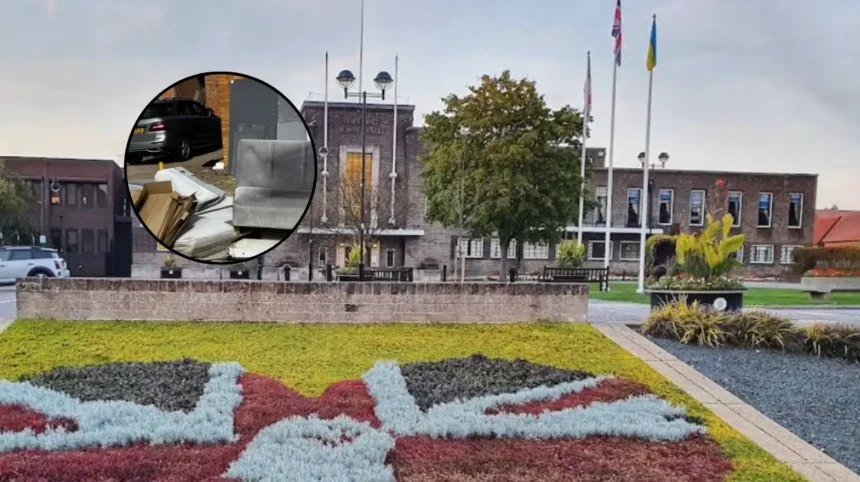
The illegal abandonment of residential, commercial, and construction waste—ranging from dumped mattresses, discarded sofas, and piles of builders’ rubble to standard household rubbish bags—continues to impair the aesthetic condition of local neighbourhoods. Beyond the physical eyesore created by illegal dumping, the trend poses ongoing operational challenges for Havering Council as local administration teams attempt to maintain public realm cleanliness and manage stretched municipal budgets.
What Financial Impact Does Illegal Waste Dumping Have on Local Public Services?
The financial strain imposed on the borough remains substantial. Historical council estimates indicate that managing and clearing fly-tipping incurs costs approaching £1 million each year when factoring in unrecorded or unreported incidents. Although this figure serves as a illustrative benchmark rather than a direct accounting total for 2024/25, it highlights the potential magnitude of tax revenues absorbed by clean-up operations.
Money expended on recovering and disposing of illegally dumped waste represents financial resources that could otherwise be allocated toward supporting core public services, maintaining infrastructure, or funding wider town centre improvements across the borough.
How Are Local Authorities Handling Enforcement and Clear-Up Operations?
Of the 4,532 instances documented in the latest annual reporting period, a total of 1,876 occurred directly on land maintained by the local authority. Havering Council maintains a statutory responsibility to investigate reports and clear dumped material from public roads, pavements, municipal car parks, and public footpaths.
Where dumping occurs on private property, statutory rules dictate that the primary responsibility for clearing and disposing of waste rests with the private landowner, though council teams retain powers to investigate the origin of the waste.
Data submitted in official returns to the Department for Environment, Food and Rural Affairs (Defra) details the extent of municipal regulatory action undertaken throughout 2024/25:
- Total Environmental Actions: 6,764 total enforcement actions recorded.
- Fixed Penalty Notices: 815 FPNs issued to offenders.
- Prosecutions: 7 successful court prosecutions executed following investigations.
Despite continuous deep-cleaning initiatives in Romford and ongoing town centre remediation projects carried out under the current council administration, local authority leaders emphasize that enforcement mechanisms alone cannot solve the underlying problem. Addressing the persistent illegal disposal of waste ultimately relies on community co-operation, proper waste management practices by residents and traders, and active public reporting of offenses.
Background to the Current Fly-Tipping Challenge
Fly-tipping remains a persistent challenge across urban and suburban authorities throughout England. Local authorities are tasked with balancing public operational demands against tight operational budgets. Under English law, fly-tipping is a criminal offense governed under Section 33 of the Environmental Protection Act 1990, exposing individual offenders and unlicensed commercial operators to heavy financial penalties or imprisonment upon conviction.
In Havering, municipal management strategies have focused on combining proactive town centre rejuvenation with strict regulatory enforcement. While deep-cleaning schedules and public realm maintenance programs have been deployed in key retail areas such as Romford, the surge in illegal waste disposal highlights ongoing operational friction between council remediation efforts and local compliance.
Local authorities across the country have faced increasing pressure from unlicensed waste removal businesses—often advertising low-cost removal services online—that collect waste from domestic residents before illegally depositing it on public highways or secluded land. Havering Council continues to encourage residents to verify the licensing status of waste contractors and to submit formal reports when illegal dumping is observed.
Predictions: How Will This Ongoing Challenge Affect Havering Residents and Taxpayers?
1. Increased Strain on Municipal Budgets
If fly-tipping figures remain at or near 4,532 annual incidents, council expenditure allocated to waste management, specialized clearance teams, and enforcement officers will remain high. Local taxpayers will likely bear the indirect financial consequences, as discretionary funds that could support parks, road repairs, or community facilities are directed toward waste remediation.
2. Heightened Regulatory and Fines Scrutiny
In response to a 35 per cent year-on-year increase, residents can expect higher levels of surveillance, stricter waste compliance checks, and a potential increase in the value or frequency of Fixed Penalty Notices. Householders who fail to ensure that private waste carriers hold a valid Environmental Agency license may face duty-of-care penalties if their waste is subsequently found illegally dumped on public or private land.
3. Impact on Local Amenity and Property Values
Neighbourhoods experiencing repeated incidents of waste dumping risk visual degradation and health concerns associated with vermin infestation. Communities subject to chronic fly-tipping may see reduced public satisfaction in local town centres, while private landowners situated in high-risk locations will remain vulnerable to sudden clean-up costs for waste abandoned on their properties.