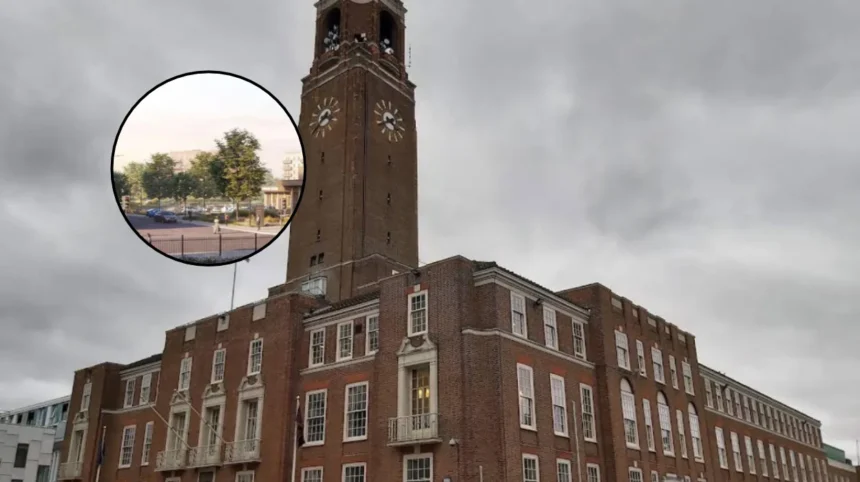
Key Points
- Barking and Dagenham Council’s planning committee has granted planning approval for 300 homes on the Dagenham side of Crowlands Heath Golf Course.
- Property developer Homes4Life proposes a overall scheme comprising 1,298 flats, a community centre, supermarket, outdoor sports courts, and a play area across the entire site.
- The development promises 100 per cent affordable housing, split into 57 per cent habitable rooms for social rent and 43 per cent for key workers, principally NHS staff.
- Reform UK councillor Ben Suter strongly opposed the scheme, describing it as “one of the worst decisions this planning committee has ever made” due to concerns over local infrastructure, healthcare, and parking.
- The majority of the site sits within the neighboring borough of Havering, whose Reform UK-controlled council must still grant planning permission before construction can commence.
- Planning officers designated the site as “grey belt” land owing to its historical use as a quarry and landfill site until the 1990s.
- The Greater London Authority retains the power to step in and make the final determination on the development if it chooses to do so.
Dagenham (East London Times) October 19, 2026 – Councillors in the London Borough of Barking and Dagenham have voted to grant planning permission for a major residential project on Crowlands Heath Golf Course, paving the way for up to 1,298 new flats despite fierce opposition from local political figures and surrounding communities. The local authority’s planning committee considered the detailed proposals for the 300-home section falling within its geographic boundary during a crucial town hall meeting on Wednesday evening, resolving to support the scheme on the grounds that it delivers a substantial wave of fully affordable housing to a borough facing severe residential shortages.
- Key Points
- What are the key details of the proposed Homes4Life development?
- How did municipal officers justify building on protected green belt land?
- Why did opposition councillors voice strong resistance to the committee’s decision?
- Which way did committee members vote on the planning decision?
- What remaining hurdles must the development clear before construction begins?
- Background of the Crowlands Heath Golf Course development
- Prediction: How this development could affect local residents and public services
What are the key details of the proposed Homes4Life development?
The broader masterplan submitted by property developer Homes4Life seeks to transform the expansive golf course site into a dense, multi-use community space featuring 1,298 flats alongside a host of public facilities. In addition to residential units, the masterplan incorporates a community centre, a full-scale supermarket, outdoor sports courts, and a children’s play area. A central pillar of the proposal is its housing tenure breakdown: 100 per cent of the proposed units are designated as affordable. Specifically, 57 per cent of the habitable rooms are earmarked for social rent, while the remaining 43 per cent are set aside for key workers, with priority allocated primarily to National Health Service (NHS) staff working in the region.
Although Barking and Dagenham Council holds legal ownership of the golf course, the vast majority of the land falls geographically within the neighboring borough of Havering. Council leaders previously agreed in March to sell the physical golf course asset to Homes4Life, provided that full planning permissions are ultimately secured across both municipal authorities.
How did municipal officers justify building on protected green belt land?
Town hall planning officers employed by Be First Regeneration Ltd—a regeneration consultancy and property developer wholly owned by Barking and Dagenham Council—strongly recommended that elected committee members vote in favor of the scheme. Addressing concerns regarding development on protected Metropolitan Green Belt land, officers argued that the imperative to deliver affordable accommodation outweighed the spatial loss.
Be First planning officer Harrison Depczysnki clarified the physical classification of the terrain, asserting that the site should properly be treated as “grey belt” rather than pristine green space. Depczysnki pointed out that the land had historically operated as an industrial quarry and subsequently served as an active landfill site until the 1990s before its adaptation into a golf course.
Furthering the case for approval, Be First planning consultant Emma Thorpe urged the committee to prioritize the pressing social dividends offered by the scheme. Thorpe highlighted the transformative impact of the proposed housing supply, noting:
“They’ll make a real difference to the lives of families, being at the affordable prices they’ll be set at. This is a really significant number of homes to be delivered at a time when housing needs only continue to grow and there’s unprecedented demand for affordable places to live.”
Why did opposition councillors voice strong resistance to the committee’s decision?
Despite the support from planning officers, the committee meeting was marked by intense political debate. Councillor Ben Suter, representing Reform UK for the Eastbrook and Rush Green ward where the development is located, delivered a scathing critique of the project and urged his colleagues to reject the application outright. Denouncing the vote, Suter declared that approving the development represented “one of the worst decisions this planning committee has ever made.”
Suter argued that introducing thousands of new residents to the site would severely strain local medical infrastructure, exacerbate existing parking shortages, and eliminate the strategic open space separating Dagenham from Havering. While stressing that addressing housing shortages “is really important to me,” Suter insisted that the high-density scheme was entirely “not suitable” for Dagenham.
Concerns were also raised regarding the development’s transport provisions. Labour councillor and committee member Ingrid Robinson challenged the minimal car parking allocation built into the design. Under the current plans, the entire development features just 70 parking spaces, with 60 reserved for residents—including 13 designated disabled bays. Expressing skepticism about the viability of such limits, Robinson stated:
“We need more car parking spaces. There’s no way you can get around without a car.”
In response to these criticisms, planning officers explained that Transport for London (TfL) had explicitly requested a minimal parking footprint to align with regional climate and transport strategies aimed at encouraging walking, cycling, and public transit adoption. Regarding public services, officers confirmed that the NHS had been formally consulted during the planning process and had requested a contribution of just over £1 million from the developer to upgrade healthcare infrastructure in nearby Romford.
Which way did committee members vote on the planning decision?
When the matter was put to a formal vote, Barking and Dagenham’s Labour committee chair Muhammad Saleem led the majority in approving the 300-home portion of the scheme. Saleem defended the outcome, emphasizing that the new construction would prove crucial in giving vulnerable residents who desperately require shelter in the borough “a roof over their head.”
The final vote passed along partisan lines. Labour councillors Muhammad Saleem, Ingrid Robinson, Alison Cormack, and Edna Fergus voted in favor of granting planning approval. Conversely, Reform UK councillors Alexandra Arnautu and Billy Edmunds, alongside Green Party councillor Faruk Choudhury, voted against the motion.
What remaining hurdles must the development clear before construction begins?
While Barking and Dagenham Council has given its conditional green light for its portion of the land, the project remains far from a certainty. Because the physical majority of the 1,298-home masterplan sits across the administrative boundary, the Reform UK-controlled Havering Council must formally review and grant planning permission for the remainder of the site before any construction machinery can enter the location.
Furthermore, procedural safeguards remain active at the regional level. Planning officer Depczysnki noted during the proceedings that the Greater London Authority (GLA) retains statutory oversight and holds the executive power to intervene, review, or make the final determination on the planning application directly should the Mayor of London choose to do so.
Background of the Crowlands Heath Golf Course development
The cross-boundary debate over Crowlands Heath Golf Course reflects long-standing urban planning tensions in Outer East London, where local councils face immense pressure from central government to meet ambitious residential targets while navigating strict Green Belt protections. Situated between Dagenham and Romford, the site historically provided industrial aggregate via quarrying before shifting to waste management operations as a municipal landfill through the late 20th century. Following environmental remediation in the 1990s, the terrain was repurposed into a commercial golf facility, serving as a recreational buffer between urban settlements.
However, escalating housing demands across Greater London over the past decade prompted Barking and Dagenham Council—which owns the underlying freehold of the land—to review its strategic property portfolio. In March 2026, council leaders took the decisive step of agreeing to sell the golf course land to private developer Homes4Life, structuring the transaction around the strict requirement that planning authorization be secured. The emergence of the “grey belt” concept within national planning policy frameworks has provided local authorities with an avenue to reclassify previously developed or altered Green Belt land, allowing brownfield-adjacent sites like former landfills to be re-evaluated for high-density residential developments.
Prediction: How this development could affect local residents and public services
Should the Crowlands Heath Golf Course development receive final approval from Havering Council and clear potential Greater London Authority scrutiny, it will significantly alter the socio-economic landscape for residents in both Barking and Dagenham and Havering.
For local families, key workers, and individuals on lower incomes, the delivery of nearly 1,300 fully affordable homes—with a majority allocated to social rent—will provide vital relief in an increasingly unaffordable housing market. NHS workers in particular stand to gain dedicated residential access close to regional medical centers such as Queen’s Hospital in Romford. Furthermore, the inclusion of a commercial supermarket, open-access sports courts, and community spaces could enhance local amenities for incoming and existing neighborhoods.
Conversely, for established residents in the Eastbrook, Rush Green, and surrounding Romford areas, the development threatens to intensify existing pressures on public infrastructure. The injection of thousands of new residents into a localized area will increase demand on GP surgeries, schools, and local transport networks, even with the developer’s pledged £1 million contribution to NHS infrastructure. Additionally, the low ratio of 70 parking spaces for over 1,000 apartments will inevitably lead to overspill parking on neighboring residential streets, potentially escalating traffic congestion along key arterial corridors. Politically, the divergent stances between Labour-led Barking and Dagenham and Reform UK-controlled Havering suggest that the project will remain a contentious flashpoint for local governance, spatial identity, and green space conservation across East London.