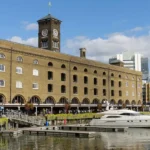
East London’s maritime history is closely connected to the development of Tower Hamlets, where historic docks, riverside warehouses, shipbuilding sites and former trading districts transformed London into an international port. The borough preserves important evidence of Britain’s shipping industry, global commerce, migration, industrial development and colonial trade.
- What Is the Maritime History of Tower Hamlets?
- How Did the River Thames Shape Local Development?
- Why Is Tower Hamlets Important to London’s Shipping History?
- Which Tower Hamlets Landmark Best Explains London’s Maritime History?
- How Do West India Docks Reveal Tower Hamlets’ Trading History?
- Why Is West India Quay Historically Important?
- How Did the West India Docks Influence Modern Canary Wharf?
- What Can Visitors Discover at Tobacco Dock and the Former London Docks?
- Why Is Limehouse Basin an Important Maritime Landmark in East London?
- What Makes Trinity Buoy Wharf Significant to London’s Maritime Heritage?
- Why Were Lighthouses Important to London’s Shipping Industry?
- What Is the Historical Value of the Site’s Buildings?
- Where Can Visitors Explore Tower Hamlets’ Historic Shipbuilding Heritage?
- What Was Blackwall Yard?
- How Did Shipbuilding Influence Local Employment?
- What Remains of the Shipbuilding Landscape?
- How Did East India Docks Contribute to Tower Hamlets’ Maritime Economy?
- What Was the Role of East India Dock Basin?
- Why Is East India Docks Important to the Wider Maritime Story?
- How Did the Second World War Affect Tower Hamlets’ Maritime Landmarks?
- Why Were the London Docks Important During Wartime?
- What Evidence of Wartime History Can Visitors See?
- How Did Docklands Redevelopment Transform Tower Hamlets?
- What Was the London Docklands Development Corporation?
- How Does Canary Wharf Preserve Its Maritime Identity?
- What Is the Best Way to Explore Tower Hamlets’ Maritime Landmarks?
- Start at London Museum Docklands and West India Quay
- Explore the Isle of Dogs and East India Dock Basin
- Visit Limehouse Basin
- Finish at Wapping and Tobacco Dock
- Include Trinity Buoy Wharf for Maritime Engineering
- Why Should Tower Hamlets’ Maritime Heritage Be Preserved?
Tower Hamlets occupies the northern bank of the River Thames in East London. Its maritime heritage centres on the Isle of Dogs, Limehouse, Wapping, Poplar and the historic docklands around Canary Wharf. These neighbourhoods once supported merchants, sailors, dockworkers, shipbuilders and warehouse operators who handled goods arriving from Europe, Africa, Asia and the Caribbean.
Today, visitors can explore this history through London Museum Docklands, West India Quay, Tobacco Dock, Limehouse Basin, Trinity Buoy Wharf and surviving industrial buildings. These landmarks demonstrate how the working port developed, how international shipping influenced local communities and how former docklands became modern residential, cultural and commercial districts.
Understanding Tower Hamlets’ maritime landmarks also explains the relationship between London’s historic economy and its present-day landscape. The transformation from enclosed cargo docks to financial centres, residential developments and public waterfronts remains one of the most significant changes in East London’s urban history.
What Is the Maritime History of Tower Hamlets?
Tower Hamlets has a maritime history shaped by shipbuilding, international trade, enclosed docks and riverside industries. From medieval shipyards to nineteenth-century commercial ports, its communities supported London’s shipping economy and connected the capital with international trading networks.
Tower Hamlets developed around the River Thames, which provided transport routes, employment and access to international markets. Before modern roads and railways, ships carried much of London’s imported and exported cargo. Riverside settlements therefore became important centres for shipbuilding, fishing, warehousing and commercial activity.
Shipbuilding existed in the area by the late fourteenth century. During the sixteenth and seventeenth centuries, maritime villages expanded as merchants and shipowners established businesses along the Thames. Blackwall, Limehouse, Poplar and Wapping developed strong connections with shipping and river transport.
The growth of international trade increased pressure on London’s riverside facilities. Ships arriving at the Port of London frequently faced congestion, delays and security problems. Cargoes remained exposed on crowded wharves, creating opportunities for theft and damage.
Merchants responded by supporting the construction of enclosed docks. These facilities provided controlled access, secure storage and improved cargo-handling arrangements.
How Did the River Thames Shape Local Development?
The River Thames provided the geographical foundation for Tower Hamlets’ maritime economy. Its tidal waterway connected London with the North Sea and international shipping routes.
The river supported several important industries, including:
- Shipbuilding and ship repair, particularly around Blackwall and Limehouse.
- Cargo handling and warehousing, especially in Wapping and the Isle of Dogs.
- Sailmaking and rope production, which supplied equipment for merchant vessels.
- Food and commodity distribution, including sugar, coffee, tobacco and spices.
- Passenger and river transport, connecting riverside communities with other parts of London.
These industries created employment for dockworkers, sailors, engineers, merchants and warehouse staff. They also encouraged migration, as workers arrived from different parts of Britain and overseas.
Why Is Tower Hamlets Important to London’s Shipping History?
Tower Hamlets became an essential part of London’s maritime infrastructure because it contained major enclosed docks, commercial warehouses and established shipbuilding facilities.
The borough’s importance increased during the nineteenth century when London expanded its dock network. West India Docks, London Docks and East India Docks strengthened the Port of London’s ability to handle growing volumes of international cargo.
Tower Hamlets Council’s conservation research identifies maritime trade, migration and industrial development as central influences on the borough’s historic character. It also highlights the survival of historic warehouses and former shipbuilding locations as important elements of the area’s built heritage.
Which Tower Hamlets Landmark Best Explains London’s Maritime History?
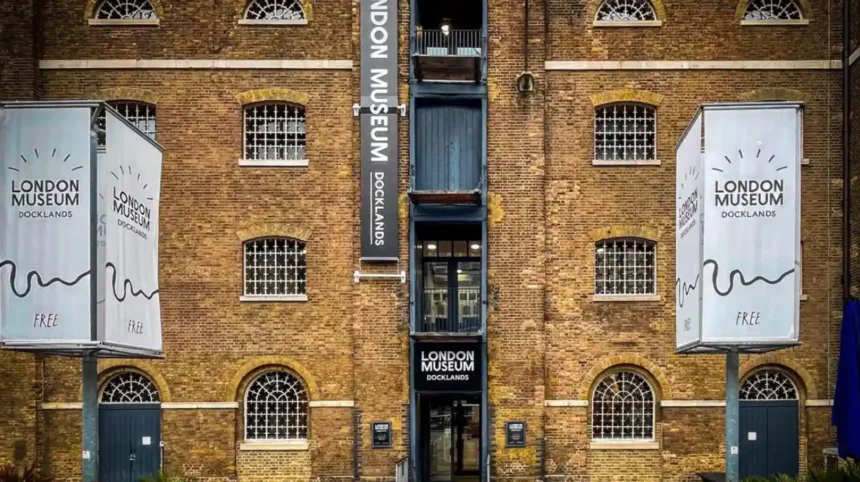
London Museum Docklands provides the most comprehensive introduction to Tower Hamlets’ maritime heritage. Its historic warehouse, permanent galleries and collections explain shipping, international commerce, dock labour, migration, slavery, wartime activity and the redevelopment of London’s historic port.
London Museum Docklands
London Museum Docklands stands inside No. 1 Warehouse at West India Quay, one of the surviving nineteenth-century warehouse buildings associated with the West India Docks.
The museum opened in 2003 and documents approximately 400 years of London’s river, port and dockland history. Its galleries examine the relationship between international trade, industrial development and the communities that lived around the docks.
The museum’s permanent exhibition covers several historical periods. Visitors can explore the expansion of trade between 1600 and 1800, the development of the nineteenth-century port, Victorian Sailortown, the growth of imperial commerce and the effects of the Second World War.
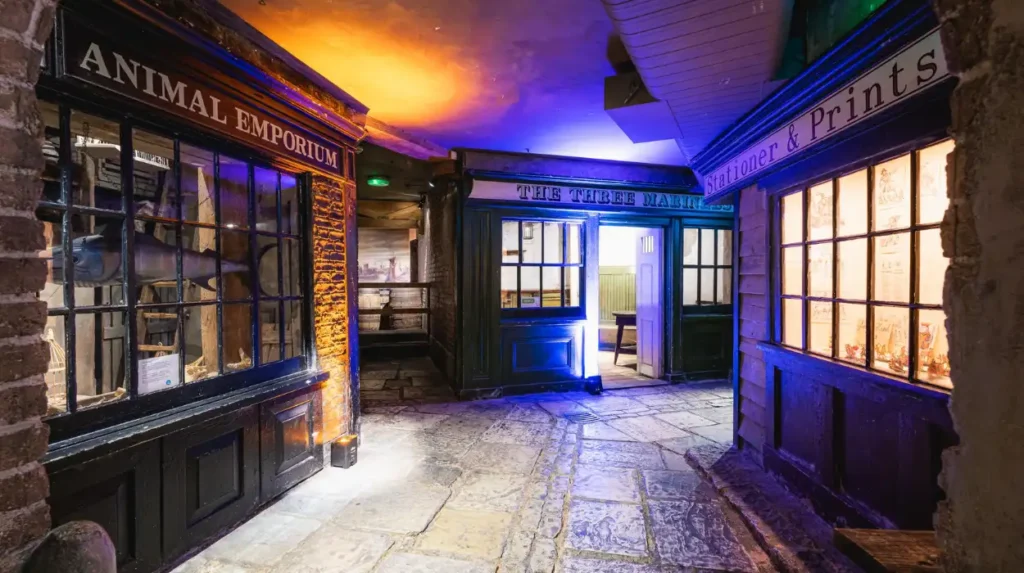
The recreated Sailortown gallery presents aspects of nineteenth-century Wapping. It explains the environment surrounding sailors, dockworkers, merchants and businesses that depended on shipping.
The museum also addresses London’s involvement in the transatlantic slave trade through its London, Sugar and Slavery gallery. This exhibition examines how enslaved African people, Caribbean plantations and commercial investment contributed to London’s economic development.
The museum provides an essential starting point for understanding the borough because it connects individual objects and buildings with wider international events.
What Can Visitors Learn From the Museum’s Collections?
The collections explain how the Port of London operated and how maritime commerce influenced everyday life.
Historical objects, documents, photographs and reconstructed environments demonstrate the movement of goods through the docks. They also provide evidence of working conditions, commercial organisation and the development of riverside neighbourhoods.
Visitors gain a broader understanding of the relationship between shipping and London’s urban growth. The museum also explains why dockland redevelopment became necessary when international shipping technology changed.
Visitor information: The museum’s galleries are advertised as free to visit. Check the official London Museum website for current opening arrangements, exhibitions and access information.
How Do West India Docks Reveal Tower Hamlets’ Trading History?
West India Docks reveal how London developed secure facilities for international cargo. Opened in 1802 on the Isle of Dogs, the enclosed dock complex handled Caribbean imports, including sugar, rum and coffee, and became a major centre of London’s commercial shipping industry.
The West India Docks represent one of the most significant developments in London’s maritime infrastructure.
The West India Dock Act of 1799 authorised the construction of the docks. Work began on the Isle of Dogs, and the first facilities opened in 1802. The project responded to congestion on the Thames and the growing volume of imported commodities.
Before their construction, merchant vessels frequently waited for extended periods to unload goods along London’s crowded riverside. The new enclosed docks provided controlled entry, dedicated unloading areas and substantial warehouse capacity.
The complex initially consisted of two principal docks connected through entrance and exit basins. Its secure design protected valuable cargo from theft and provided merchants with more organised storage facilities.
The docks handled commodities including:
- Sugar from Caribbean plantations.
- Coffee imported through international trading networks.
- Rum produced from sugar cane.
- Other commercial goods transported through imperial and international shipping routes.
The history of West India Docks also requires an examination of slavery. Caribbean sugar production depended heavily on the forced labour of enslaved African people. London merchants, financial institutions and shipping businesses benefited from this system.
The docks continued operating after the abolition of slavery in the British Empire in 1833. Their commercial importance expanded alongside other international trading activities.
The Port of London remained a major shipping centre during the twentieth century. West India Docks eventually stopped general cargo operations in 1980 as containerisation and changing shipping practices shifted maritime activity towards ports further downstream.
Why Is West India Quay Historically Important?
West India Quay preserves an important part of the original dockland environment. Its historic warehouses demonstrate the scale of storage infrastructure required by nineteenth-century international commerce.
No. 1 Warehouse is particularly significant because it survives as part of the former West India Docks complex. The building originally stored commodities such as sugar and rum.
The warehouse contained multiple floors and a basement. Goods moved between ships and storage areas through openings facing the dock. This arrangement allowed workers to transfer cargo efficiently between vessels and warehouses.
Today, the building houses London Museum Docklands. Its continued use demonstrates how historic industrial architecture can support modern cultural activities.
The surrounding waterfront also provides an opportunity to examine the relationship between historic dock structures and Canary Wharf’s modern commercial buildings.
How Did the West India Docks Influence Modern Canary Wharf?
The closure of the historic docks changed the economic direction of the Isle of Dogs. Container shipping required larger facilities, deeper water and different cargo-handling systems.
Central London’s older enclosed docks became less competitive. Commercial shipping operations gradually moved towards facilities further east, including Tilbury.
The London Docklands Development Corporation took responsibility for regeneration in 1981. Its redevelopment programme supported new housing, commercial buildings, transport infrastructure and public spaces.
Canary Wharf subsequently became an international financial district. The area’s modern skyscrapers occupy land that previously supported warehouses, dockworkers and merchant shipping.
This transition makes West India Quay particularly valuable for visitors interested in industrial heritage. It presents a direct connection between London’s former trading economy and its modern business landscape.
What Can Visitors Discover at Tobacco Dock and the Former London Docks?
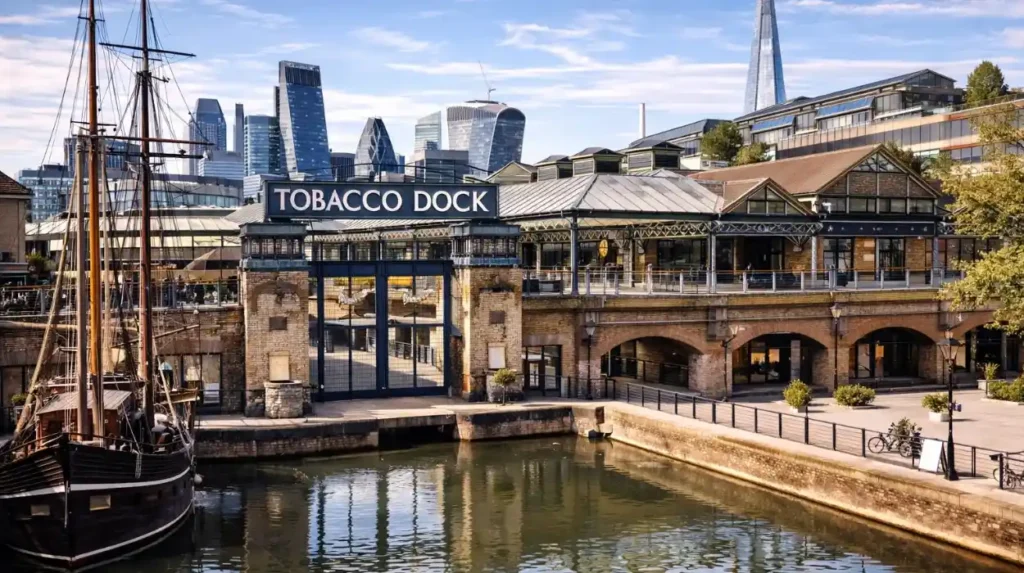
Tobacco Dock preserves part of London’s former commercial dock infrastructure in Wapping. Its historic warehouses and surviving dock features illustrate the storage of imported tobacco, wine, tea and spices, connecting modern East London with the nineteenth-century shipping economy.
Tobacco Dock forms part of the former London Dock complex, which opened in Wapping in 1805.
The London Dock Company developed the facility to improve the handling and storage of valuable imported goods. Scottish civil engineer John Rennie was responsible for the dock’s engineering design.
The dock complex included wet docks, warehouses and underground storage vaults. Its facilities supported the unloading and distribution of imported commodities.
Tobacco Dock took its name from the tobacco trade. However, the wider London Docks handled a much broader range of imported goods, including:
- Wine and spirits arriving in barrels.
- Tobacco transported from overseas territories.
- Tea distributed through international trading networks.
- Spices and other luxury commodities.
These products demonstrate the international reach of London’s commercial port.
Why Does Tobacco Dock Have Architectural Significance?
The surviving buildings illustrate the scale and engineering requirements of nineteenth-century dock infrastructure.
The warehouse architecture used substantial brickwork, timber structures and large internal spaces. These features supported the storage and movement of heavy cargo.
The surrounding dock layout also demonstrates how enclosed ports separated shipping operations from ordinary streets. Controlled access protected valuable goods and supported commercial security.
The buildings later experienced several changes of use as the shipping industry declined. Tobacco Dock now operates as an events venue, retaining its historic architectural identity while accommodating modern activities.
Visitors interested in industrial architecture can examine the building’s exterior, historic structure and relationship with the former dock environment. Access to interior areas depends on events and venue arrangements.
What Happened to London’s Commercial Docks?
The London Docks closed to commercial shipping in 1968. Their decline reflected wider changes in maritime transport and cargo distribution.
Containerisation transformed the shipping industry by standardising cargo units and reducing the need for traditional warehouse-based handling. Larger vessels also required different port facilities.
The former dockland sites experienced extensive redevelopment. Some warehouses disappeared, while others survived through conservation and new commercial uses.
The London Museum’s historical records provide further details about the London Dock, its construction and its connection with international trade.
Why Is Limehouse Basin an Important Maritime Landmark in East London?
Limehouse Basin demonstrates the historic relationship between London’s docks, canals and inland transport networks. Originally developed as a connection between the Thames and the Regent’s Canal, it supported cargo movement between ocean-going ships, barges and industrial destinations.
Limehouse Basin is a historic waterside facility connecting the River Thames with the Regent’s Canal.
Its development reflects the importance of waterways in nineteenth-century British transport. Canals provided an alternative route for moving heavy goods between ports, industrial districts and inland markets.
Limehouse Basin was originally known as the Regent’s Canal Dock. It opened in 1820 and served as an important interchange between the Thames and the canal network.
Ocean-going vessels could unload cargo into smaller craft. Canal boats then transported goods towards industrial and commercial destinations across London and beyond.
The basin therefore formed part of a wider transport system that linked maritime shipping with inland distribution.
How Did the Regent’s Canal Support Maritime Trade?
The Regent’s Canal connected Limehouse with other waterways and commercial districts in London.
Its construction improved the movement of materials such as coal, timber, building supplies and manufactured goods. Canal transport reduced dependence on congested roads and supported industrial development.
The connection between Limehouse Basin and the Thames also allowed imported cargo to reach inland destinations without requiring larger ships to travel through the canal network.
This relationship demonstrates how maritime trade depended on more than ships and docks. Canals, warehouses, locks, bridges and distribution facilities formed an interconnected commercial system.
What Can Visitors See at Limehouse Basin Today?
The basin is now a marina and public waterside destination. Its historic industrial function has largely disappeared, but its geographical importance remains visible.
Visitors can explore the surrounding waterfront, observe moored boats and examine the connection between the basin and the canal.
The area also offers access to riverside walking routes and nearby Limehouse streets. Historic buildings and surviving waterways provide evidence of the neighbourhood’s former industrial character.
Limehouse Basin is particularly useful for understanding how transport infrastructure influenced the development of Tower Hamlets.
As you explore the modern waterfront, you are crossing land with a deep industrial and maritime heritage. Discover the full [History of Limehouse and Its Maritime Heritage] to understand the origins of its docks, waterways and riverside communities.
What Makes Trinity Buoy Wharf Significant to London’s Maritime Heritage?
Trinity Buoy Wharf preserves important evidence of maritime navigation, lighthouse engineering and river safety. Located where the River Lea meets the Thames, the historic site supported Trinity House operations and the maintenance of navigation equipment used by shipping vessels.
Trinity Buoy Wharf occupies a distinctive position at the confluence of the River Lea and River Thames.
Its history is associated with Trinity House. Trinity House is the organisation responsible for important lighthouse and navigational safety functions around England, Wales, the Channel Islands and Gibraltar.
Trinity House established its Thames-side workshop at Trinity Buoy Wharf in 1803. The site supported the production, storage, maintenance and repair of navigation equipment.
These activities were essential to safe shipping. Commercial vessels depended on reliable navigation markers to identify river channels, avoid dangerous waters and approach ports.
Why Were Lighthouses Important to London’s Shipping Industry?
Lighthouses and other navigation markers helped ships travel safely through rivers, estuaries and coastal waters.
The Thames presented several navigational challenges. Its tidal conditions, changing water levels and busy shipping traffic required reliable navigational information.
Trinity Buoy Wharf became an important centre for producing and maintaining equipment used to mark navigable routes.
The site also contains historic lighthouse structures associated with nineteenth-century engineering.
The Experimental Lighthouse is particularly notable. It reflects the development and testing of lighthouse technology during a period of innovation in maritime navigation.
What Is the Historical Value of the Site’s Buildings?
Trinity Buoy Wharf retains industrial structures associated with its former maritime operations.
The surviving river wall, workshops and lighthouse buildings provide evidence of its engineering history. The river wall was rebuilt in brick in 1822, while the Electrician’s Building dates from 1836.
The first lighthouse on the site was constructed in 1854. Engineer James Walker was associated with its development, while James Douglass later contributed to the site’s engineering work.
Today, Trinity Buoy Wharf operates as a creative and cultural destination. Its historic industrial buildings accommodate artistic, educational and commercial activities.
The location demonstrates how maritime infrastructure can survive through adaptive reuse while retaining its historical identity.
Where Can Visitors Explore Tower Hamlets’ Historic Shipbuilding Heritage?
Blackwall and Poplar preserve the geographical history of East London’s shipbuilding industry. Their former shipyards supported merchant vessels, naval construction and marine engineering, connecting Tower Hamlets with important developments in British maritime technology and international shipping.
Blackwall and Poplar developed as important maritime communities because of their access to the River Thames and the commercial advantages of riverside locations.
Shipbuilding required substantial land, access to deep water, skilled labour and supplies of timber and other materials. Blackwall provided an environment where large vessels could be constructed, repaired and maintained.
What Was Blackwall Yard?
Blackwall Yard was an important historic shipbuilding site.
The yard was established in 1614 and became one of the country’s largest private shipyards. It was associated with the construction of significant vessels, including Brunel’s Great Eastern.
The Great Eastern was a pioneering nineteenth-century steamship designed by engineer Isambard Kingdom Brunel. Its construction demonstrated the scale of engineering ambition associated with Britain’s maritime industries.
Blackwall Yard also had connections with the Cutty Sark’s history. The famous sailing ship was associated with the local maritime industrial network, although it was constructed at Dumbarton in Scotland rather than at Blackwall.
This distinction is important when interpreting Tower Hamlets’ maritime heritage. A vessel’s connection with an area does not always mean it was physically built there.
How Did Shipbuilding Influence Local Employment?
Shipbuilding supported a wide range of specialist occupations.
Workers included shipwrights, carpenters, engineers, metalworkers, riggers and labourers. Ship repair and maintenance also generated continuing employment after vessels entered service.
The industry encouraged the growth of supporting businesses, including suppliers of ropes, sails, tools, metal components and provisions.
Blackwall and Poplar therefore developed as industrial communities rather than simply residential areas beside the river.
What Remains of the Shipbuilding Landscape?
The original shipyard environment has experienced extensive redevelopment. Visitors should not expect to find a complete preserved shipyard at Blackwall.
However, the surrounding waterfront, historic street pattern and remaining industrial buildings help explain the area’s former function.
The nearby East India Dock Basin also provides an important connection with the commercial shipping history of the Isle of Dogs and Blackwall.
Tower Hamlets’ conservation research identifies Blackwall Yard’s historical significance and its connection with major vessels as important parts of the borough’s maritime identity. towerhamlets.gov.uk+1
How Did East India Docks Contribute to Tower Hamlets’ Maritime Economy?
East India Docks strengthened London’s international trading capacity by providing dedicated facilities for goods arriving from Asian trading networks. Opened in 1806, the docks supported commercial shipping, warehousing and distribution, expanding the maritime importance of Blackwall and the Isle of Dogs.
East India Docks formed another important part of London’s expanding dock network.
The East India Dock Act of 1802 authorised the construction of the facility. The docks opened in 1806 and provided commercial infrastructure for ships involved in trade with Asia.
Their development followed the success of West India Docks. London merchants needed additional facilities to handle increasing international cargo volumes.
The docks provided dedicated storage and unloading facilities for imported commodities. Their commercial operations connected London with trading routes across the Indian Ocean and wider Asian markets.
What Was the Role of East India Dock Basin?
East India Dock Basin formed part of the dock complex and supported the movement of vessels between the river and enclosed dock facilities.
The basin’s remaining waterside features help visitors understand the physical arrangement of historic dock infrastructure.
Unlike a modern marina, the original basin served a commercial shipping purpose. Its design accommodated vessels involved in the movement of goods through London’s port system.
The surrounding area experienced substantial industrial and commercial development during the nineteenth century.
Why Is East India Docks Important to the Wider Maritime Story?
East India Docks demonstrate that Tower Hamlets’ shipping economy was not dependent on one commercial route.
West India Docks handled Caribbean trade, while East India Docks supported trade associated with Asian markets. London Docks in Wapping handled additional imported commodities.
Together, these facilities demonstrate how different dock companies organised cargo operations according to commercial requirements.
The expansion of the dock network also increased the importance of warehouses, transport connections and skilled dock labour.
The East India Dock Basin is particularly relevant to visitors exploring the historical geography of Blackwall and the Isle of Dogs. It provides a clearer understanding of the relationship between river access and enclosed commercial ports.
How Did the Second World War Affect Tower Hamlets’ Maritime Landmarks?
The Second World War significantly damaged London’s Docklands because its warehouses, shipping facilities and riverside industries were important targets during the Blitz. Tower Hamlets experienced destruction, disruption and reconstruction, while surviving buildings preserve evidence of this wartime maritime history.
Tower Hamlets experienced extensive bombing during the Second World War. Its concentration of warehouses, industrial facilities, transport connections and shipping infrastructure made the docklands strategically important.
The Port of London supported the movement of essential supplies and materials. Ships transported food, industrial products and military-related cargo through the river and its associated facilities.
The docks also supported Britain’s wartime logistics. Their warehouses and transport connections helped distribute goods across the country.
Why Were the London Docks Important During Wartime?
The docks formed part of Britain’s wider supply network.
London depended on maritime imports, and the Port of London played an important role in receiving essential goods. Damage to warehouses and transport facilities therefore affected commercial and logistical operations.
Bombing destroyed or damaged buildings across the East End. Dockworkers and other local residents experienced dangerous working conditions while attempting to maintain essential services.
What Evidence of Wartime History Can Visitors See?
London Museum Docklands includes the Docklands at War gallery, which examines the relationship between the port and the Second World War.
Its exhibitions explain how the docklands contributed to the war effort and how local communities experienced wartime disruption.
Visitors can connect the museum’s historical material with surviving dockside buildings and former industrial sites.
This historical context also explains why some original warehouses disappeared while others remained standing. The combination of wartime damage, post-war reconstruction and later redevelopment reshaped the historic waterfront.
How Did Docklands Redevelopment Transform Tower Hamlets?
Docklands redevelopment transformed Tower Hamlets after traditional commercial shipping declined. Former warehouses, enclosed docks and industrial sites became locations for financial offices, housing, cultural venues and public waterfronts, creating a modern urban landscape that retains important elements of its maritime heritage.
The decline of traditional shipping changed the economic structure of Tower Hamlets during the second half of the twentieth century.
Containerisation reduced the need for the older enclosed docks in central and eastern London. Shipping companies increasingly required larger facilities capable of handling standardised containers and modern cargo vessels.
The West India and Millwall Docks stopped general cargo operations in 1980. The Royal Docks followed in 1984.
These closures created substantial challenges for communities that depended on maritime employment.
What Was the London Docklands Development Corporation?
The London Docklands Development Corporation was established in 1981 to support the regeneration of London’s former docklands.
Its work covered major areas of East and South-East London. The programme encouraged investment in commercial property, housing, transport and infrastructure.
The redevelopment of the Isle of Dogs became particularly significant because Canary Wharf developed into a major international financial centre.
Former industrial land was converted into office buildings, residential developments and public spaces.
How Does Canary Wharf Preserve Its Maritime Identity?
Canary Wharf is built within the former West India Docks landscape. Its modern skyline represents a major change in land use, but elements of the historic dock environment remain.
West India Quay provides one of the clearest examples. Historic warehouse buildings stand beside modern commercial towers.
The contrast demonstrates how the same geographical location has served different economic purposes over time.
The surviving dock basins, warehouse structures and waterfront spaces also maintain a connection with the area’s industrial past.
This relationship between historic preservation and redevelopment is an important part of Tower Hamlets’ contemporary identity. Visitors can explore the area as both a financial district and a former centre of international maritime commerce.
Explore More Area Guide
Historic Pubs and Traditional Streets in Tower Hamlets
Tower Hamlets Public Squares: Modern Urban Landscapes in East London
What Is the Best Way to Explore Tower Hamlets’ Maritime Landmarks?
Visitors can explore Tower Hamlets’ maritime landmarks through a connected route covering West India Quay, the Isle of Dogs, Limehouse and Wapping. Combining museums, surviving warehouses, former dock basins and historic industrial sites provides a broader understanding of East London’s shipping heritage.
A maritime heritage visit works best when it combines indoor exhibitions with outdoor exploration. London Museum Docklands provides historical context, while the surrounding waterfronts reveal the physical geography of the former port.
The following locations offer a practical way to organise a visit.
Start at London Museum Docklands and West India Quay
Begin at London Museum Docklands to understand the development of London’s port.
Explore the museum’s galleries before walking around West India Quay. The surviving warehouse architecture provides a direct connection with the historical exhibits.
This location is particularly suitable for visitors interested in international trade, slavery, dock labour and industrial architecture.
Explore the Isle of Dogs and East India Dock Basin
Continue towards the Isle of Dogs to examine the former dock landscape.
West India Docks and East India Dock Basin demonstrate how enclosed ports supported international shipping.
The surrounding Canary Wharf district provides an opportunity to compare historic industrial infrastructure with modern commercial development.
Visit Limehouse Basin
Travel towards Limehouse to explore the historic canal connection.
Limehouse Basin provides a different perspective on maritime transport because it illustrates the relationship between ocean-going ships and inland waterways.
The surrounding waterfront is suitable for walking, photography and observing the surviving canal infrastructure.
Finish at Wapping and Tobacco Dock
Wapping provides access to the former London Dock area and Tobacco Dock.
Its historic buildings demonstrate how imported goods were stored and distributed through London’s commercial port.
The neighbourhood also retains elements of its historic riverside character, making it an important destination for visitors interested in industrial and social history.
Include Trinity Buoy Wharf for Maritime Engineering
Visitors with additional time can explore Trinity Buoy Wharf.
Its historic lighthouse structures and industrial buildings introduce the engineering and navigational side of maritime history.
The location is particularly useful for understanding the systems that helped vessels navigate the Thames safely.
Why Should Tower Hamlets’ Maritime Heritage Be Preserved?
Tower Hamlets’ maritime heritage deserves preservation because its historic docks, warehouses and shipbuilding sites document London’s economic development, international connections and working communities. Protecting these landmarks maintains architectural evidence and helps future generations understand the consequences of global trade.
The historic waterfront is an important cultural and educational resource. Its buildings provide evidence of engineering techniques, industrial organisation and changing commercial practices.
Preservation also supports local identity. Historic warehouses and dock basins distinguish Tower Hamlets from other parts of London because they demonstrate the area’s relationship with the river.
What Are the Main Challenges Facing Maritime Heritage?
Historic dockland preservation involves several challenges.
Urban redevelopment: Commercial and residential investment creates pressure to adapt former industrial land. Planning authorities must balance development with the conservation of important historic structures.
Building maintenance: Older warehouses require ongoing structural maintenance. Brickwork, timber components and historic foundations need appropriate conservation methods.
Loss of industrial context: Individual buildings lose some of their historical meaning when surrounding dock structures disappear. Conservation planning therefore considers wider streetscapes and relationships between historic buildings.
Public access: Some historic sites operate as private venues or commercial properties. Visitors do not always have access to every surviving maritime structure.
How Does Maritime Heritage Support Education and Tourism?
Historic docklands provide opportunities to study London’s industrial, social and economic development.
Schools, researchers and visitors can use museums and surviving buildings to understand the relationship between international trade and local communities.
Maritime heritage tourism also encourages visitors to explore neighbourhoods beyond central London’s major attractions.
The combination of museums, walking routes, industrial architecture and modern waterfront spaces supports cultural tourism across Tower Hamlets.
The borough’s historic landmarks therefore remain relevant to its contemporary economy and public identity.
Tower Hamlets offers an important introduction to East London’s maritime history. Its historic docks, warehouses, shipyards and navigation facilities explain how the River Thames supported London’s growth as an international trading centre.
London Museum Docklands, West India Quay, Tobacco Dock, Limehouse Basin, Trinity Buoy Wharf and East India Dock Basin each represent a different aspect of this history.
Together, these landmarks document the development of commercial shipping, industrial employment, international trade, maritime engineering and dockland communities. They also reveal the economic and social consequences of colonial commerce and the transatlantic slave trade.
The transformation of former docks into modern commercial and residential districts demonstrates the continuing relevance of maritime heritage. Exploring these locations allows visitors to understand how Tower Hamlets developed from a working port into one of London’s most recognisable urban waterfront areas.
What is Tower Hamlets famous for in maritime history?
Tower Hamlets is famous for its historic docks, shipbuilding yards, riverside warehouses and international trading connections. West India Docks, East India Docks and London Docks helped establish London as one of the world’s major commercial ports.