Spitalfields is one of East London’s most historically significant neighbourhoods. Located in the London Borough of Tower Hamlets, it combines centuries-old architecture, historic market streets, Huguenot heritage, independent shops and a diverse cultural identity. Its streets preserve evidence of London’s development through trade, immigration, manufacturing, religion and urban regeneration.
- What Makes Spitalfields One of East London’s Most Historic Neighbourhoods?
- How Did Spitalfields Develop from a Medieval Settlement into a Trading District?
- Which Historic Streets Should Visitors Explore in Spitalfields?
- What Architectural Features Make Spitalfields Historically Important?
- Georgian townhouses and residential design
- Silk-weaving lofts
- Victorian commercial architecture
- Religious architecture
- Why Is Christ Church Spitalfields an Important Historic Landmark?
- Where Can Visitors Experience Spitalfields’ Huguenot Heritage?
- What Can Visitors Discover at Old Spitalfields Market?
- What can shoppers find inside the market?
- Why should visitors include the market in a historic walking tour?
- Where Are the Best Independent Shops and Galleries in Historic Spitalfields?
- Commercial Street
- Brick Lane boutiques
- Contemporary art and creative spaces
- The relationship between historic buildings and independent businesses
- How Can Visitors Explore Spitalfields on a Historic Walking Tour?
- What Cultural Experiences Can Visitors Enjoy Around Spitalfields?
- How Can Visitors Reach Spitalfields and Plan Their Visit?
- Underground and rail connections
- Walking and cycling
- When is the best time to visit?
- How much time should visitors allocate?
- How Is Spitalfields’ Historic Character Protected for Future Generations?
- Why are conservation areas important?
- What role does archaeological research play?
- How can tourism support heritage preservation?
- Why Should Spitalfields Be Included in an East London Heritage Itinerary?
The neighbourhood sits close to the City of London, Liverpool Street Station and Shoreditch. Its location made Spitalfields an important centre for merchants, craftspeople and migrant communities. Today, visitors explore its historic streets to discover Georgian townhouses, Victorian commercial buildings, traditional markets, contemporary galleries and independent businesses.
Exploring historic Spitalfields involves more than visiting individual attractions. The street layout, surviving buildings, religious landmarks and market spaces explain how the neighbourhood developed from a medieval settlement into a major centre of London’s commercial and cultural life.
What Makes Spitalfields One of East London’s Most Historic Neighbourhoods?
Spitalfields is a historic East London district in Tower Hamlets, recognised for its Georgian architecture, Huguenot heritage, textile industry, Victorian markets and multicultural communities. Its streets preserve important evidence of London’s commercial expansion, migration and architectural development.
Spitalfields developed outside the eastern boundary of the historic City of London. Its name derives from the Priory and Hospital of St Mary Spital, a religious institution established in the medieval period. The hospital provided accommodation and assistance to travellers, the poor and sick people.
The surrounding settlement gradually developed into a residential and commercial district. Its position near London’s eastern gateways encouraged trade and attracted workers, merchants and immigrant communities.
Spitalfields became particularly important during the late 17th and 18th centuries. French Protestant refugees, known as Huguenots, established silk-weaving businesses in the area. Their craftsmanship transformed local employment, architecture and commercial activity.
The neighbourhood subsequently became home to Irish, Jewish and Bangladeshi communities. Each community contributed to its cultural identity, businesses, religious buildings and food traditions.
Today, Spitalfields retains several layers of this history. Visitors encounter historic streets alongside modern developments, creating a distinctive architectural and cultural landscape.
How Did Spitalfields Develop from a Medieval Settlement into a Trading District?
Spitalfields developed around the medieval Priory and Hospital of St Mary Spital before becoming a centre for textile production and food trading. Its growth accelerated during the 17th and 18th centuries through immigration, market activity and expanding London commerce.
The origins of Spitalfields date back to 1197, when the Priory and Hospital of St Mary Spital was established outside the City of London. The religious institution served travellers and disadvantaged people. Its surrounding land included open fields, gardens and agricultural spaces.
The dissolution of the monasteries under Henry VIII resulted in the closure of the institution in 1539. Its land subsequently became available for other uses, contributing to the area’s gradual transformation.
During the 17th century, residential development expanded eastwards from the City. Merchants, craftspeople and traders established businesses around the developing street network.
The arrival of French Huguenots following the revocation of the Edict of Nantes in 1685 accelerated this development. These Protestant refugees brought specialist silk-weaving skills and established workshops throughout Spitalfields.
The neighbourhood became internationally recognised for silk production. Its textile industry supported merchants, master weavers, apprentices and associated trades. Residential buildings were adapted to accommodate workshops, with upper floors providing suitable light for weaving.
Market activity also shaped the district. King Charles II granted a Royal Charter in 1682, allowing John Balch to hold a regular market in Spitalfields. The market became an important source of fresh produce for London’s growing population.
For a deeper understanding of the people, migration patterns and events behind the neighbourhood’s development, explore the [History of Spitalfields: From Medieval Hospital to Huguenot Silk-Weaving Centre].
Archaeological investigations have provided additional evidence of the area’s development. Excavations around the former St Mary Spital site uncovered Roman burials, medieval cemetery remains and evidence of later residential and commercial activity. Museum of London Archaeology (MOLA) has documented discoveries spanning approximately 2,000 years of local history.
Which Historic Streets Should Visitors Explore in Spitalfields?
The most significant historic streets in Spitalfields include Fournier Street, Princelet Street, Wilkes Street, Folgate Street, Elder Street and Brick Lane. Each preserves different aspects of Georgian architecture, Huguenot textile production, religious heritage and East London’s commercial history.
Spitalfields is best explored on foot. Its historic streets are relatively close together, allowing visitors to examine architectural details and cultural landmarks within a single walking route.
Fournier Street
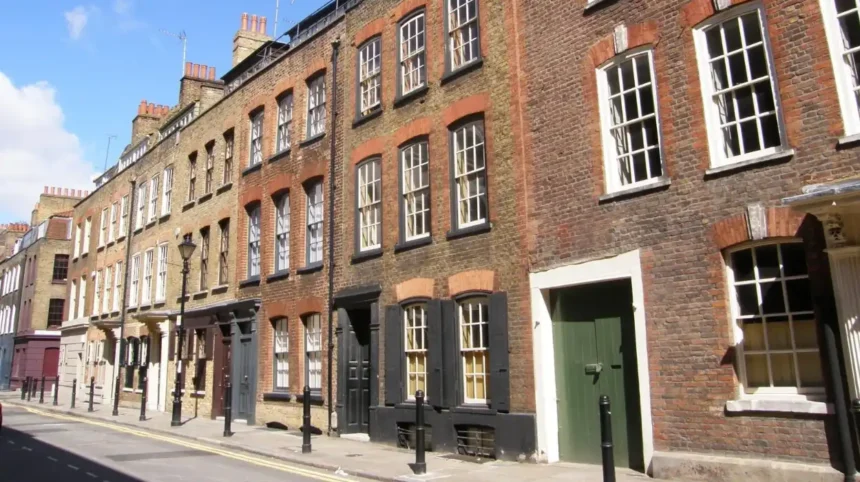
Fournier Street is one of Spitalfields’ most recognisable historic streets. Its Georgian townhouses date mainly from the early 18th century.
The street developed between 1718 and 1728 as part of a residential expansion associated with Charles Wood and Simon Michell. The houses were designed for prosperous merchants and silk-weaving families.
Their architectural features include:
- Red-brick and painted brick façades.
- Traditional sash windows.
- Decorative door surrounds.
- Timber-panelled entrances.
- Large upper-floor windows associated with textile workshops.
These buildings demonstrate how domestic architecture accommodated commercial production. The upper floors provided natural light for silk weaving, while the lower floors supported household and business activities.
Christ Church Spitalfields stands at the western end of the street, creating an important architectural connection between religious and residential development.
Princelet Street
Princelet Street preserves Georgian residential architecture associated with the Huguenot silk industry.
Many original houses contained specialised upper-floor windows designed to provide natural light for weaving. The buildings later accommodated Jewish immigrant families and other residents as the area’s population changed.
Princelet Street is also associated with the history of immigration and community life in the East End. Its surviving buildings provide evidence of changing household arrangements, employment and religious identities.
Visitors should pay attention to the proportions of the townhouses, their doorways and the differences between original and later architectural details.
Wilkes Street
Wilkes Street forms another important part of the historic residential network.
Its Georgian houses share architectural characteristics with Fournier Street and Princelet Street. The street developed during the early 18th-century expansion of Spitalfields.
The surviving buildings demonstrate the quality of residential construction associated with the area’s prosperous weaving industry.
Wilkes Street also helps visitors understand the original layout of the neighbourhood. Its relationship with neighbouring streets reveals how residential development and textile production operated together.
Folgate Street
Folgate Street is particularly significant because of its association with Dennis Severs’ House at number 18.
The street contains historic buildings that preserve the domestic character of Georgian Spitalfields. Dennis Severs’ House presents an imaginative interpretation of an 18th-century Huguenot silk-weaving household.
Its setting helps visitors understand the relationship between historic interiors, domestic life and textile production.
Folgate Street is also useful for exploring the transition between Spitalfields’ residential streets and its commercial surroundings.
Elder Street
Elder Street contains some of the area’s important Georgian buildings. Its historic character is connected with the development of Spitalfields as a residential district during the 18th century.
The street is particularly relevant to visitors interested in architectural conservation. Its building façades, traditional proportions and surviving historic features illustrate the value of protecting London’s older residential streets.
Brick Lane
Brick Lane connects Spitalfields’ architectural history with its continuing multicultural identity.
The street became an important location for successive immigrant communities. Its buildings reflect different periods of religious, commercial and social activity.
Brick Lane Jamme Masjid is a particularly important example. The building was originally constructed as a French Huguenot chapel in 1744. It subsequently became a Methodist chapel in 1819, a synagogue in 1897 and a mosque in 1976.
This sequence demonstrates how one historic building accommodated different religious communities as the area’s population changed.
What Architectural Features Make Spitalfields Historically Important?
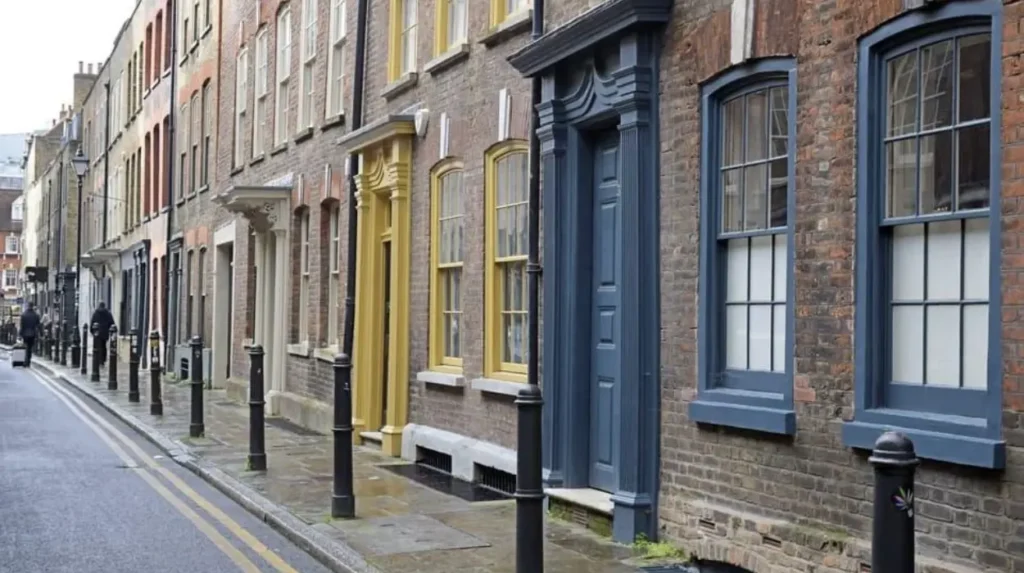
Spitalfields is recognised for its surviving Georgian townhouses, silk-weaving lofts, Victorian market structures, historic religious buildings and traditional street layouts. These features demonstrate how architecture responded to migration, manufacturing, trade and population growth in East London.
The architectural character of Spitalfields reflects several centuries of development. Georgian buildings form a particularly important part of the neighbourhood’s identity.
Georgian townhouses and residential design
Georgian architecture refers broadly to British architectural styles associated with the reigns of the four Hanoverian monarchs named George, from 1714 to 1830.
Spitalfields contains many buildings from the early and middle Georgian periods.
Typical features include symmetrical façades, sash windows, brick construction and decorative entrances. These characteristics created a consistent architectural appearance across residential streets.
The townhouses also reflected differences in household wealth and commercial status. Larger properties often belonged to successful merchants and master weavers.
Silk-weaving lofts
One of Spitalfields’ most distinctive architectural features is the weaving loft.
These upper-floor spaces were designed to provide sufficient natural light for silk production. Large windows allowed workers to operate looms in relatively bright conditions.
The arrangement demonstrates the integration of manufacturing and residential use within the same building.
Victorian commercial architecture
Old Spitalfields Market preserves an important example of Victorian market architecture.
Construction of a new market building began in 1876 under Robert Horner. The original building was completed in 1893 and subsequently extended during the 1920s.
Its roof structure and traditional commercial design reflect the scale of London’s expanding food trade during the Victorian period.
Religious architecture
Religious buildings provide another important architectural layer.
Christ Church Spitalfields, the Brick Lane Jamme Masjid and historic Jewish religious sites reflect the neighbourhood’s changing population.
Together, these buildings illustrate how religious architecture contributed to the development of local communities.
The conservation of these architectural features helps maintain Spitalfields’ historic identity while allowing the neighbourhood to accommodate modern businesses and residents.
Why Is Christ Church Spitalfields an Important Historic Landmark?
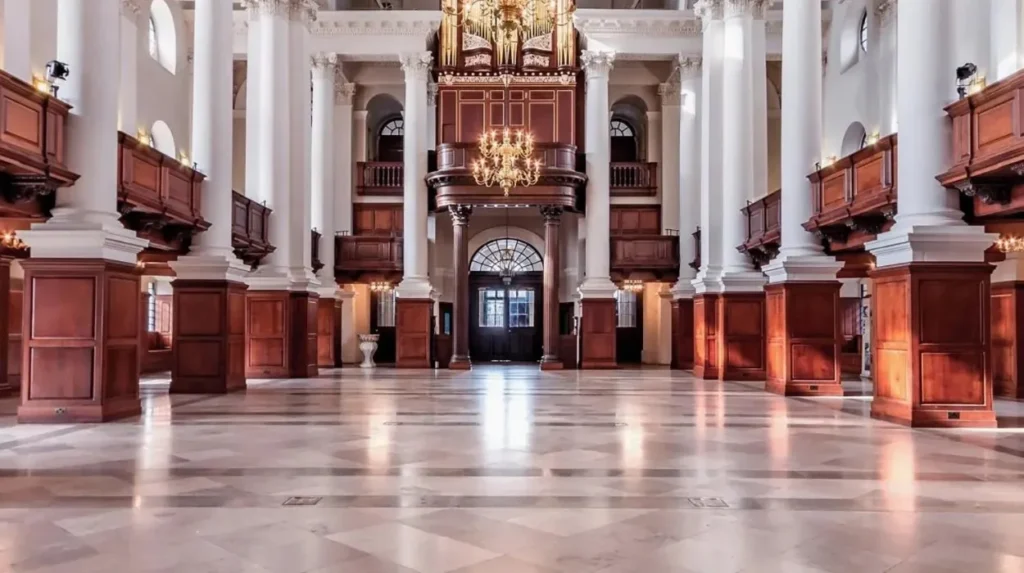
Christ Church Spitalfields is an early 18th-century Anglican church designed by architect Nicholas Hawksmoor. Built between 1714 and 1729, it represents English Baroque architecture and forms one of the most recognisable historic landmarks in East London.
Christ Church stands beside Fournier Street and provides a major architectural focal point for the neighbourhood.
Its construction followed the Fifty New Churches Act of 1711. The legislation established a programme to provide additional Anglican churches for London’s expanding population.
Nicholas Hawksmoor, a British architect who worked with Sir Christopher Wren, was appointed to the church-building programme.
Construction began in 1714, and the church opened on 5 July 1729.
Its architectural design features a monumental stone portico, a prominent tower and a distinctive spire. The scale of the building contrasts with the smaller Georgian houses surrounding it.
This contrast reflects the religious and political context of early 18th-century Spitalfields. The neighbourhood contained a substantial population of French Protestant refugees who established their own religious communities.
Christ Church subsequently experienced periods of decline and restoration. It closed in 1957 because of structural problems. Conservation efforts helped prevent demolition, and a major restoration was completed in 2004.
The redeveloped crypt opened in 2015.
Visitors can examine the building’s exterior, attend services and check its programme of cultural activities. Its position makes it an essential stop on a walking tour of Fournier Street and the surrounding historic streets.
Where Can Visitors Experience Spitalfields’ Huguenot Heritage?
Visitors can explore Spitalfields’ Huguenot heritage through Fournier Street, Princelet Street, Dennis Severs’ House and surviving silk-weaving buildings. These locations explain how French Protestant refugees transformed the neighbourhood through textile production, craftsmanship, religious life and residential development.
The Huguenots were French Protestants who faced religious persecution in Catholic France. Following the revocation of the Edict of Nantes in October 1685, many fled the country.
A significant number settled in London, particularly in Spitalfields.
Their arrival introduced specialist knowledge of silk weaving, textile finishing and related crafts. The neighbourhood became a major centre for silk manufacturing.
The Huguenot contribution remains visible in the architecture of the area.
Dennis Severs’ House
Dennis Severs’ House at 18 Folgate Street is one of the neighbourhood’s distinctive heritage attractions.
The house dates from 1724. Artist Dennis Severs acquired the property in 1979 and developed its interiors into an imaginative recreation of a Huguenot family’s domestic environment.
The fictional Jervis family provides the basis for the house’s interpretation of life across several historical periods.
The rooms contain period-style furniture, household objects and atmospheric details. Visitors experience the building as an interpretation of domestic history rather than a conventional museum exhibition.
The Spitalfields Trust has maintained the property since 1999. Visitors should check opening arrangements and admission requirements before travelling.
Historic silk-weaving houses
Fournier Street and Princelet Street contain buildings associated with the silk-weaving trade.
Their large upper-floor windows provide evidence of how Georgian architecture accommodated manufacturing.
These buildings also demonstrate the relationship between immigration and economic development. The Huguenots contributed specialist skills that helped establish Spitalfields as a nationally significant textile centre.
Religious and cultural heritage
The neighbourhood’s religious buildings reveal how immigrant communities established places of worship and maintained cultural traditions.
The former Huguenot chapel on Brick Lane is especially significant because it later served Methodist, Jewish and Muslim communities.
Its changing religious use represents the wider history of immigration in East London.
What Can Visitors Discover at Old Spitalfields Market?
Old Spitalfields Market is a historic covered market near Liverpool Street, offering independent retail, food, crafts and cultural experiences. Its origins date back to the 17th century, while its Victorian market buildings preserve the area’s long-established commercial identity.
Old Spitalfields Market is one of the most important destinations for understanding the commercial history of the neighbourhood.
The market has operated in Spitalfields since the 17th century. In 1638, traders received permission to sell produce in Spital Fields. A Royal Charter followed in 1682, granting John Balch permission to organise regular trading sessions.
For approximately two centuries, the market supplied London’s population with fruit, vegetables and other food products.
The Victorian market building was developed under Robert Horner. Construction began in 1876, with the original building completed in 1893.
The market expanded during the 20th century as London’s demand for wholesale food increased. However, congestion and limited space eventually made the original location unsuitable for its wholesale operations.
In May 1991, the wholesale market relocated to Leyton in East London. The historic Spitalfields site subsequently developed into a destination for independent retail, food and cultural activities.
What can shoppers find inside the market?
The market combines independent businesses with established retail operators.
Visitors can explore:
- Independent fashion boutiques, including specialist clothing retailers.
- Handmade jewellery and accessories, including locally produced designs.
- Arts and crafts stalls, including prints and decorative objects.
- Vintage and collectible products, including clothing and household items.
- Food vendors, including international street food and traditional British dishes.
The market also provides restaurants, cafés and indoor spaces for visitors who want to take a break during their walking tour.
Its retail environment connects Spitalfields’ historic trading traditions with contemporary independent businesses.
Why should visitors include the market in a historic walking tour?
The market provides a clear example of how traditional commercial spaces adapt to changing economic conditions.
Its Victorian roof, brickwork and historic structural details remain important features of the site.
Visitors can compare the market’s commercial architecture with the Georgian residential buildings along nearby streets. This comparison explains the different roles that manufacturing, food distribution and retail played in the neighbourhood’s development.
Where Are the Best Independent Shops and Galleries in Historic Spitalfields?
Spitalfields offers independent boutiques, contemporary art spaces, vintage retailers and creative businesses. Visitors can discover these places around Commercial Street, Brushfield Street, Brick Lane and the historic market, combining shopping with architectural and cultural exploration.
Independent retail is an important part of modern Spitalfields.
The neighbourhood attracts visitors interested in fashion, design, art and specialist products. Its shopping environment differs from conventional high-street retail because many businesses operate from smaller premises and market stalls.
Commercial Street
Commercial Street connects Spitalfields with the wider East End.
It developed as an important transport and commercial route during the 19th century. Its buildings reflect the neighbourhood’s transition from a predominantly residential and manufacturing district into a mixed commercial area.
Visitors can explore independent businesses, restaurants and historic buildings along the street.
Brick Lane boutiques
Brick Lane is particularly associated with vintage clothing, independent fashion and specialist retail.
Its shops provide opportunities to discover second-hand garments, unusual accessories and independent designs.
The street also contains cafés, restaurants and businesses reflecting the area’s Bangladeshi cultural heritage.
Contemporary art and creative spaces
Spitalfields has a longstanding relationship with artistic communities.
The Spitalfields area attracts artists, designers, photographers and creative businesses because of its historic buildings and central East London location.
Visitors should explore current exhibitions and temporary events through individual gallery listings before visiting. Exhibition programmes and opening arrangements change throughout the year.
The relationship between historic buildings and independent businesses
Many independent businesses operate within older commercial buildings.
This creates a connection between architectural preservation and economic activity. Historic premises remain useful when adapted for modern retail, hospitality and creative industries.
For visitors, this combination makes shopping part of the wider experience of exploring Spitalfields’ historic streets.
How Can Visitors Explore Spitalfields on a Historic Walking Tour?
Visitors can explore Spitalfields through a self-guided walking route connecting Liverpool Street, Old Spitalfields Market, Christ Church, Fournier Street, Princelet Street, Brick Lane and Folgate Street. The compact layout makes a two-hour introductory walk practical.
Walking is the most practical way to explore the historic neighbourhood. Many important landmarks stand within a short distance of each other.
A structured route helps visitors understand the relationship between the market, residential streets, religious buildings and independent businesses.
Starting point: Liverpool Street Station
Liverpool Street Station is one of the most convenient transport connections for visitors arriving from other parts of London and the UK.
From the station, walk towards Old Spitalfields Market.
Stop 1: Old Spitalfields Market
Spend time exploring the market’s historic structure, independent stalls and food businesses.
Allow approximately 25–35 minutes for a general visit. Visitors interested in shopping and food should allocate additional time.
Stop 2: Christ Church Spitalfields
Continue towards Christ Church on Commercial Street.
Examine the church’s exterior, tower and architectural relationship with the surrounding Georgian houses.
Allow approximately 15–20 minutes for the exterior visit. Additional time is necessary if entering the church or attending an event.
Stop 3: Fournier Street
Walk along Fournier Street to examine the surviving Georgian townhouses.
Look for the large upper-floor windows, sash windows and decorative entrances associated with the area’s textile industry.
Stop 4: Princelet Street
Continue towards Princelet Street to explore another important section of the historic residential district.
Observe how the architecture reflects the development of Huguenot households and later immigrant communities.
Stop 5: Brick Lane
Walk towards Brick Lane to experience its independent businesses, food destinations and multicultural heritage.
The Brick Lane Jamme Masjid is an important historical landmark along this route.
Stop 6: Folgate Street
Continue towards Folgate Street and explore the exterior of Dennis Severs’ House.
Check the property’s visitor arrangements if you want to experience its historic interiors.
Final stop: Elder Street
Finish the walk on Elder Street, where surviving Georgian buildings provide another perspective on the area’s residential history.
The route provides a useful introduction to Spitalfields’ architecture, market traditions and multicultural development.
What Cultural Experiences Can Visitors Enjoy Around Spitalfields?
Spitalfields combines historic architecture with markets, religious heritage, food traditions, independent retail and creative activities. Visitors can explore its cultural identity through local businesses, historic buildings, community events and the wider Brick Lane neighbourhood.
Spitalfields’ cultural identity developed through successive waves of immigration and commercial activity.
The Huguenot community established its textile industry during the late 17th century. Jewish immigrants subsequently contributed to the neighbourhood’s businesses, religious institutions and social life.
Bangladeshi migration during the 20th century created another important cultural layer, particularly around Brick Lane.
These communities influenced the area’s food, language, architecture and local businesses.
Food and culinary traditions
Brick Lane is particularly associated with Bangladeshi restaurants and South Asian food.
Visitors can explore restaurants serving curries, grilled dishes, rice-based meals and traditional sweets.
The wider Spitalfields area also offers international street food, independent cafés and contemporary restaurants.
Religious and community heritage
The Brick Lane Jamme Masjid provides a direct connection to the neighbourhood’s changing religious history.
Its former uses as a Huguenot chapel, Methodist chapel and synagogue demonstrate the continuity of religious buildings within an evolving immigrant community.
Markets and cultural events
Old Spitalfields Market regularly attracts independent traders and visitors interested in creative products.
Its retail and food activities provide opportunities to experience contemporary East London culture within a historic commercial setting.
Visitors should check the market’s official programme for current events, seasonal activities and special markets.
How Can Visitors Reach Spitalfields and Plan Their Visit?
Spitalfields is accessible by London Underground, Elizabeth line, rail services, buses and walking routes. Liverpool Street Station is the principal transport connection, while Aldgate East and Shoreditch High Street provide alternative access to nearby attractions.
Spitalfields benefits from its position close to central London and the City.
Underground and rail connections
Liverpool Street Station is the most convenient starting point for many visitors.
It provides access to:
- Central, Circle, Hammersmith and City and Metropolitan Underground lines.
- Elizabeth line services.
- National Rail connections.
Aldgate East Underground Station also provides access to the southern part of the neighbourhood.
Shoreditch High Street Overground Station is useful for visitors approaching from the northern and eastern sides.
Walking and cycling
Walking is particularly suitable for exploring Spitalfields because its major historic attractions are concentrated within a relatively small area.
Cyclists can also access the neighbourhood through surrounding East London streets. Visitors should use designated cycle routes where available and check local restrictions.
When is the best time to visit?
Weekdays are suitable for visitors interested in architecture, quieter street exploration and independent businesses.
Weekends generally attract more market shoppers and visitors, particularly around Old Spitalfields Market and Brick Lane.
Morning visits provide opportunities to examine the architecture before the busiest shopping periods.
Afternoons are suitable for combining historic exploration with food, galleries and independent retail.
How much time should visitors allocate?
A short visit focusing on the main streets and market requires approximately two hours.
A more comprehensive experience involving the historic interiors, shopping, food and cultural attractions requires half a day.
Visitors interested in photography and architectural details should allow additional time.
Explore More Area Guide
Discovering the Architectural Heritage of Bethnal Green and Bow
Commercial Road Tower Hamlets: Interesting Places to Visit
How Is Spitalfields’ Historic Character Protected for Future Generations?
Spitalfields’ historic character is protected through conservation-area planning, heritage-building preservation, archaeological research and sensitive redevelopment. These measures help retain Georgian architecture, historic street patterns and cultural landmarks while supporting contemporary residential, commercial and creative activities.
Historic preservation is particularly important in Spitalfields because its buildings represent different stages of London’s social and economic development.
The Brick Lane and Fournier Street Conservation Area contains important examples of Georgian residential architecture and historic commercial buildings.
Conservation policies help manage changes to building façades, original materials, architectural details and the surrounding streetscape.
Why are conservation areas important?
A conservation area is a designated location recognised for its special architectural or historic interest.
Planning controls help protect the overall character of these areas rather than focusing exclusively on individual listed buildings.
In Spitalfields, this approach is important because the historic environment depends on the relationship between streets, buildings, public spaces and commercial activities.
What role does archaeological research play?
Archaeological research provides evidence of settlements that existed before the surviving Georgian buildings.
Excavations around St Mary Spital have revealed Roman burials, medieval remains and evidence of later commercial and residential activity.
These discoveries help researchers understand how the neighbourhood developed over approximately two millennia.
MOLA’s archaeological investigations demonstrate the importance of examining underground remains alongside visible historic architecture. MOLA+1
How can tourism support heritage preservation?
Responsible tourism supports local businesses and creates economic activity around historic destinations.
Visitors contribute through market purchases, independent retail, restaurants, cultural attractions and heritage experiences.
Respecting residential properties, avoiding littering and following photography restrictions also helps protect the neighbourhood.
The future of Spitalfields depends on maintaining a balance between heritage conservation, local communities and sustainable commercial development.
Why Should Spitalfields Be Included in an East London Heritage Itinerary?
Spitalfields deserves a place in an East London heritage itinerary because it combines medieval history, Georgian architecture, Huguenot craftsmanship, Victorian market buildings and multicultural traditions. Its compact historic streets provide a practical introduction to the area’s changing identity.
Spitalfields offers a concentrated view of London’s architectural and social history.
Fournier Street and Princelet Street preserve evidence of the Huguenot silk industry. Christ Church represents the architectural ambitions of early 18th-century London. Old Spitalfields Market connects historic food trading with modern independent retail.
Brick Lane demonstrates how successive immigrant communities shaped the neighbourhood’s cultural identity.
Visitors can explore these locations independently or combine them into a wider East London itinerary covering Shoreditch, Whitechapel and the City of London.
The neighbourhood also offers opportunities for photography, independent shopping, historical research and cultural exploration.
For tourists, Spitalfields provides an accessible introduction to East London’s historic environment. For local residents, it offers opportunities to discover the architectural and cultural heritage of familiar streets.
Its continued relevance depends on preserving historic buildings while allowing the neighbourhood’s communities and businesses to develop.
What is Spitalfields famous for?
Spitalfields is famous for its Georgian architecture, Huguenot silk-weaving heritage, historic markets, independent shops and multicultural history. Its best-known landmarks include Fournier Street, Christ Church Spitalfields, Brick Lane and Old Spitalfields Market.