Key Points
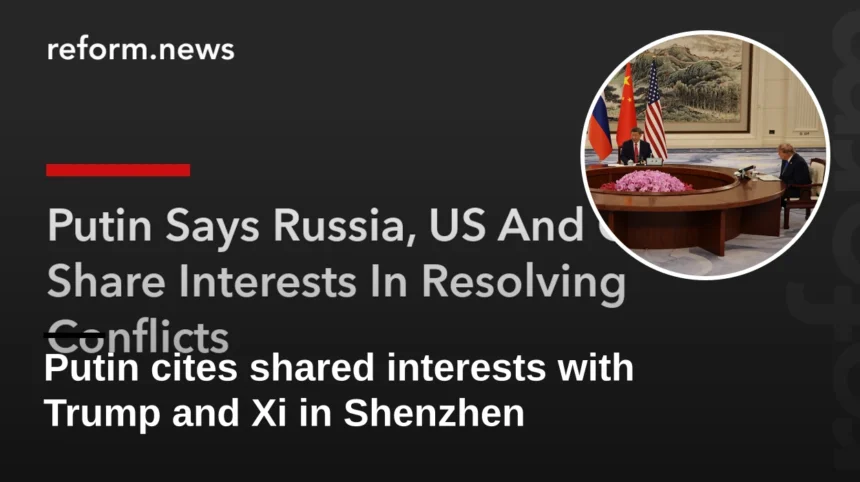
- Russian President Vladimir Putin said Russia, China and the United States share interests in resolving regional conflicts, including the war in Ukraine.
- Putin made the remarks during a trilateral meeting with United States President Donald Trump and Chinese President Xi Jinping in Shenzhen.
- He said the three countries have a shared responsibility for international peace and security.
- Food security, energy security, nuclear disarmament and global stability were among the issues expected to feature in discussions.
Shenzhen (East London Times) November 19, 2026 – Russian President Vladimir Putin said Russia, China and the United States have “many converging interests” in resolving regional conflicts, including the war in Ukraine, during a landmark trilateral meeting with United States President Donald Trump and Chinese President Xi Jinping in Shenzhen, China. Putin also said the three countries shared responsibility for maintaining international peace and security.
As reported by Khaleej Times, Putin made the remarks in opening comments at the meeting, describing cooperation among the three powers as potentially significant for global stability. Deutsche Welle similarly reported that he identified Ukraine, food security and energy security as issues connected to the talks.
What did Vladimir Putin say about shared interests?
Putin said the three countries had common or converging interests in settling regional conflicts, including the conflict in Ukraine. Reports differed slightly in their wording, with some describing his remarks as referring to “common interests” and others using “competing interests” in the settlement of regional conflicts.
Putin also said Russia, China and the United States could make a substantial contribution to strengthening global stability if they worked together. He linked the discussion to a shared responsibility for international peace and security.
What issues were expected at the Shenzhen meeting?
The Financial Times reported that the leaders were expected to discuss the wars in Ukraine and Iran, nuclear disarmament and global stability. Khaleej Times and Deutsche Welle reported that food and energy security were also expected to be addressed in closed-door discussions.
The meeting was described by the Financial Times and The Independent as a rare and significant gathering of the three leaders. The talks took place on the sidelines of the Asia-Pacific Economic Cooperation summit in Shenzhen.
What happened before the trilateral meeting?
Vladimir Putin and Xi Jinping held bilateral talks in Shenzhen before the meeting with Donald Trump. The South China Morning Post reported that the two leaders pledged to maintain stable relations and promote a fairer multipolar global order.
Putin said Russian-Chinese foreign-policy coordination was working steadily and positively. He also said Russia was prepared to deepen cooperation with China in trade, energy, education, culture and social exchanges, according to the report citing Chinese state media.
Euronews reported that Putin had called the trilateral meeting highly useful and argued that unity and dialogue were needed instead of division and ultimatums.
Background to the development
The Shenzhen meeting brought together the leaders of Russia, China and the United States at a time of continuing international tension. Russia’s full-scale invasion of Ukraine in 2022 has remained a central issue in relations between Moscow and Western governments. China has maintained close relations with Russia while presenting itself as a supporter of dialogue on international conflicts. The gathering was held during the Asia-Pacific Economic Cooperation summit and was reported as the first trilateral meeting involving Putin, Trump and Xi.
How could the remarks affect Putin’s audience?
Putin’s message may reinforce his domestic audience’s view that Russia remains a central participant in discussions about international security. By stressing converging interests with China and the United States, he presented Russia as a potential partner in negotiations over Ukraine and other conflicts. The remarks did not, however, announce a ceasefire, peace agreement or specific diplomatic settlement. Their practical effect will depend on whether the three governments translate the stated areas of common interest into confirmed agreements or further negotiations.